An Epic Story Of 1980s FPV Flight

A staple of today’s remote-controlled flight is the so-called FPV transmitter, allowing the pilot of a multirotor or other craft to see the world from onboard, as a pilot might do. It’s accessible enough that it can be found on toy multirotors starting at not much more than pocket money prices, and reliable enough that in its better incarnations it can send back high definition video at surprisingly long range.

In case you think of FPV flight as a recent innovation, the video below the break from [Larry Mitschke] should come as a revelation. In 1986 he was a bona-fide rockstar playing in a band, whose radio-controlled flight hobby led him into creating an FPV system for his planes and soaring above the Texas countryside at significant distance from his base while flying it watching a CRT screen.

The video is quite long but extremely watchable, all period footage with his narration here in 2020. We see his earliest experiments with a monochrome security camera and a video sender, and a whole host of upgrades until finally he can fly three miles from base with good quality video. 70 cm amateur TV makes an appearance with a steerable tracking antenna, he even makes a talking compass for when he loses himself. It’s an epic tale of hacking with what seems rudimentary equipment by our standards but was in fact the cutting edge of available video technology at a time when the state of the video art was moving rather fast. This is the work that laid the path for today’s $30 FPV toys, and for flying FPV from space.

Continue reading “An Epic Story Of 1980s FPV Flight”

Welcome To The Open Hardware (Virtual) Summit

Readers are no doubt aware of the COVID-19 pandemic and the impact it’s having on many public gatherings. Some events have been curtailed, while others have been cancelled outright. Among the events impacted is the Open Hardware Summit, which was set to kick off this Friday in New York. But all is not lost, as the decision has been made to turn it into a virtual event with with speakers delivering their talks to a live online audience.

Full refunds are available should anyone want them, but ticket holders will still receive their swag bags. The schedule for the one day event is expected to remain pretty close to the one that was already announced, and there will also be a Discord chat and #ohs2020Virtual Twitter hashtag for viewers to discuss the presentations. When it goes live, a link to watch the stream will be added to the front page of the event’s website.

With the usual schedule of hacker events stretching out across the year, it’s likely that this won’t be the only major one impacted by COVID-19. Judging by what we have heard from those event organizers among our friends, the planning required for the outbreak is causing a lot of stress on top of the usual worries inherent to the job. We’d like to ask everyone to extend their understanding to the teams behind any events that are cancelled or postponed during these exceptional times. Stay safe everyone, and enjoy the (virtual) Open Hardware Summit.

The Hacker Hotel 2020 Badge

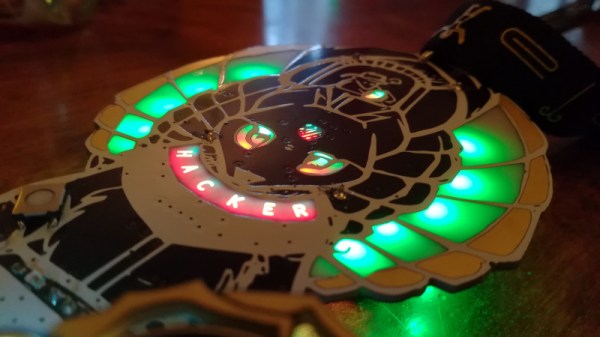
The art of the electronic conference badge has evolved over the last decade or more, such that for an individual example to be of note it now has to include some exceptional features. Perhaps a function that might previously have been considered impossible in a badge, or maybe an unusually beautiful design, an entertaining and compelling functionality, or it simply pushes the capabilities of an otherwise limited device in an unusually ingenious way. The badge from the recent Hacker Hotel 2020 comes from the same badge team that created the software platform derived from the SHA 2017 badge, and it ticks many of these boxes by combining a genuine work of art with a set of delightfully intricate puzzles at enough levels to interest all participants in the event.

Continue reading “The Hacker Hotel 2020 Badge”

EU Duty Changes, A Whole VAT Of Trouble For Hackers?

It could be said that there are a number of factors behind  the explosion of creativity in our community of hardware hackers over the last couple of decades, but one in particular that is beyond doubt is the ease with which it has been possible to import small orders from China. See something on AliExpress and it can be yours for a few quid, somewhere in a warehouse on the other side of the world it’s put into a grey shipping bag, and three weeks later it’s on your doorstep. This bounty has in no small part been aided by a favourable postage and taxation environment in which both low postage costs and a lack of customs duties on packages under a certain value conspire to render getting the product in front of you a fraction of the cost of buying the thing in the first place. Continue reading “EU Duty Changes, A Whole VAT Of Trouble For Hackers?”

The Best Voltage And Current Reference This Side Of A Test Lab

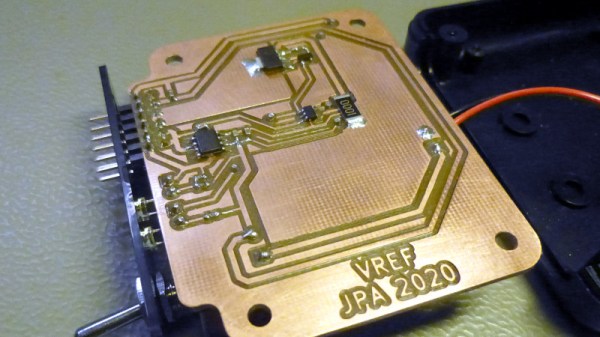
When you measure a voltage, how do you know that your measurement is correct? Because your multimeter says so, of course! But how can you trust your multimeter to give the right reading? Calibration of instruments is something we often trust blindly without really thinking about, but it’s not always an impossible task only for a high-end test lab. [Petteri Aimonen] had enough need for a calibrated current source to have designed his own, and he’s shared the resulting project for all to see.

The cost of a reference source goes up with the degree of accuracy required, and can stretch into the many millions of dollars if you are seeking the standards of a national metrology institute, but fortunately [Petteri]’s requirements were considerably more modest. 0.02% accuracy would suffice. An Analog Devices precision voltage reference driving a low-offset op-amp with a driver transistor supplies current to a 0.01% precision resistor, resulting in a reference current source fit for his needs. The reference is available in a range of voltages, his chosen 2.048 volts gave a 2.048 mA current sink with a 100 ohm resistor.

In a way it is a miracle of technology that the cheapest digital multimeter on the market can still have a surprisingly good level of calibration thanks to its on-chip bandgap voltage reference, but it never hurts to have a means to check your instruments. Some of us still rather like analogue multimeters, but beware — calibration at the cheaper end of that market can sometimes be lacking.

John Deere And Nebraska’s Right To Repair, The Aftermath Of A Failed Piece Of Legislation

For the past few years now we’ve covered a long-running battle between American farmers and the manufacturers of their farm machinery, over their right to repair, with particular focus on the agricultural giant John Deere. The manufacturer of the familiar green and yellow machinery that lies in the heart and soul of American farming has attracted criticism for using restrictive DRM and closed-source embedded software to lock down the repair of its products into the hands of its dealer network.

This has been a hot-button issue in our community as it has with the farmers for years, but it’s failed to receive much traction in the wider world. It’s very encouraging then to see some mainstream coverage from Bloomberg Businessweek on the subject, in which they follow the latest in the saga of the Nebraska farmers’ quest for a right to repair bill. Particularly handy for readers wishing to digest it while doing something else, they’ve also recorded it as an easy-to-listen podcast.

We last visited the Nebraska farmers a couple of years ago when they were working towards the bill reaching their legislature. The Bloomberg piece brings the saga up to date, with the Nebraska Farm Bureau failing to advance it, and the consequent anger from the farmers themselves. It’s interesting in its laying bare the arguments of the manufacturer, also for its looking at the hidden aspect of the value of the data collected by these connected machines.

It’s likely that the wider hardware hacker community and the farming community have different outlooks on many fronts, but in our shared readiness to dive in and fix things and now in our concern over right to repair we have a common purpose. Watching these stories at a distance, from the agricultural heartland of the European country where this is being written, it’s striking how much the farmers featured are the quintessential salt-of-the-earth Americans representing what much of America still likes to believe that it is at heart. If a company such as John Deere has lost those guys, something really must have gone wrong in the world of green and yellow machinery.

Header image: Nheyob / CC BY-SA 4.0

Velocity Based Training, With A Camera

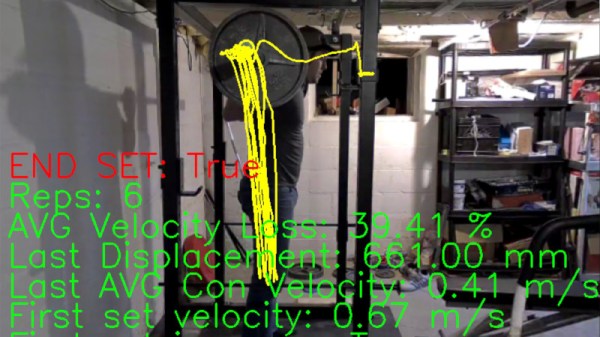
In the world of weight training, the buzzword of the moment is VBT, or Velocity Based Training. This involves sensors being used to measure the speed and position of a weight as it moves through each repetition, and thus provide instant feedback for the athlete and glean information from which they can work upon their training routine. Typically the sensors involved may be accelerometers, but [Kris] has taken a different tack using a webcam and machine vision to do the same job.

The barbell has a green disc attached to its end, and the software tracks it and measures the velocity. It issues a warning when the velocity of a repetition drops below a preset level, telling the athlete to stop their set before pushing themselves too far. Under the hood is a Python script and OpenCV, and the write-up in his GitHub repository takes us through its camera calibration to remove the effects of distortion, and set-up. All calibration of distances within the image is made through the known size of the green disc, allowing the software to accurately chart the distance through which it travels.

We’ve not seen a machine vision approach to weight training before, but we have seen one using accelerometers. Maybe this project will re-ignite interest in this field.