Accurate Dispensing Of Toilet Paper Will Get Us Through The Crisis

As we enter our second week of official COVID-19-related lockdown where this is being written, it’s evident that there are some resources we will have to conserve to help get us through all this. Instead of just using all of something because we can nip out to the store and buy more, we have to look at what we’ve got and treat it as though it will have to get us through the next three months. It’s not always certain that on our infrequent trips to the supermarket they’ll have stocks of what we want.
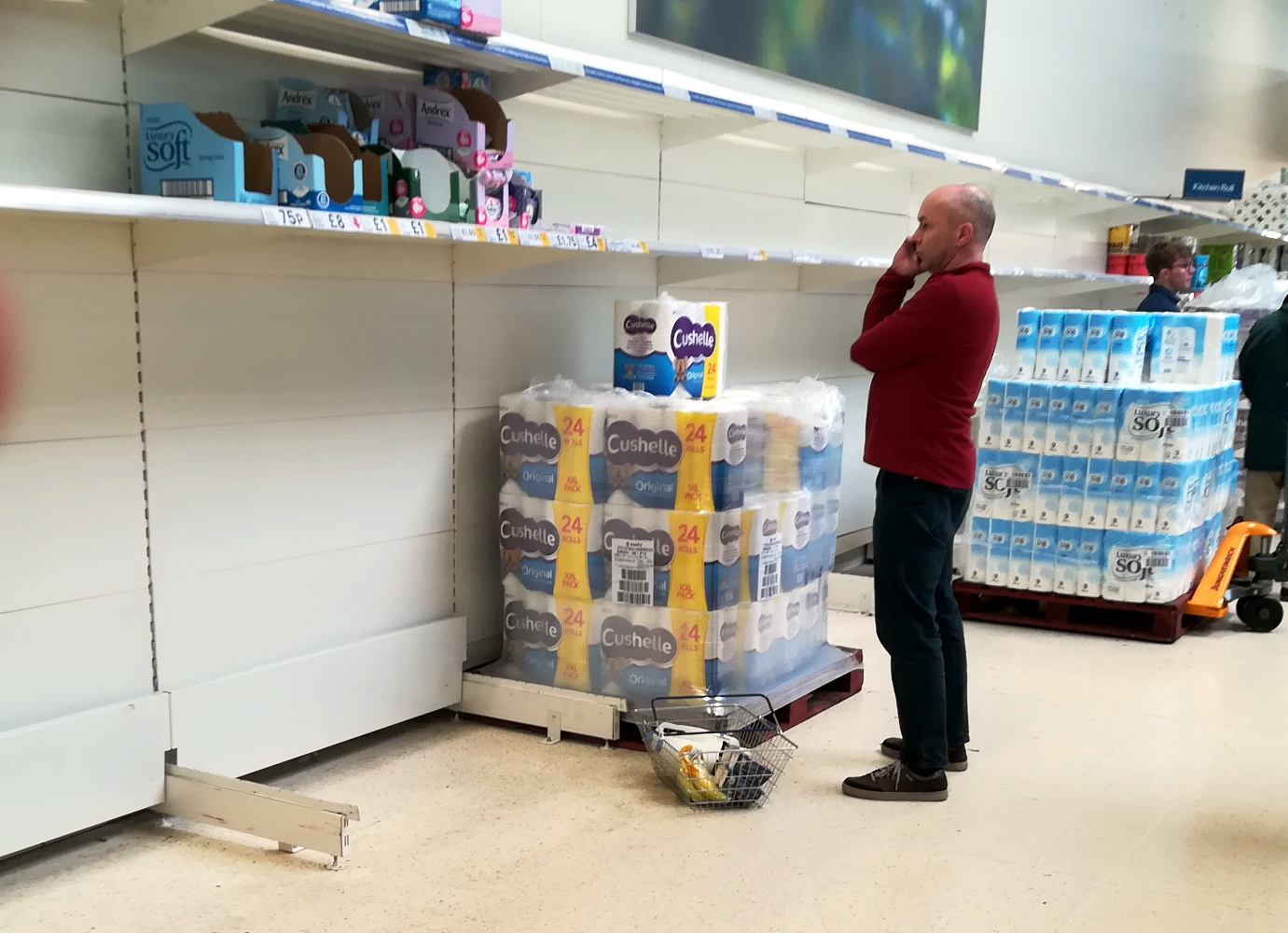
This is the very last of the toilet paper in my local supermarket, on the 8th of March.

A particular shortage has been of toilet paper. The news was full of footage showing people fighting for the last twelve-pack, and since early last month there has been none to be had for love nor money. To conserve stocks and save us from the desperate measures of having to cut the Daily Mail into squares and hang them on the wall, a technical solution is required. To this end I’ve created a computerised toilet roll dispenser which carefully controls the quantity of the precious sanitary product, in the hope of curbing its consumption to see us through the crisis.

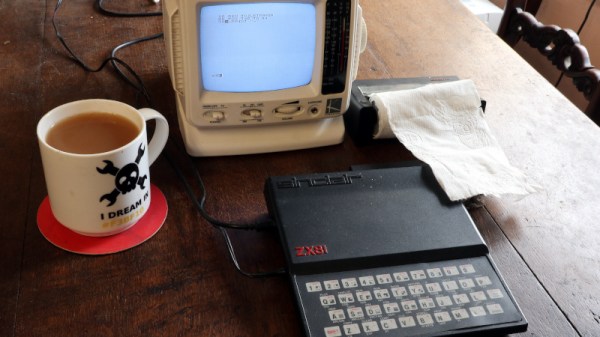
In the midst of a full lockdown it’s difficult to secure immediate delivery of our usual maker essentials, so rather than send off for the controller boards I might have liked it has been necessary to make do with what I had. In the end I selected an older single board computer I had in a box under my bench. The Sinclair ZX81 has a single-core Z80 processor running at 3.25 MHz, dual-channel memory, a Ferranti GPU, and plenty of expansion possibilities from its black plastic case. I chose it because I could repurpose its thermal printer peripheral as a toilet paper printer, and because it has an easily wiped and hygienic membrane keyboard rather than a conventional one that could harbour germs.

Hardware wise I found I was fairly easily able to adapt a standard roll of Cushelle to the ZX printer, and was soon dispensing sheets with the following BASIC code.

10 REM TOILET PAPER PRINTER
20 FOR T=0 TO 44
30 LPRINT ""
40 NEXT T
50 LPRINT "---------- TEAR HERE -----------"

For now it’s working on the bench, but it will soon be mounted with a small portable TV as a monitor on the wall next to the toilet. Dispensing toilet paper will be as simple as typing RUN and hitting the ZX’s NEW LINE key, before watching as a sheet of toilet paper emerges magically from the printer. It’s the little hacks like this one that will be so useful in getting us through the crisis. After all, this Sinclair always has a square to spare.
Gold Cables Really Do Work The Best

As a writer, I have long harboured a dream that one day an editor will buy me a top-of-the-range audio analyser, and I can set up an audio test lab and write pieces debunking the spurious claims made by audiophiles, HiFi journalists, and the high-end audio industry about the quality of their products. Does that amp really lend an incisive sibilance to the broader soundstage, and can we back that up with some measurable figures rather than purple prose?

An Audio Playground You Didn’t Know You Had

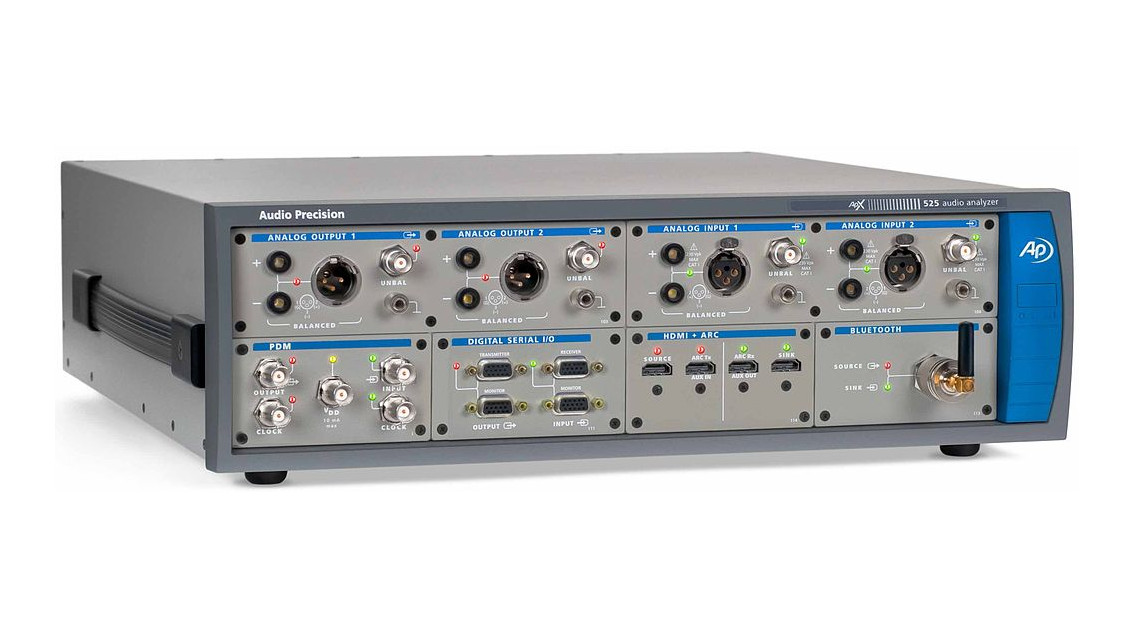
An Audio Precision APx525 audio analyser.
An Audio Precision APx525 audio analyser. Bradp723 (CC-BY-SA 3.0)

Sadly Hackaday is not an audio magazine, and if Mike bought me an Audio Precision he’d have to satisfy all the other writers’ test equipment desires too, and who knows where that would end! So there will be no Hackaday audio lab — for now. But that doesn’t mean I can’t play around with audio analysis.

Last month we carried a write-up of a Supercon talk from Kate Temkin and Michael Ossmann, in which they reminded us that we have a cracking general purpose DSP playground right under our noses; GNU Radio isn’t just for radio. Once I’d seen the talk my audio analysis horizons were opened up considerably. Maybe that audio analyser wouldn’t be mine, but I could do some of the same job with GNU Radio.

It’s important to stress at this point that anything I can do on my bench will not remotely approach the quality of a professional audio analyser. But even if I can’t measure infinitesimal differences between very high-end audio circuitry, I can still measure enough to tell a good audio product from a bad one.

Continue reading “Gold Cables Really Do Work The Best”

A 1950s Ampex Tape Recorder Microphone Preamplifier Restoration

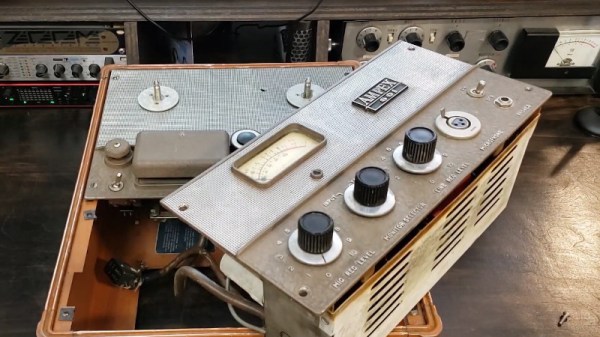
So often when we read of a modification on a classic piece of tube electronics we prepare to wince, as such work often results in senseless butchery of a well-preserved survivor. With [Frank Olson]’s work on a 1958 Ampex 601 tape recorder though we were pleasantly surprised, because while he makes a modification to allow its use as a stand-alone microphone preamplifier he also performs an extremely sympathetic upgrade to modern components and retains it in substantially the form it left the Ampex factory.

The video below the break is a satisfying wallow in pre-PCB-era construction for any of the generation who cut their teeth on tube, chassis, and tag strip electronics. We can almost smell the phenolic as he carefully removes time-expired capacitors and fits modern replacements complete with period features such as sheathing over their leads. The larger multiway can electrolytics are left in the chassis, with their modern miniaturised equivalents nestling underneath them out of sight. We all know that electronic components have become a lot smaller over the decades, but it’s still a bit of a shock to see just how tiny even a high voltage electrolytic has become.

The Ampex would have been a very high quality tape recorder when new, and while this one has a problem with its mechanism it’s that quality that makes it easier for him to do this work in 2020. There’s every chance that this one could be returned to service as a tape recorder if someone was of a mind to fix it, and meanwhile it will give Frank excellent service as a high quality pre-amp. This is how resto-mods should be done!

Ampex are very much still in existence making digital storage products, but back in the 1950s they were at the forefront of analogue magnetic tape technology. We’ve written in the past about how Bing Crosby had a hand in the development of high quality tape recorders, and also about Ampex’s part in the gestation of the video recorder.

Continue reading “A 1950s Ampex Tape Recorder Microphone Preamplifier Restoration”

A Soldering LightSaber For The Speedy Worker

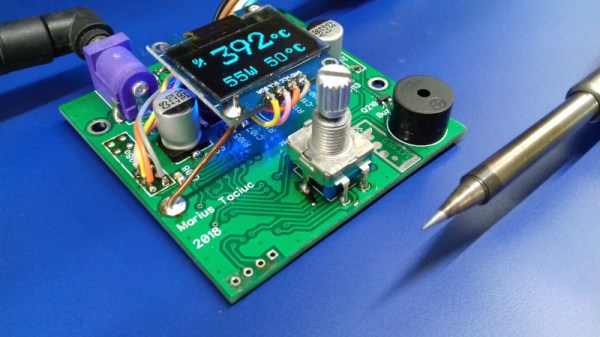
We all have our preferences when it comes to soldering irons, and for [Marius Taciuc] the strongest of them all is for a quick heat-up. It has to be at full temperature in the time it takes him to get to work, or it simply won’t cut the mustard. His solution is a temperature controlled iron, but one with no ordinary temperature control. Instead of a normal feedback loop it uses a machine learning algorithm to find the quickest warm-up.

The elements he’s using have a thermocouple in series with the element itself, meaning that to measure the temperature the power must be cut to the element. This duty cycle can not be cut too short or the measurements become noisy, so under a traditional temperature control regimen there is a limit on how quickly it can be heated up. His approach is to turn it on full-time for a period without stopping to measure the temperature, only measuring after it has had a chance to heat up. The algorithm constantly learns how long to switch it on to achieve what temperature, and is able to interpolate to arrive at the desired reading. It’s a clever way to make existing hardware perform new tricks, and we like that.

He’s appeared on these pages quite a few times over the years, but perhaps you’d like to see the first version of the same hardware. Meanwhile watch the quick heat up in action with a fuller explanation in the video below.

Continue reading “A Soldering LightSaber For The Speedy Worker”

It’s Not An Arc Lamp, It’s A Lamp Arc

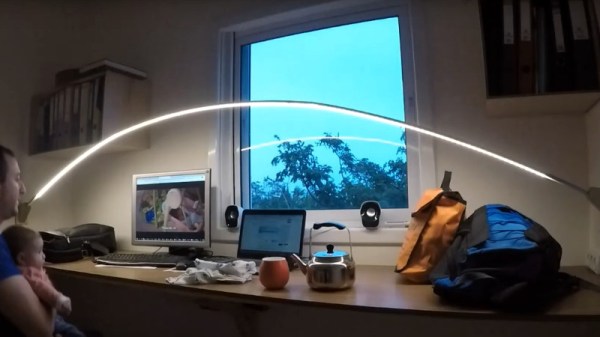
One wouldn’t expect there to be much to cause envy in the world of desk lamps, after all whether it’s a classic Anglepoise or a dollar store LED affair if it does its job of casting the requisite quantity of light where it’s needed, most of us are happy. But then we saw [Ronny Ziss]’s LED arc desk lamp, and suddenly all other lamps simply aren’t good enough any more. If it’s not a wall-to-wall arc of LEDs spanning the length of the desk, it quite simply no longer cuts the mustard. We’ve entered the world of lamp envy, folks, and it’s a poorly-illuminated place to be.

As you can see in the video below the break both the hardware and the software of this lamp are impressive in their own right, the structure being an aluminium extrusion carrying an addressable white LED strip fitted into an arc between two custom plywood blocks on the walls either side of the desk. The software is controlled through a rotary encoder, and allows command of the position, width, and brightness of the illuminated portion, as well as having a hidden Pong game. Sadly he doesn’t reveal the software or the microcontroller in question, however the task is not an onerous one and it’s likely most Hackaday readers could put it together using their board or processor of choice.

In years of lamp projects on Hackaday, we can’t find another quite like this one. Conventional lamp projects can still be stylish though.

Continue reading “It’s Not An Arc Lamp, It’s A Lamp Arc”

Electromagnetic Field 2020 Cancelled

It’s the news we were all expecting but not looking forward to hearing: this summer’s EMF Camp which was to be held at the end of July in Herefordshire, UK, has been cancelled. This is of course due to the ongoing public health measures surrounding the COVID-19 virus pandemic. With the country on lockdown for the forseeable future, this is a responsible decision for a gathering the size of EMF which hosted around 2,500 attendees in 2018.

Existing ticket holders will be refunded, and will be guaranteed a ticket to the next event in 2022. According to the announcement, EMF is in the red to the tune of at least £25,000 ($29,523) because of non-refundable payments associated with booking the event, something to remember in two years time when faced with the choice of a normal ticket or a supporters ticket.

Work on starting conference badge production has been halted, but development continues apace and will not go to waste as it will form the basis of the 2022 item. This will make them the event badge team with the earliest preparation ever, and from what we saw when we had a brief look at an early prototype last year it should be a badge worth waiting for.

We’re sure all readers will understand the gravity of the situation, and that the EMF team have taken an appropriate response to what is an extraordinary series of events. Organising a hacker camp is a tough job at the best of times, and this must have been particularly hard on them. We thank them for their work on our behalf at previous events and in preparing for this aborted one, and we look forward to the next EMF Camp in 2022.

Hack The Quarantine, Not Just The Medical Equipment

As the COVID-19 pandemic invades in some way every corner of life, we’ve seen significant effort from the hardware community in considering the problem of inadequate supplies of medical equipment. The pandemic and its associated quarantine and lockdowns do not stop at medical supplies though, a whole host of problems associated with the whole population self-isolating are there to be solved. This makes Hack Quarantine, an online event that bills itself as “A global virtual hackathon”, particularly interesting. It’s encouraging its participants to look at the wider aspects of the whole thing rather than solely dreaming up an open-source ventilator design, because in the absence of clinical trials or indeed any experts in medical devices it’s possible that medical equipment from a hackathon might be of limited usability.

The hackathon will run from March 23rd to April 12th, and it already has a schedule of talks and workshops. We can’t help noticing a dearth of hardware-related stuff among all the software, and perhaps this could be where you come in. It’s something that never ceases to amaze us as Hackaday writers, the depth of hardware skill among our readership, and we’re guessing that plenty of you could bring something to this event.

We’ve brought you more than a few COVID-19 stories over the last few weeks. If this hackathon isn’t for you then can we point you at our Folding@Home team? Also, you may wish to look at the best fabric choice for your own face masks.