Help Save The National Videogame Museum

The National Videogame Museum in Sheffield, UK, houses a unique collection celebrating all decades of video games and their culture, and as the lockdown has brought with it a crisis threatening its very existence, has launched a crowdfunding campaign with a video we’ve placed below the break. As a relatively young organisation, they have yet to build up the financial buffer that a more established one would have. It’s important that this and other heritage sites live to open again another day, so we’d urge you to take a look.

On their website they’re providing a page of activities for the bored youngster in your life, but to whet your appetite should you wish to visit them in the future they also have a selection of pages about the rest of their exhibition.

One of the sad features of living through  a pandemic comes in knowing that some of the businesses and organisations we hold dear might not make it through the crisis. We’ve put in a few orders to smaller suppliers over the last week or two to shove a bit of extra business their way, and no doubt you have too. What is not so easy however, is when the threatened organisation is a visitor attraction; we can’t make the trip during a lockdown. The NVM is unlikely to be the only such attraction facing the pinch, so we’d urge you to look out for those that are close to you as well.
Continue reading “Help Save The National Videogame Museum”

Download A Bit Of Sinclair History

If you are a devotee of the Sinclair series of 8-bit home computers then a piece of news from the Centre For Computing History in Cambridge may be of interest to you, they’ve released a copy of the ROM from their ZX Spectrum prototype. This machine surfaced last year as part of a donation form the company originally contracted to write the Spectrum ROM and has been given pride of place int heir exhibition ever since. They’ve been doing some very careful work on it, and while The Register reports they can’t yet make the board boot, they have extracted the code for study. In the video below the break, we see it running on the Speccy emulator on an older Windows PC.

The ROM comes with an invitation to the ZX Spectrum community to analyze it against the stock version, in the hope of revealing ossified fragments of code such as that for the Microdrive storage peripheral which never made it into the stock Spectrum. But should you simply want to try your favorite games with the earliest possible version of the ROM, you can do that too.

We covered the machine’s emergence last year, meanwhile, if you haven’t been to the Centre for Computing History yet, we suggest you take a look at our review from a few years ago.

Continue reading “Download A Bit Of Sinclair History”

Turn Off Those Batteries With Their Protection Chip

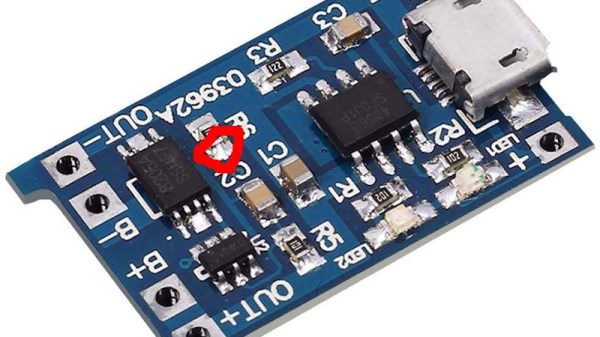
It should be a feature of every device powered by a lithium-ion battery, that it has a protection chip on board that automatically disconnects it should it go out of its safe voltage range. A chip most often used for this purpose in single-cell applications is the Fortune Semiconductor DW01, and [Oliver] shares a tip for using this chip to power down the battery. The DW01 has a CS, or current sense pin, which if taken high momentarily will put the chip into an off state until the battery is disconnected.

Looking at the DW01 datasheet we can see that this would work, but we can’t help having a few questions. The CS pin is a safety sensor pin, providing over current, short circuit, and reverse polarity detection. It’s the kind of pin one might mess with only when one is absolutely certain it’s not likely to trigger a dangerous fault condition, so a bit of care should be required. However, we can see that leaving its resistor in place and supplying it a momentary logic level through another resistor should work. We’d be interested in the views of any readers with more experience in the world of lithium battery protection on this hack.

Meanwhile, a good read for any reader should be our look last year at lithium-ion safety.

Is This The Oldest Still-Working Geostationary Satellite?

The LES-5 spacecraft

Regular followers of space news will know that when satellites or space probes reach the end of their life, they either are de-orbited in a fiery re-entry, or they stay lifeless in orbit, often in a safe graveyard orbit where they are unlikely to harm other craft. Sometimes these deactivated satellites spring back into life, and there is a dedicated band of enthusiasts who seek out these oddities. Dead satellite finder extraordinaire [Scott Tilley] has turned up a particularly unusual one, a craft that is quite likely to be the oldest still-working geostationary satellite.

LES-5 is an experimental satellite built by MIT’s Lincoln Labs, launched in 1967, and used to test military UHF communications in a geosynchronous orbit. It had an active life into the early 1970s after which it was placed in a graveyard orbital slot for redundant craft. It’s lain forgotten ever since, until this month when [Scott]  found its beacon transmitting on 236.75 MHz. The Twitter thread is an extremely interesting glimpse into the satellite finder’s art, as first he’s not certain at all that it is LES-5 so he waits for its solar eclipse to identify its exact position.

Whether anything on the craft can find another use today is not certain, as he finds no evidence of its transponder. Still, that something is working again 53 years after its launch is a testament to the quality of its construction. Should its transponder be reactivated again it’s not impossible that people might find illicit uses for it, after all that’s not the first time this has happened.

Full-Colour, Full-Motion Video – On An Audio Cassette!

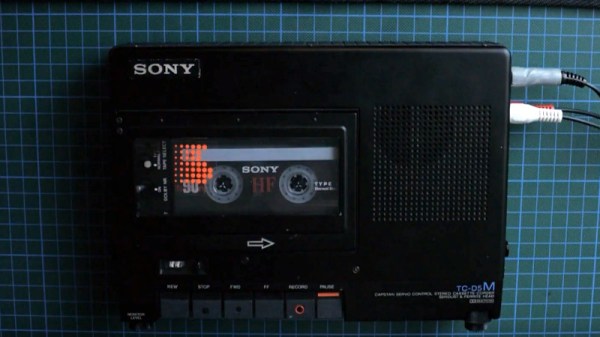
A lot of projects we feature use video in some form or other, but that video is invariably digital, it exists as a stream of numbers in a computer memory or storage, and is often compressed. For some of us who grew up working with composite video there is a slight regret that we rarely get up-close and personal with an analogue stream, so [Kris Slyka]’s project putting video on a conventional audio cassette is a rare opportunity.

It's fair to say this isn't the highest quality video.
It’s fair to say this isn’t the highest quality video.

Readers with long memories may recall the Fisher-Price PixelVision toy from the late 1980s which recorded black-and-white video on a conventional cassette running at many times normal speed. This system does not take that tack, instead it decreases resolution and frame rate to a point at which it can be recorded at conventional cassette speeds. The result is not particularly high quality, but with luminance on one side of a stereo recording and chrominance on the other it does work.

The video below the break is a run through the system, with an explanation of how video signals work. Meanwhile the code for both encoder and decoder are available through the magic of GitHub. If you’re interested further, take a look at our examination of a video waveform.

Continue reading “Full-Colour, Full-Motion Video – On An Audio Cassette!”

FDA Says PPE Can Be Reused After Trip Through Shipping Container Decontamination System

We are hearing so much in the news about shortages of personal protective equipment, or PPE, for healthcare workers. Factories are being asked to perform the impossible when it comes to production be the need is so real, so immediate, and so widespread.

The problem with rapid consumption of PPE is that once it has been exposed to infection, it’s contaminated and can’t be used again. Physically it may be fine, but it retains the capability to infect other people. If there were some way it could be effectively cleaned and decontaminated for re-use, it would reduce the strain on the supply chain and result in a greater availability of PPE for all those who require it.

This is the promise of Battelle’s Critical Care Decontamination System, a shipping-container-sized unit which has received approval from the FDA at break-neck speed.

Continue reading “FDA Says PPE Can Be Reused After Trip Through Shipping Container Decontamination System”

Peel Apart Your ISP’s Router

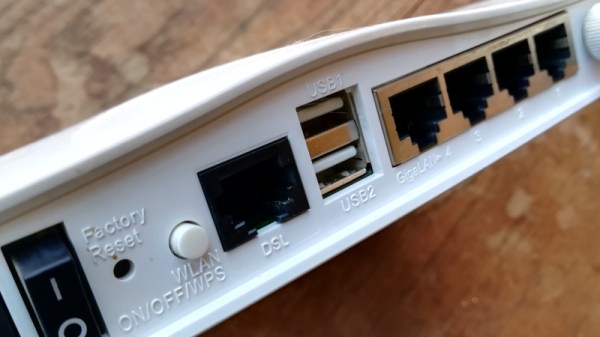
Whether your home Internet connection comes by ADSL, fibre, cable, or even satellite, at some point in the chain between your ISP and your computer will be a router in your home. For some of us it’s a model we’ve bought ourselves and loaded up with a custom distro, but for the majority it’s a box supplied by our ISP and subject to their settings and restrictions. [Paddlesteamer] has just such a router, a Huawei model supplied by the Turkcell ISP, and decided to do a little snooping into its setup.

In a tale of three parts, we see the device unravel, from uncovering a shell to reverse engineering its update process, to delving in its firmware and finally removing all its restrictions entirely. It’s a fascinating process in which we learn a lot, such as the way a man-in-the-middle attack is performed on the router’s connection tot he ISP, or that it contains an authorised SSH key seemingly giving Huawei a back door into it. You may never do this with your ISP’s router, but it pays to be aware of what can be put in your home by them without your realising it.

The Golden Age of router hacking may be behind us as the likes of the Raspberry Pi have replaced surplus routers as a source of cheap Linux boards, but  as this shows us there’s still a need to dive inside a router from time to time. After all, locked-down routers are hardly a new phenomenon.

Via Hacker News.