A Barn Find 6502 Is Restored

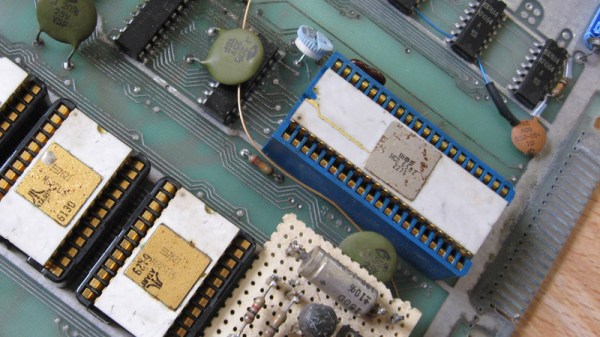
The phrase “Barn find” is normally associated with the world of older cars, where enthusiasts live in the hope that they may one day stumble upon a dusty supercar lurking unloved for decades on a remote farm. It’s not so often found in the context of electronics, but that’s the phrase that [John Culver] uses for a mid-1970s Atari arcade board that had been through a very hard time indeed and was in part coated with cow dung. It’s interesting because it sports a very early example of a MOS 6502 in a ceramic package, whose date code tells us was manufactured in week 22 of 1976.

Finding a microprocessor, even a slightly rare one, is not that great an event in itself. What makes this one interesting is the state it was in when he got it, and the steps he used to retrieve it from the board without it sustaining damage, and then to clean it up and remove accumulated rust on its pins. We are fast approaching a point at which older microprocessors become artifacts rather than mere components, and it’s likely that more than one of us with an interest in such things may one day have to acquire those skills.

We’re rewarded at the end with a picture of the classic chip passing tests with flying colours, and the interesting quirk that this is a chip with the famous rotate right bug that affected early 6502s. If you are interested in the 6502 then you should definitely read our colleague [Bil Herd]’s tribute to its recently-departed designer, [Chuck Peddle].
3D Printing For Wire Paths Yields An Arduboy Minus The PCB

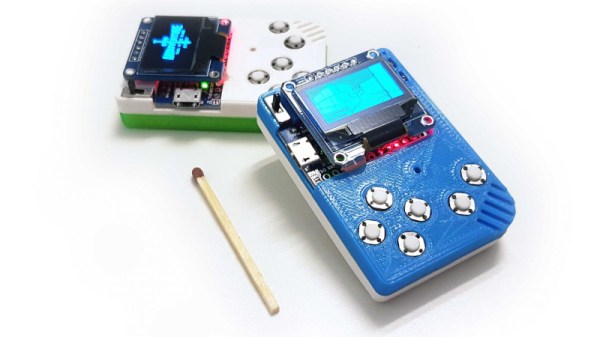
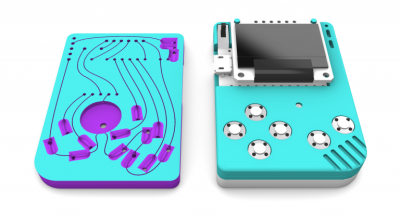
What is part way between a printed circuit board and a rats-nest of point-to-point wiring? We’re not sure, but this is it. [Johan von Konow] has come up with an inspired solution, 3D printing an Arduboy case with channels ready-made for all the wires. The effect with his 3DPCBoy is of a PCB without the PCB, and allows the console to be made very quickly and cheaply.

The Arduboy — which we originally looked at back in 2014 — is a handheld gaming console in a somewhat Gameboy-like form factor. Normally a credit-card sized PCB hosts all the components, including a microcontroller, display, and buttons. Each has a predictable footprint and placement so they can simply be wired together with hookup wire, if you don’t mind a messy result.

Here the print itself has all the holes ready-created for the components, and the path of the wires has a resemblance to the sweeping traces of older hand-laid PCBs. The result is very effective way to take common components — and Arduino pro micro board for the uC, an OLED breakout board, and some buttons — and combine them into a robust package. This technique of using 3D prints as a combination of enclosure and substrate for components and wiring has an application far beyond handheld gaming. We look forward to seeing more like it.

[Via the Arduboy community forum, thanks Kevin Bates for the tip.]

A 3.3 V Tube Preamp Without An Inverter

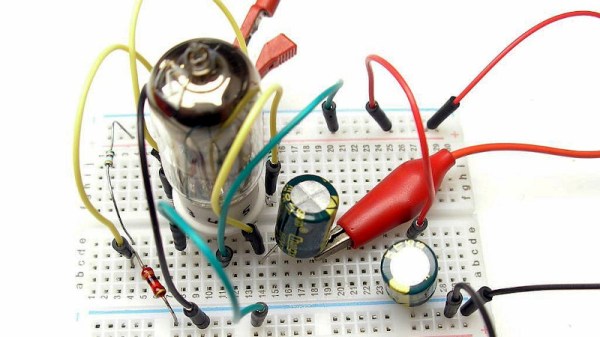
If you’ve ever worked with vacuum tubes, you’ll probably have a healthy appreciation for high voltage power supplies. These components require higher potentials to get those electrons moving, or so we’re told. It’s not the whole truth though, as [Albert van Dalen] demonstrates with his tube preamplifier running from only 3.3 V. If your first thought is that he must have made a flyback converter to step that voltage up to something more useful then you’re in for a surprise, because the single 6J6 pentode really does run from just 3.3 volts. Even its heater, normally supplied with 6.3 V, takes the lower voltage.

The circuit appears at first sight to be a conventional single-ended design, but closer examination reveals a grid bias circuit more reminiscent of a bipolar transistor. This results in a positive grid voltage rather than the more usual negative, and an unusually high 0.3 mA grid current. The cathode current is only  0.15 mA, but the preamplifier delivers a 3.5x gain. There is more detail on his website.

It would be interesting to subject this circuit to a full audio analysis and comparison with a more conventional design. As with so much in the world of audio there’s some smoke and mirrors around what constitutes the so-called “valve sound”, and it’s a question whether the satisfaction comes through the sound itself or the bragging rights of having a unit with a vacuum tube on show.  Still, this is a simple enough design which takes few resources to build, so we look forward to seeing further experimentation. Careful though – down the vacuum audio route can lie folly.

This PIC Is A Squarewave Generator

When we use a microcontroller to flip a few GPIOs or talk SPI to a peripheral chip, we are often overlooking that it will usually contain an array of built-in peripherals that were once the preserve of extra hardware. Analogue ports, timers, UARTs, and clock generators, to name just a few. [Giovanni Bernardo] has been experimenting with one of these, the internal frequency synthesiser on many PIC microcontrollers, and he’s  produced a handy square wave generator for which he’s placed code on GitHub and produced a write-up (Italian language, Google translate link).

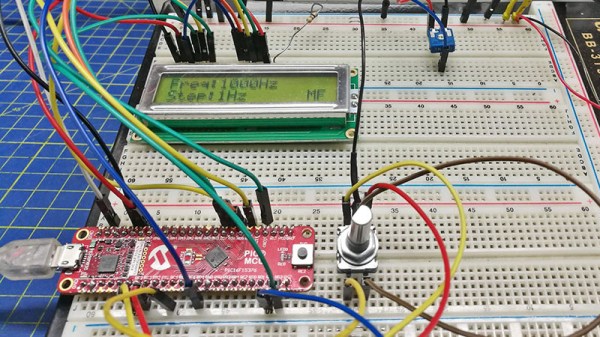
The board used is a PIC16F375 Curiosity Nano, and code takes input from a rotary encoder to set the frequency, with a button to select different step sizes and an alphanumeric LCD display to show the current settings. Frequencies from 1 Hz to 15 MHz are possible, with a clever switch between two of the PICs internal clocks to be used as the reference frequency. Stability depends upon whatever source the PIC uses for its own clock, and while we suspect that will be enough for most users it’s not inconceivable that the PIC could be clocked from a GPS-disciplined source or similar were there a requirement for it.

There are plenty of ways to generate square waves from a microcontroller. Most projects use waveform generator ICs.

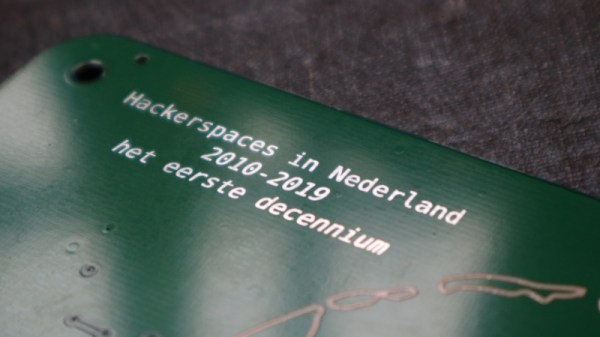
Dutch Hackerspaces At Ten Years Old: Celebrating A Community With A Special Map

The exotic cruise destination of Hoek van Holland Haven.

A couple of months ago I wrote a piece about the evolution of hackerspaces, and mentioned that I’d be attending a party for a hackerspace birthday. As I write this that party was last weekend, and it was celebrating both the birthday of RevSpace in the Hague, and the tenth anniversary of hackerspaces in the Netherlands. After a relaxing ocean cruise across the North Sea and a speedy train ride I found myself in RevSpace with a bottle of Club-Mate in my hand, hanging out with not only the locals but a selection of others from all across northwestern Europe and beyond. RevSpace is an exceptionally well-organised hackerspace with a large membership, so there was plenty to talk about and a lot of interesting projects to look at.

There was a short programme of talks in Dutch, covering hackerspace history and interviewing a panel of hackerspace founders. I am told that these may make their way online with an English translation in due course, and should be worth looking out for. Then there was an epic-scale barbecue, an old-school rave with Gameboy chiptunes and analogue synth EDM among other delights, and the chance for an evening’s socialising with the rest of the attendees. Continue reading “Dutch Hackerspaces At Ten Years Old: Celebrating A Community With A Special Map”

An EV Motor Controller Home Build

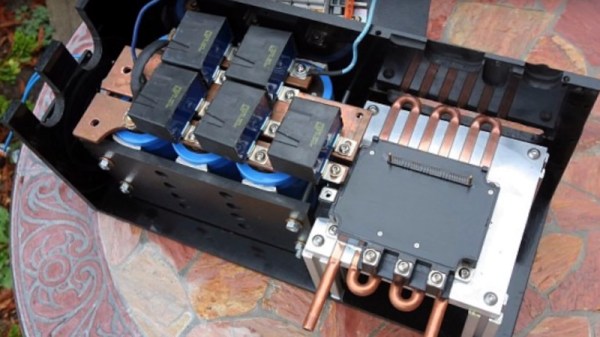
Many of us will have experimented with brushless motors, and some of us will have built our own controllers rather than using an off-the-shelf part. Doing so is a good way to understand their operation, and thus to design better brushless motor powered projects. Few of us will have gone as far as [etischer] though, and embarked upon building our own controller for a 300V 90kW traction motor.

The tricky part of a high power brushless motor controller lies not in the drive but in the high-power switching arrangements. He’s using a bank of IGBTs, and to drive them he’s using a smaller industrial variable frequency drive controller with its own output transistors removed. He takes us through some of the development of the system, including showing him blowing up a set of IGBTs through having too much inductance between transistors and reservoir capacitor, and then to his final design.

This is part of a project VW first converted ten years ago, and as part of a series of videos he’s produced one going through the whole project. It’s a fascinating breakdown of the parts required for an EV conversion, and the teething troubles he’s encountered along the way.

Continue reading “An EV Motor Controller Home Build”

A Mini SDR Receiver Using An Audio DSP

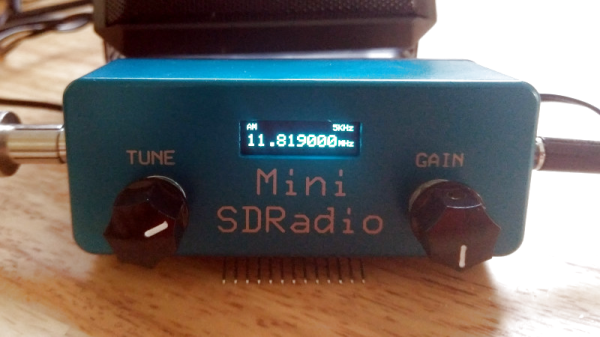
Software defined radio or SDR is the most exciting frontier in the field of radio, transferring as it does all signal functions from the analogue to the digital domain. Radios using SDR techniques can be surprisingly straightforward and easy to understand, and [Ray Ring]’s little SDR receiver manages to combine this with the novel use of an audio DSP rather than a computer to perform its SDR functions.

The front end is a conventional enough direct conversion design with an Si5531 clock generator providing I and Q phase-shifted local oscillator signals to a TS3A5017 analogue switch used as a mixer. An unexpected presence is an LTC6252 op-amp as an RF amplifier, but the special part comes after the I and Q baseband signals have been filtered. The SDR part of this receiver is an audio DSP, but it’s one that might not be an immediate choice. The Spin Semiconductor FV-1 is a dedicated digital reverb chip for musical effects boxes, but it comes with the feature that its internal DSP core can access custom code from an external ROM. [Ray] has written his own code for demodulation of AM, USB, and LSB signals rather than musical effects, and used the device’s left and right audio channels to process I and Q quadrature signals. The use of a single purpose chip to do something its designers never intended gives it the essence of a good hack, and we’re mightily impressed at his spotting the potential for an SDR in a musical effect. Hear it in action in the video below the break.

Meanwhile if the operation of a receiver such as this one is a mystery to you, we published a handy primer back in 2017.

Continue reading “A Mini SDR Receiver Using An Audio DSP”