Router Rebooter Without The Effort

It’s one of the rituals of our age, rebooting the family router when the bandwidth falters. Flip the power, and after half a minute or so your YouTube video starts up again. Consumer-grade router hardware is not the most reliable computing equipment you will own, as [Nick Sayer] found out when the router at his vacation home wasn’t reliable enough to support his remote monitoring equipment. His solution is an auto-reboot device, that power-cycles the offending device on command.

An obvious method might be to switch the mains supply, but instead he’s taken the simpler option of switching the DC from the router’s wall wart power supply with a cunning arrangement of three MOSFETs to keep the router defaulting to on under all conditions except when it is commanded to power down by the ATtiny microcontroller overseeing it. This chip provides extra fail-safe and debouncing functions to ensure no accidental rebooting.

Driving the circuit is a Raspberry Pi that handles the house monitoring, on which a Python script checks for Internet access and asks for a reboot if there is none. For extra safety it requires access to be down for a sustained period before doing so in case of a router firmware upgrade.

This isn’t the first router rebooter, for a mains-switching ESP8266 take a look at this one.

Router picture: Asim18 [CC BY-SA 3.0]

RPi4: Now Overclocked, Net-Booted, And Power-Sipping

It has now been a few months since the launch of the Raspberry Pi 4, and it would only be fair to describe the launch as “rocky”. While significantly faster than the Pi 3 on paper, its propensity for overheating would end up throttling down the CPU clock even with the plethora of aftermarket heatsinks and fans. The Raspberry Pi folks have been working on solutions to these teething troubles, and they have now released a bunch of updates in the form of a new bootloader, that lets the Pi 4 live up to its promise. (UPDATE: Here’s the download page and release notes)

The real meat of the update comes in an implementation of a low power mode for the USB hub. It turns out that the main source of heat on the SoC wasn’t the CPU, but the USB. Fixing the USB power consumption means that you can run the processor cool at stock speeds, and it can even be overclocked now.

There is also a new tool for updating the Pi bootloader, rpi-eeprom, that allows automatic updates for Pi 4 owners. The big change is that booting the Pi 4 over the network or an attached USB device is now a possibility, which is a must if you’re installing the Pi permanently. There are some fixes that caused problems with certain HATs, in which the Pi 4’s 3.3 V line was cycled during a reboot.

With a device as complex as a Raspberry Pi it comes as no surprise that it might ship with a few teething troubles. We’ve already covered some surrounding the USB-C power, for example. And the overheating. Where the Pi people consistently deliver though is in terms of support, both official and from the community, and we’re very pleased to see them come through in this case too.

A Dancing Cowboy Nixie Tube

If there were four words you never expected to hear in sequence, they would probably be “Dancing cowboy Nixie tube”. But that’s just what [Glasslinger] has made, and it’s exactly what it sounds like – an encapsulated cowboy that dances.

We’ve placed the resulting video below the break, and in it we see a compelling tour through the construction of a Nixie, and the specialist tools required. Little touches such as the need to insulate with glass capillary tube whose wires which shouldn’t glow, the construction of the envelope and stem, and the painstaking layout of the various cowboy components on a sheet of mica are carefully explained.

The tube takes shape in front of us, a driver PCB is etched, and the whole arrangement is placed in a custom wooden box. This is old-school construction at its finest, with the only touch of modernity coming from an Arduino Uno that schedules the various segments. It’s not beyond imagination though to see in time gone by that a Honeywell mechanical sequencer might have been used for the same task.

We’ve brought you [Glasslinger]’s work before of course, but we’ve also seen some more conventional self-made Nixies.

Continue reading “A Dancing Cowboy Nixie Tube”

Reverse Engineering A Two-Wire Intercom

There was a time when an intercom was simply a pair of boxes with speakers joined by a couple of wires, with an audio amplifier somewhere in the mix. But intercoms have like everything else joined the digital age, so those two wires now carry a load of other functionality as digital signalling. [Aaron Christophel] installs these devices for a living, and has posted a fascinating reverse engineering video that we’ve also placed below the break.

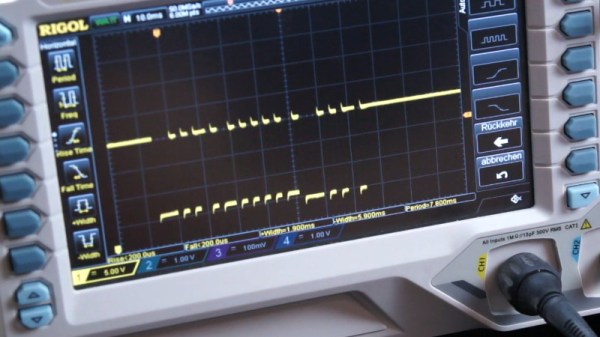
Power for the system is present as a constant 24V DC, and the audio is still an old-fashioned analogue signal that we’ll all be familiar with. On that 24V DC though are imposed a series of pulse trains to trigger the different alarms and other functions, and he describes extracting these with an oscilloscope before showing us the circuitry he’s used to send and receive pulses with an Arduino. The bulk of the video is then devoted to the software on the Arduino, which you can also find in a GitHub repository.

The result is an interesting primer for anyone who fancies a bit of serial detective work, even if they don’t have a intercom to hand.

Continue reading “Reverse Engineering A Two-Wire Intercom”

It’s A TV-Scope-Guitar Amplifier!

Guitar amplifiers are a frequent project, and despite being little more than a simple audio amplifier on paper, they conceal a surprising quantity of variables in search of a particular sound. We’ve seen a lot of them, but never one quite like [Nate Croson]’s CRT TV guitar amplifier. The LM386 doesn’t just drive the speaker, he’s also using it to turn the TV into a crude oscilloscope to form a visualisation of the sound.

The video showing this feat is below the break, and it puts us in a quandary due to being short on technical information. He’s driving the horizontal coils with the TV’s 50 Hz sawtooth field timebase, and the vertical ones with the audio from the LM386. We aren’t sure whether he’s rotated the yoke or whether the connections have been swapped, but the result is certainly impressive.

So given that there’s not quite as much technical detail as we’d like, why has this project captured our interest? Because it serves as a reminder that a CRT TV is a bit more than a useless anachronism, it’s a complex analogue device with significant and unique hacking potential. The older ones in particular provide endless possibilities for modification and circuit bending, and make for a fascinating analogue playground at a very agreeable price. It’s worth pointing out however that some of the voltages involved can make them a hazardous prospect for the unwary hacker. If you’re interested though, take a look at our dive into an older model.

Continue reading “It’s A TV-Scope-Guitar Amplifier!”

Collapse OS, An OS For When The Unthinkable Happens

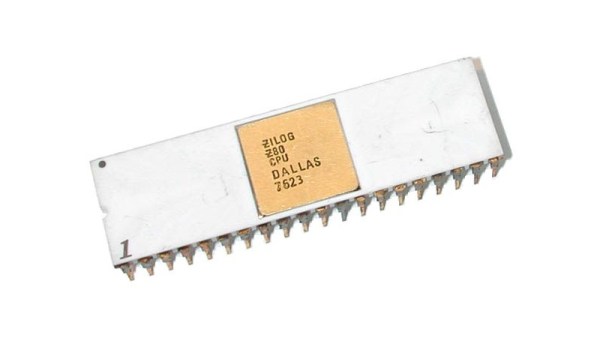
Decades of post-apocalyptic Hollywood movies have taught us that once all the trappings of our civilisation have been stripped away, it’s going to be kinda cool. We’re all going to wear slightly dusty looking 1980s motorcycling gear, and we’re going to drive really cool cars. Except of course Mad Max is fantasy, and the reality is likely to be unspeakbly grim. The future [Virgil Dupras] is anticipating is not a post-nuclear wasteland though, instead he’s trying to imagine what access to computing might look like in a world where the global supply chain has broken down. His solution is CollapseOS, an operating system designed for resilience and self-replication, that runs upon the minimal hardware of an 8-bit Z80.

It’s a pretty basic operating system so brace yourself if you are expecting a 64-bit fully multithreading kernel. Instead, you’re looking at a kernel, an assembler, and a text editor. One of the stated aims is that it can compile assembly language for a wide range of target CPUs, but it does not make it clear whether this means the OS itself will support those platforms. The self-replication is a fascinating feature though.

It’s an interesting question: what computing hardware would be available to the would-be hacker in a world in which all parts must be scavenged? The Z80 and other processors like it fit the bill admirably in one sense as it is possible to create a working computer using them with fairly minimal tools and knowledge, but we can’t help wondering whether the days when almost any electronic junk pile would contain one are now past. So what other easily accessible computing platforms might be created from post-apocalyptic junk in 2019? Remember, with no laptop and IDE you can’t just put an Arduino bootloader on that ATmega328 you desoldered from an old thermostat. As always the comments are open.

Image: Damicatz [CC BY 2.5].

Grind Your Welds With Pride, If That’s The Way You Do It

To grind or not to grind? What a question! It all depends on what you’re really trying to show, and in the case of welded joints, I often want to prove the integrity of the weld.

My ground-back piece of welded tube. Eagle-eyed readers will spot that the grinding reveals a weld that isn't perfect.
My ground-back piece of welded tube. Eagle-eyed readers will spot that the grinding reveals a weld that isn’t perfect.

Recently, I wrote a piece in which I talked about my cheap inverter welder and others like it. As part of it I did a lower-current weld on a piece of thin tube and before snapping a picture of the weld I ground it back flat. It turns out that some people prefer to see a picture of the weld bead instead — the neatness of the external appearance of the weld — to allow judgment on its quality. Oddly I believe the exact opposite, that the quality of my weld can only be judged by a closer look inside it, and it’s this point I’d like to explore.

Continue reading “Grind Your Welds With Pride, If That’s The Way You Do It”