The Backbone Of VHF Amateur Radio May Be Under Threat

A story that has been on the burner for a few weeks concerns a proposal that will be advanced to the ITU World Radiocommunication Conference 2023. It originates with French spectrum regulators and is reported to be at the behest of the Paris-based multinational defence contractor Thales. The sting in its tail is the proposed relegation of amateur radio to secondary status of the widely used two-meter band (144 MHz) to permit its usage by aircraft. The machinations of global spectrum regulation politics do not often provide stories for Hackaday readers, but this one should be of concern beyond the narrow bounds of amateur radio.

Most parts of the radio spectrum are shared between more than one user, and there is usually a primary occupant and a secondary one whose usage is dependent upon not interfering with other users. If you’ve used 435 MHz radio modems you will have encountered this, that’s a band shared with both radio amateurs and others including government users. While some countries have wider band limits, the two-meter band between 144 MHz and 146 MHz is allocated with primary status to radio amateurs worldwide, and it is this status that is placed under threat. The latest ARRL news is that there has been little opposition at the pan-European regulator CEPT level, which appears to be causing concern among the amateur radio community.

Why should this bother you? If you are a radio amateur it should be a grave concern that a band which has provided the “glue” for so many vital services over many decades might come under threat, and if you are not a radio amateur it should concern you that a commercial defence contractor in one country can so easily set in motion the degradation of a globally open resource governed by international treaties penned in your grandparents’ time. Amateur radio is a different regulatory being from the licence-free spectrum that we now depend upon for so many things, but the principle of it being a free resource to all its users remains the same. If you have an interest in retaining the spectrum you use wherever on the dial it may lie, we suggest you support your national amateur radio organisation in opposing this measure.

FarmBot Genesis XL gardening robot

FarmBot Unveils New CNC Gardening Robot Models

Across the Northern Hemisphere it is now summer and the growing season is in full swing. Vigorous plants that will soon bear tasty fruit are springing forth from the soil, but unfortunately so are a lush carpet of weeds that require the constant attention of the gardener. “If only there were a machine that could take that on!” she cries, and as it happens she’s in luck.

The FarmBot is an open-source robotic vegetable grower able to take care of all aspects of sowing and tending a vegetable plot. We first saw them five years as a semifinalist in the first Hackaday Prize. This is a CNC machine for the raised beds of your backyard garden. Give it power, water, and a WiFi connection, and FarmBot goes into service planting, watering, weeding, and monitoring the soil. Now they’ve shipped over a thousand of their Genesis model and today have announced of a pair of new models that promise to make their technology more accessible than it ever has been.

FarmBot moisture sensor and watering head
FarmBot has a tool changer. Soil moisture sensor and watering heads are shown here.

In a nod to Tesla, FarmBot is calling this their “Model 3 moment” — the new offering is smaller and leaner to appeal to a wider customer base than their well-heeled, CNC machine loving, early adopters. The new FarmBot Express and Express XL models are now shipped 95% pre-assembled to lower the bar on getting up and running.  They cover two sizes of planting bed: 1.2m x 3m or 2.4m x 6m, with an MSRP of $2295/2795 although there is currently an $800 launch discount available.

For us, FarmBot is the success story of an early Hackaday Prize entrant. From a great idea and a functional prototype, the project has successfully made the transition to commercial viability and holds a genuine promise of making the world a better place by helping people grow some of their own produce. Who knows, in five years time it could be your idea that’s reaching commercial viability, we think you should enter the Hackaday Prize too!

The Comforting Blue Glow Of Old Time Radio

When you think of an old radio it’s possible you imagine a wooden-cased tube radio receiver as clustered around by a 1940s family anxious for news from the front, or maybe even a hefty 19-inch rack casing for a “boat anchor” ham radio transmitter. But neither of those are really old radios, for that we must go back another few decades to the first radios. Radio as demonstrated by Giulielmo Marconi didn’t use tubes and it certainly didn’t use transistors, instead it used an induction coil and a spark gap. It’s a subject examined in depth by [The Plasma Channel] and [Blueprint], as they come together to build and test a pair of spark gap transmitters.

This is a collaboration between two YouTube channels, so we’ve put videos from both below the break.They both build simple spark gap transmitters and explain the history behind them, as well as running some tests in RF-shielded locations. The transmitters are fairly crude affairs in that while they both use electronic drives for their induction coils they don’t have the resonant tank circuitry that a typical early-20th-century transmitter would have had to improve its efficiency.

They are at pains to remind the viewer that spark gap transmitters have been illegal for nearly a century due to their wideband interference so this is definitely one of those “Don’t do this at home” projects even if it hasn’t stopped others from trying. But it’s still a fascinating introduction to this forgotten technology, and both videos are definitely worth a watch.

Continue reading “The Comforting Blue Glow Of Old Time Radio”

Make The Product By Hacking The Catalogue

We’ve all had that moment of seeing a product that’s an object of desire, only to realize that it’s a little beyond our means. Many of us in this community resolve to build our own, indeed these pages are full of projects that began in this way. But few of us have the audacity of [vcch], who was so taken with the QLockTwo expensive designer word clock that they built their own using the facsimile of its face on the front of QLock’s own catalogue. The claim is that this isn’t an unauthorized copy as such because no clock has been copied — as far as we’re aware there’s nothing against taking the scissors to a piece of promotional literature, and it certainly differs from the usual word clocks we’ve seen.

So how has this masterpiece of knock-off engineering been performed? The catalog cover has a high-quality cut-out rendition of the clock face, and the pages behind are thick enough to conceal an addressable LED. By cutting slots through the pages enough space is created for strips of LEDs, which are then hooked up to a Wemos D1 that runs the show. The software is provided, et voila! A faithful facsimile of the original QLockTwo, in part produced by QLock themselves. We applaud the ingenuity involved, but like [vcch] we’d say that if you like the QLockTwo then perhaps you’d like to consider buying one.

An SDR Transceiver The Old-School Way

Software-defined radios or SDRs have provided a step-change in the way we use radio. From your FM broadcast receiver which very likely now has single-application SDR technology embedded in a chip through to the all-singing-all-dancing general purpose SDR you’d find on an experimenter’s bench, control over signal processing has moved from the analogue domain into the digital. The possibilities are limitless, and some of the old ways of building a radio now seem antiquated.

[Pete Juliano N6QW] is an expert radio home-brewer of very long standing, and he’s proved there’s plenty of scope for old-fashioned radio homebrewing in an SDR with his RADIG project.  It’s an SDR transceiver for HF which does all the work of quadrature splitting and mixing with homebrewed modules rather than the more usual technique of hiding it in an SDR chip. It’s a very long read in a diary format from the bottom up, and what’s remarkable is that he’s gone from idea to working SDR over the space of about three weeks.

A block diagram of the N6QW SDR

So what goes into a homebrew SDR? Both RF preamplifier, filters, and PA are conventional as you might expect, switched between transmit and receive with relays. A common transmit and receive signal path is split into two and fed to a pair of ADE-1 mixers where they are mixed with quadrature local oscillator signals to produce I and Q that is fed to (or from in the case of transmit) a StarTech sound card. The local oscillator is an Si5351 synthesiser chip in the form of an SDR-Kits USB-driven module, and the 90 degree phased quadrature signals are generated with a set of 74AC74 flip-flops as a divider.

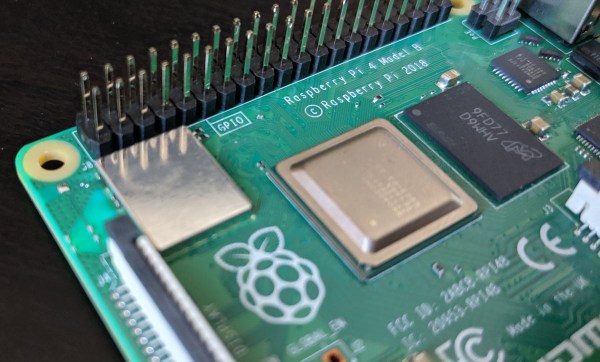
Running the show is a Raspberry Pi running Quisk, and though he mentions using a Teensy to control the Si5351 at the start of his diary it seems from the pictures of the final radio that the Pi has taken on that work. It’s clear that this is very much an experimental radio as it stands with wired-together modules on a wooden board, so we look forward to whatever refinements will come. This has the feel of a design that could eventually be built by many other radio amateurs, so it’s fascinating to be in at the start.

If I and Q leave you gasping when it comes to SDR technology, maybe we can help.

Thanks [Bill Meara N2CQR] for the tip!

Tic-Tac-Toe, In TTL

We’ll all be familiar with Tic-Tac-Toe, or Noughts and Crosses, a childhood pencil-and-paper diversion which has formed the basis of many a coding exercise. It’s an easy enough task to implement in software, but how many of us have seen it done in hardware alone? That’s just what [Warren Toomey] has done using TTL chips, and his method makes for a surprisingly simple circuit.

At its heart is an 8 kB ROM that contains precomputed move sequences that are selected via an address composed of the game states for both player and machine. A series of flip-flops control and buttons to make the board, and a 555 provides a clock.

The technique of using a ROM to replace complex logic is a very powerful one that is facilitated by the low price of relatively large devices that would once have been unaffordable. We’ve seen the technique used elsewhere, including as an ALU in a TTL CPU, and even for an entire CPU in its own right.

You can see the result in operation in the video below the break, and should you wish to have a go for yourself all the relevant information can be found in a GitHub repository.

Continue reading “Tic-Tac-Toe, In TTL”

Parallel Processing Was Never Quite Done Like This

Parallel processing is an idea that will be familiar to most readers. Few of you will not be reading this on a device with only one processor core, and quite a few of you will have experimented with clusters of Raspberry Pi or similar SBCs. Instead of one processor doing tasks sequentially, the idea goes, take a bunch of processors and hand out the tasks to be done simultaneously.

It’s a fair bet though that few of you will have designed and constructed your own parallel processing architecture. [BB] sends us a link which though it’s an old one is interesting enough to bring you today: [Michael] created a massively parallel array of Parallax Propeller microcontrollers back in 2008, and he did so on a breadboard.

The Parallax Propeller is an 8-core RISC microcontroller from the company that had found success in the 1990s with the BASIC Stamp, the PIC-based board that was all the rage before Arduino came into the world. In the last decade it was seen as an extremely exciting prospect, but high price and arcane development tools compared to a new generation of low-cost and easy to code competitors meant that it never quite caught on and remains today something of an intriguing oddity. So today’s value in this project lies not in something that you should run out and do yourselves, but instead in what the work tells us about the nuts and bolts of parallel processing architecture. It involves more than simply hooking up a load of chips and hoping for the best, and we gain some insight into the different strategies involved.

The Propeller certainly wasn’t the first attempt at a massively parallel microcontroller, and we doubt it will be the last. We’re certainly seeing microcontrollers with more than one core becoming more mainstream even in our community, but even with those how many of you have made use of the second core in your dual-core ESP32? Is a multicore microcontroller a solution searching for a problem, or will somebody one day crack it and the world will never be the same again? As always, the comments are below.