Reverse Engineering A Two-Wire Intercom

There was a time when an intercom was simply a pair of boxes with speakers joined by a couple of wires, with an audio amplifier somewhere in the mix. But intercoms have like everything else joined the digital age, so those two wires now carry a load of other functionality as digital signalling. [Aaron Christophel] installs these devices for a living, and has posted a fascinating reverse engineering video that we’ve also placed below the break.

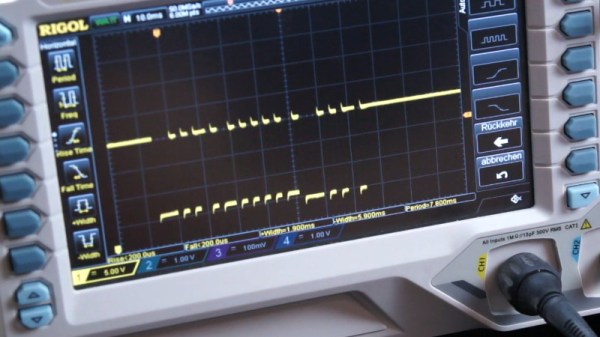
Power for the system is present as a constant 24V DC, and the audio is still an old-fashioned analogue signal that we’ll all be familiar with. On that 24V DC though are imposed a series of pulse trains to trigger the different alarms and other functions, and he describes extracting these with an oscilloscope before showing us the circuitry he’s used to send and receive pulses with an Arduino. The bulk of the video is then devoted to the software on the Arduino, which you can also find in a GitHub repository.

The result is an interesting primer for anyone who fancies a bit of serial detective work, even if they don’t have a intercom to hand.

Continue reading “Reverse Engineering A Two-Wire Intercom” →

It’s A TV-Scope-Guitar Amplifier!

Guitar amplifiers are a frequent project, and despite being little more than a simple audio amplifier on paper, they conceal a surprising quantity of variables in search of a particular sound. We’ve seen a lot of them, but never one quite like [Nate Croson]’s CRT TV guitar amplifier. The LM386 doesn’t just drive the speaker, he’s also using it to turn the TV into a crude oscilloscope to form a visualisation of the sound.

The video showing this feat is below the break, and it puts us in a quandary due to being short on technical information. He’s driving the horizontal coils with the TV’s 50 Hz sawtooth field timebase, and the vertical ones with the audio from the LM386. We aren’t sure whether he’s rotated the yoke or whether the connections have been swapped, but the result is certainly impressive.

So given that there’s not quite as much technical detail as we’d like, why has this project captured our interest? Because it serves as a reminder that a CRT TV is a bit more than a useless anachronism, it’s a complex analogue device with significant and unique hacking potential. The older ones in particular provide endless possibilities for modification and circuit bending, and make for a fascinating analogue playground at a very agreeable price. It’s worth pointing out however that some of the voltages involved can make them a hazardous prospect for the unwary hacker. If you’re interested though, take a look at our dive into an older model.

Continue reading “It’s A TV-Scope-Guitar Amplifier!” →

Collapse OS, An OS For When The Unthinkable Happens

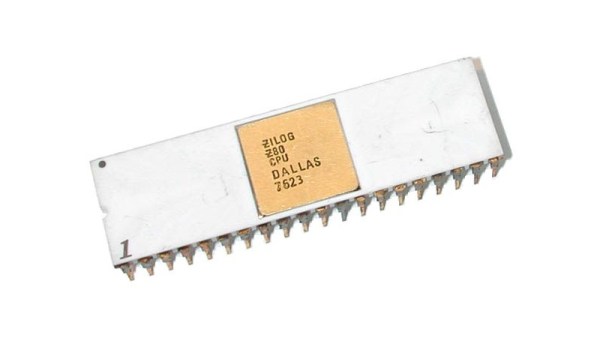
Decades of post-apocalyptic Hollywood movies have taught us that once all the trappings of our civilisation have been stripped away, it’s going to be kinda cool. We’re all going to wear slightly dusty looking 1980s motorcycling gear, and we’re going to drive really cool cars. Except of course Mad Max is fantasy, and the reality is likely to be unspeakbly grim. The future [Virgil Dupras] is anticipating is not a post-nuclear wasteland though, instead he’s trying to imagine what access to computing might look like in a world where the global supply chain has broken down. His solution is CollapseOS, an operating system designed for resilience and self-replication, that runs upon the minimal hardware of an 8-bit Z80.

It’s a pretty basic operating system so brace yourself if you are expecting a 64-bit fully multithreading kernel. Instead, you’re looking at a kernel, an assembler, and a text editor. One of the stated aims is that it can compile assembly language for a wide range of target CPUs, but it does not make it clear whether this means the OS itself will support those platforms. The self-replication is a fascinating feature though.

It’s an interesting question: what computing hardware would be available to the would-be hacker in a world in which all parts must be scavenged? The Z80 and other processors like it fit the bill admirably in one sense as it is possible to create a working computer using them with fairly minimal tools and knowledge, but we can’t help wondering whether the days when almost any electronic junk pile would contain one are now past. So what other easily accessible computing platforms might be created from post-apocalyptic junk in 2019? Remember, with no laptop and IDE you can’t just put an Arduino bootloader on that ATmega328 you desoldered from an old thermostat. As always the comments are open.

Image: Damicatz [CC BY 2.5].

Grind Your Welds With Pride, If That’s The Way You Do It

To grind or not to grind? What a question! It all depends on what you’re really trying to show, and in the case of welded joints, I often want to prove the integrity of the weld.

My ground-back piece of welded tube. Eagle-eyed readers will spot that the grinding reveals a weld that isn't perfect.
My ground-back piece of welded tube. Eagle-eyed readers will spot that the grinding reveals a weld that isn’t perfect.

Recently, I wrote a piece in which I talked about my cheap inverter welder and others like it. As part of it I did a lower-current weld on a piece of thin tube and before snapping a picture of the weld I ground it back flat. It turns out that some people prefer to see a picture of the weld bead instead — the neatness of the external appearance of the weld — to allow judgment on its quality. Oddly I believe the exact opposite, that the quality of my weld can only be judged by a closer look inside it, and it’s this point I’d like to explore.

Continue reading “Grind Your Welds With Pride, If That’s The Way You Do It” →

Name A Hacker Camp

Many of us look forward to visiting a summer hacker camp, as an opportunity to immerse ourselves in some of the coolest and most stimulating stuff that comes out of our community. The names trip off the tongue, ToorCamp, CCCamp, EMFcamp, BornHack, and more.

There’s one major event that doesn’t trip off the tongue in the same way though, because though it’s one of the oldest in our calendar it doesn’t have the same name every time. Since the end of the 1980s the Netherlands has seen a sequence of  hacker camps with three letter names such as HAR, OHM, and SHA. Every four years these events delight and amaze us, and every four years they need a new name. Do you think you can help them pick one for 2021?

There are a few ground rules to observe, for the would-be coiner of a new moniker. The tradition is of a three-letter acronym, usually one with a meaning somewhere in technology, and so far always containing the letter H somewhere to stand for “Hack” in some form. The idea is that it should somehow encapsulate the spirit of hacker camp culture rather than simply be three words containing “Hack”. HAR for example was Hacking At Random, OHM was Observe Hack Make, and SHA was Still Hacking Anyway. So if you can dream up a TLA within those parameters, there is a group of hackers in the Netherlands who might like to hear from you. We suspect that HAD is already taken.

If you want to know more about the Netherlands camps, read our review of SHA, in 2017.

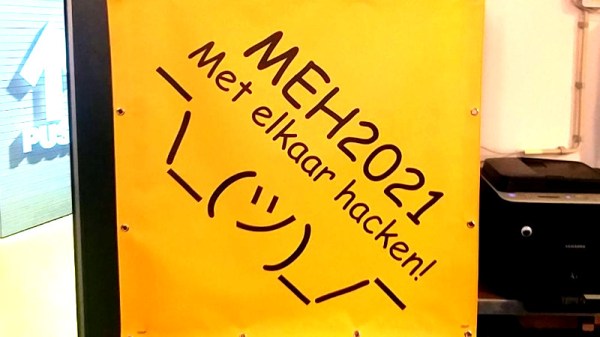
Header image: [Renze]. “Met Elkaar Hacken” means something close to “Hack together”.

Hackaday Prize China Finalists Announced

In the time since the Hackaday Prize was first run it has nurtured an astonishing array of projects from around the world, and brought to the fore some truly exceptional winners that have demonstrated world-changing possibilities. This year it has been extended to a new frontier with the launch of the Hackaday Prize China (Chinese language, here’s a Google Translate link), allowing engineers, makers, and inventors from that country to join the fun. We’re pleased to announce the finalists, from which a winner will be announced in Shenzhen, China on November 23rd. If you’re in Shenzen area, you’re invited to attend the award ceremony!

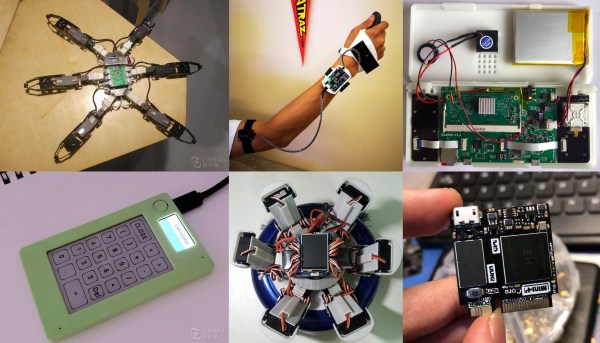
All six of these final project entries have been translated into English to help share information about projects across the language barrier. On the left sidebar of each project page you can find a link back to the original Chinese language project entry. Each presents a fascinating look into what people in our global community can produce when they live at the source of the component supply chain. Among them are a healthy cross-section of projects which we’ll visit in no particular order. Let’s dig in and see what these are all about!

Continue reading “Hackaday Prize China Finalists Announced” →

Get Dirty In Your Quest For Power!

A fascinating oddity in the list of potential alternative power sources is the microbial fuel cell, in which the chemical reactions of micro-organisms digesting their food are harnessed to harvest electrons and thus generate electrical current. We’d like to know more, so [Williamolyolson]’s soil microbial fuel cell is a particularly interesting glimpse into this field.

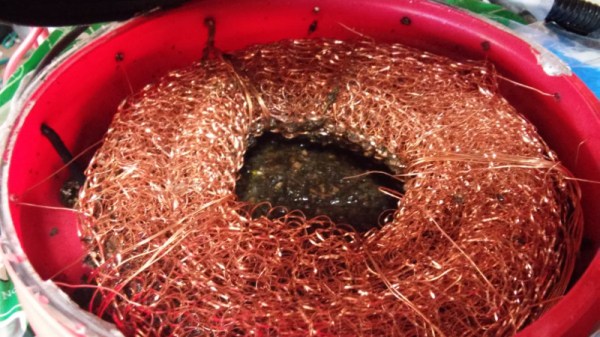
In this type of cell, an anode is placed at the bottom of a container of anaerobic wet soil medium laced with biomass to provide a food source for the bacteria, and a cathode is placed on the top of the medium exposed to air. The cell in this project appears to be a plastic coffee tub, and the electrodes are copper pan scourers. Unlike a chemical battery they do not need to be different materials and they themselves are not part of the chemistry of the cell, instead, they serve to collect and return the electrons to the cell.

The project logs detail a series of time-series measurements and experiments with placement of the cathode. Yield seems to be in the region of 200mV at about 1mA, though peaks as high as 400mV have been seen. It’s clear that this is not a cell that will replace your grid hook-up any time soon, but it still retains a lot of possibilities for use in micropower applications. There has been plenty of work in the field of micropower harvesting using other sources such as small solar cells, and this has the advantage of microbe-laden dirt being ubiquitous and free.

A couple of previous MFCs we’ve brought you include this multi-cell design said to be capable of charging a phone, and this cell that also supports a fish.