Not All 7-Segment Displays Are Electronic

There are a variety of means by which numbers can be displayed from an electronic circuit, and probably the most ubiquitous remains the seven-segment display. Take seven LEDs, lamps, LCDs, VFD segments or mechanical flip-dot style units in the familiar rectangular figure eight, and your microcontroller or similar can display numbers. There are a variety of different interfaces, but at most all that is needed is a level shifter and a driver.

Sometimes though we encounter a completely novel 7-segment display, and such is the case with [Fhuable]’s all mechanical single digit display. It bears a superficial resemblance to a flipdot display, but instead of a magnetic actuator, it instead uses a complex system of gears and cams to flip the segments sequentially from the turning of a small crank. It appears to be the same mechanism he’s used in his subscription counter project whose video we’ve placed below the break, and it is truly a thing of beauty. We’re not entirely certain how useful it would be as a general-purpose display in its current form, however, we can see it being adapted with relative ease. A clock might, for example, be an eye-catching project.

Most displays that make it here have some electrical components, so it’s unusual to see an entirely mechanical one. But that’s not necessarily always the case.

Continue reading “Not All 7-Segment Displays Are Electronic” →

Quality Sound-Proof Cans From Personal Protective Equipment

Working in a noisy office can be distracting. To combat the problem in his workplace [Rikard Anglerud] bought himself a pair of 3M ear defenders. They were good, but not quite good enough to completely extinguish the noise, so he inserted the drivers from a pair of cheap headphones and played a low-level white noise. This prototype proved effective, so he returned to the project and produced a much nicer pair that approach much more costly cans in their execution.

[Rikard’s] first set of headphones left something to be desired in the quality department. The second set followed with a pair of better-quality drivers sourced online, and more care was taken with cable routing and in their fitting. Finally some filler was used to remove the moulded 3M branding, and make them look more hi-fi than workwear.

From an audiophile perspective these cans might not approach a very high quality pair because their drivers are unlikely to be matched to the acoustic properties of their enclosures. But it sounds as though he’s achieved an adequate result despite that, and completely satisfied his need to exclude office noise.

Tools, You Can’t Take Them With You

When I die I hope be buried in the English rural churchyard that has been my responsibility as churchwarden, after a funeral service that has been a celebration of my life. I am neither an Egyptian pharaoh nor a Viking queen though, so my grave will not contain all my tools and equipment to serve me in the afterlife. Instead aside from my mortal remains it will contain only a suitably biodegradable coffin, and my headstone will be a modest one bearing perhaps a technical puzzle to entertain visitors to the churchyard.

My workshop, my bench, and my tools will be the responsibility of my nearest and dearest, and I hope I will have suitably equipped them for the task of their dispersal. But for anyone who has a sizeable collection of gear, have you thought of what would happen if someone else had to clean it all out? What is profession for some and hobby for others, we deal in specialization that might as well be tools of arcane magic to the uninitiated.

Continue reading “Tools, You Can’t Take Them With You” →

Connected World Contest: Four Top Winners Announced

We love seeing the astonishing array of projects large and small entered into Hackaday contests which push the boundaries of what is possible. Our latest has been the Connected World contest which was announced back in June, and today we’re pleased to bring you its four top winners. As a recap, the brief was to create something that connects wirelessly and shows a blend of creativity and functionality. The final four have a diverse range of applications, and here they are with their respective categories:

Continue reading “Connected World Contest: Four Top Winners Announced” →

Europeans Now Have The Right To Repair – And That Means The Rest Of Us Probably Will Too

As anyone who has been faced with a recently-manufactured household appliance that has broken will know, sometimes they can be surprisingly difficult to fix. In many cases it is not in the interests of manufacturers keen to sell more products to make a device that lasts significantly longer than its warranty period, to design it with dismantling or repairability in mind, or to make spare parts available to extend its life. As hardware hackers we do our best with home-made replacement components, hot glue, and cable ties, but all too often another appliance that should have plenty of life in it heads for the dump.

Czech waste management workers dismantle scrap washing machines. Tormale [CC BY-SA 3.0].
If we are at a loss to fix a domestic appliance then the general public are doubly so, and the resulting mountain of electrical waste is enough of a problem that the European Union is introducing new rules governing their repairability. The new law mandates that certain classes of household appliances and other devices for sale within the EU’s jurisdiction must have a guaranteed period of replacement part availability and that they must be designed such that they can be worked upon with standard tools. These special classes include washing machines, dishwashers, refrigerators, televisions, and more.

Let’s dig into the ramifications of this decision which will likely affect markets beyond the EU and hopefully lead to a supply of available parts useful for repair and beyond.

Continue reading “Europeans Now Have The Right To Repair – And That Means The Rest Of Us Probably Will Too” →

This Hurricane Uses A Novel Technique

You’ve probably heard of the brave pilots, the so-called ‘few’, that took to the air in their Supermarine Spitfires and saved the day during the Battle of Britain. It’s a story that contains a lot of truth, but as is so often the case, it masks a story with a bit more complexity. Those pilots did scramble across the airfields of Southern England back in the summer of 1940, but more of them went into battle behind the controls of a Hawker Hurricane than its more glamorous stablemate.

The Hurricane might have been eclipsed by the Spitfire in the public’s eye, but not for [Marius Taciuc], who’s made a fully-functional RC model of one. Normally that wouldn’t be worthy of our attention, but in this case he’s employed a rather fascinating construction technique. He’s recreated the doped-fabric skin of the original by 3D-printing the frame of the aircraft and covering it in heat-shrink film, making this a very rare bird indeed.

The video below takes us through the steps including the development of the frame in a CAD package based on a tracing of a 2D aircraft picture, fitting the film, and finally attempts at flight that are unfortunately foiled by inappropriate wheel choice. But the short flight and crash does demonstrate that this construction method is durable, which leads on to our interest in it. While it evidently makes a functional aircraft, there are other applications that could benefit from such a lightweight and strong combination of materials.

[Marius] actually created a model of the somewhat more photogenic Spitfire using a similar technique, though as far as we can tell, that one has remained grounded. Incidentally, these pages have been previously graced by Hurricanes of the non-PLA variety. Continue reading “This Hurricane Uses A Novel Technique” →

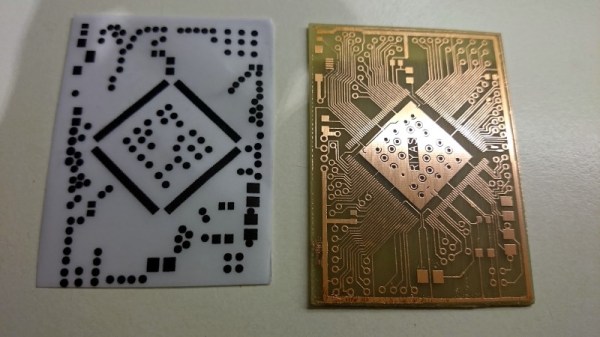
This Home-Etched ARM Dev Board Is A Work Of Art

One of the step changes in electronic construction at our level over the last ten or fifteen years has been the availability of cheap high-quality printed circuit boards. What used to cost hundreds of dollars is now essentially an impulse buy, allowing the most intricate of devices to be easily worked with. Many of us have put away our etching baths for good, often with a sigh of relief.

We’re pleased that [Riyas] hasn’t though, because they’ve etched an STM32 dev board that if we didn’t know otherwise we’d swear had been produced professionally. It sports a 176-pin variant of an STM32F4 on a single-sided board, seemingly without the annoying extra copper or lack-of-copper that we remember from home etching. We applaud the etching skill that went into it, and we’ll ignore the one or two boards that didn’t go entirely to plan. A coat of green solder mask and some tinning, and it looks for all the world as though it might have emerged from a commercial plant. All the board files are available to download along with firmware samples should you wish to try making one yourself, though we won’t blame you for ordering it from a board house instead.

It’s always nice to see that single board computers are not the sole preserve of manufacturers. If the RC2014 Micro doesn’t isn’t quite your style, there’s always the Blueberry Pi which features a considerably higher penguin quotient.