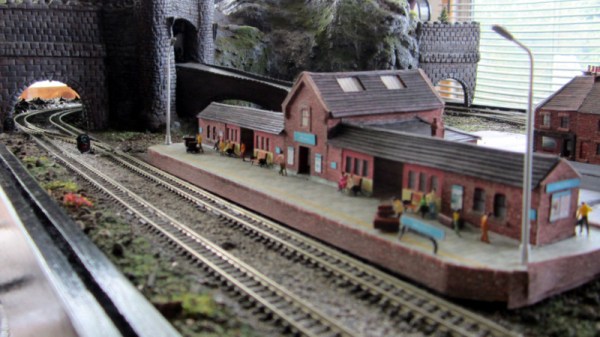
If you were a British kid at any time from the 1950s to the 1980s, the chances are that your toy shop had a train set in it. Not just any train set, but a full model railway layout in a glass case roughly the size of a pool table, with a button that when pressed started a timer and set a little tank engine off on a circuit with a pair of coaches. Magical for a generation raised on black-and-white TV, but probably not something that would cut it with today’s youth. A modern take on the glass-case layout comes from [Jack Flynn], who has created a coffee table with an automated and computerised N-gauge railway layout inside it. And this is definitely a railway rather than a railroad, the main locomotive is a Brush Type 4, a British Rail Class 47 diesel.
The modelling is a work of art, with a slightly idealised British street scene in an oval of double track against a backdrop of a rocky hillside. In the hill is an unexpected surprise which you can see on the video we’ve placed below the break, and beneath it lie the electronics. A Teensy handles the track switching and all the various LED lights around the board, a Sprog DCC controller takes care of the trains, and overseeing everything is a Raspberry Pi running some custom software in Python with a web interface for control. We probably wouldn’t be able to resist a bit of remote-control railway action if our coffee table had a layout like this one!
When we recently discussed the skills that we might wish to impart upon a youngster, one of those discussed was the ability to speak more than one language. If any demonstration were required as to why that might be the case, it comes today in [Byfeel]’s Notif’Heure, an ESP8266-powered clock and display (French-language, Google Translate link). If we only watch for English-language projects, we miss much of the picture.
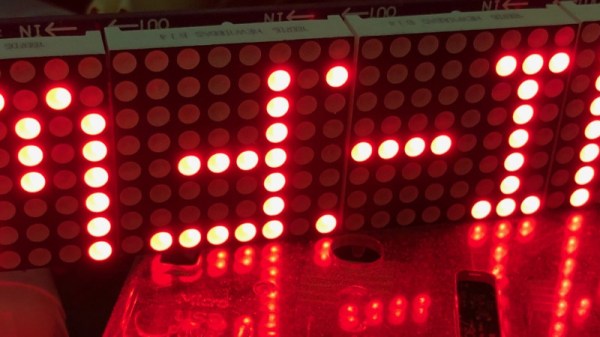
The project began life in April 2018 (Google Translate link) and has since speedily progressed through many software versions to the current v3.2. In hardware terms it’s pretty simple: an ESP8266 development board drives a set of LED matrix displays. In the software though it has the primary function of an NTP-synchronised clock, there is also support for notification display and integration with the Jeedom home automation package.
We’ve featured innumerable ESP8266 clocks over the years, but surprisingly this is the first one with Jeedom integration. With so many to choose from it’s difficult to pick examples to show you, so perhaps it’s time to go to the truly ridiculous with this twelve-ESP monster.
Commuting through the urban sprawl of a 21st century city brings exposure to significant quantities of pollution. For a Medway Makers member that meant the Isle of Dogs, London, and a drive through the Blackwall Tunnel under the Thames. When you can taste the pollution in the air it’s evident that this isn’t the best environment to be in, but just how bad is it? Time to put together an environmental monitoring and recording rig.
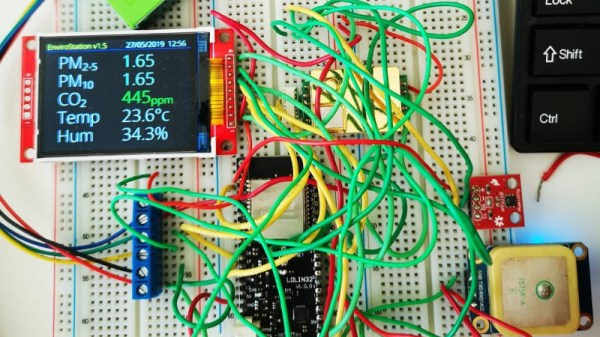
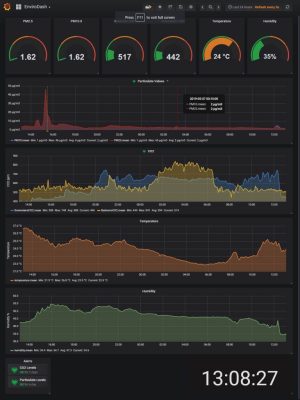
Into the build went an ESP32 module, an SPS30 particulate sensor, an MH-Z19 CO₂ sensor, an HTU21D temperature and humidity sensor, and a uBlox NEO 6M GPS module. The eventual plan is to add an SD card for data logging, but in the absence of that it connects to a Raspberry Pi running Grafana over InfluxDB for data analysis. The result provides a surprising insight into the environmental quality of not just a commute but of indoor life. We’re sorry to say that they don’t seem to have posted any of the code involved onto the Medway Makers writeup, though we hope that’s an oversight they’ll rectify by the time this has gone live.
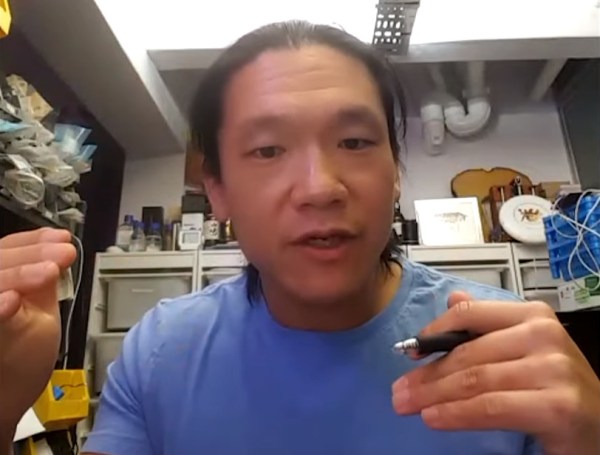
Andrew “Bunnie” Huang’s mentor session for the Hackaday Prize shows off the kind of experience and knowledge hard to come by unless you have been through the hardware development gauntlet countless times. These master-classes match up experts in product development with Prize entrants working to turn their projects into products. We’ve been recording them so that all may benefit from the advice and guidance shared in each session.
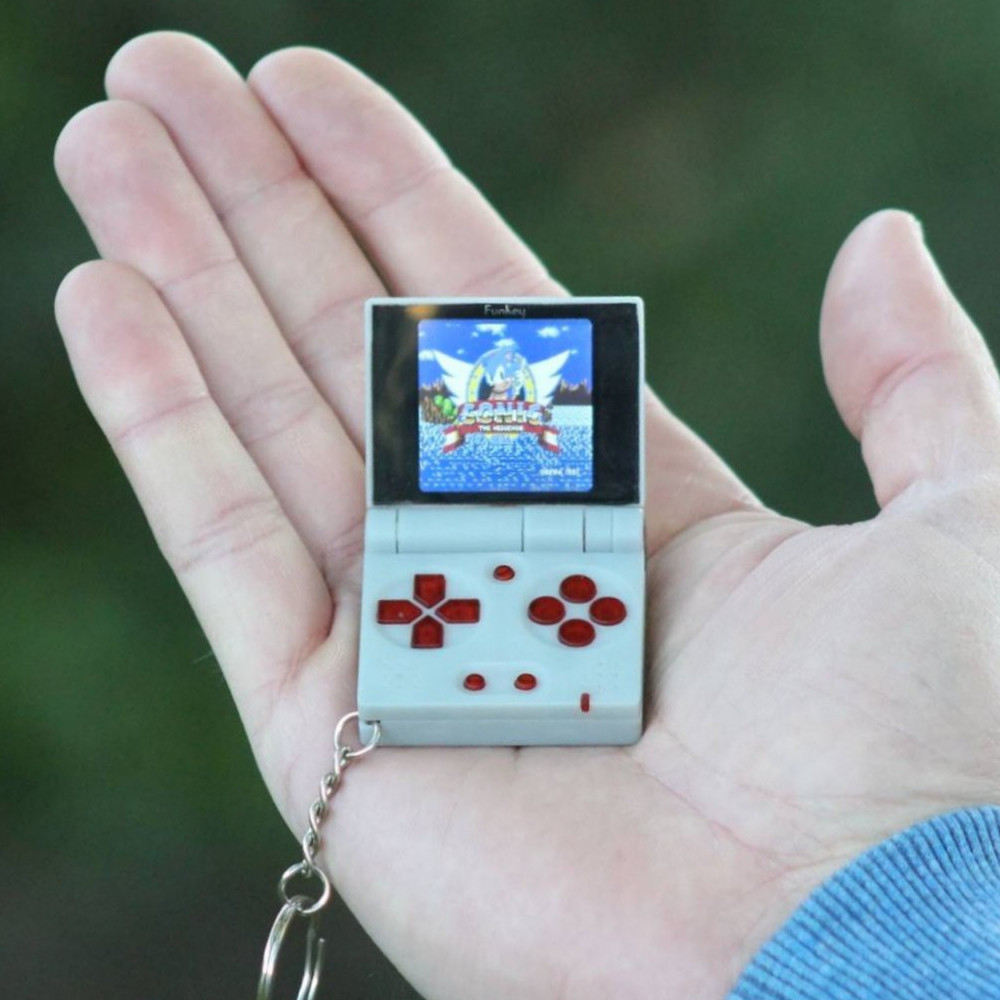
The appealing little FunKey pocket gaming platform.
Bunnie is someone who is already familiar to most Hackaday readers. His notoriety in our community began nearly two decades ago with his work reverse engineering the original Microsoft X-box, and he quickly went on to design (and hack) the Chumby Internet appliance, he created the Novena open-source laptop, and through his writing and teaching, he provides insight into sourcing electronic manufacture in Shenzhen. He’s the mentor you want to have in your corner for a Hackaday Prize entry, and that’s just what a lucky group had in the video we’ve placed below the break.
While this session with Bunnie is in the bag it’s worth reminding you all that we are still running mentor sessions for Hackaday Prize entrants, so sign up your entry for a chance to get some great feedback about your project.
The first team to meet with Bunnie are FunKey, whose keychain Nintendo-like handheld gaming platform was inspired by a Sprite_tm project featuring a converted novelty toy. The FunKey team have produced a really well-thought-out design that is ready to be a product, but like so many of us who have reached that point they face the impossible hurdle of turning it into a product. Their session focuses on advice for finding a manufacturing partner and scaling up to production.
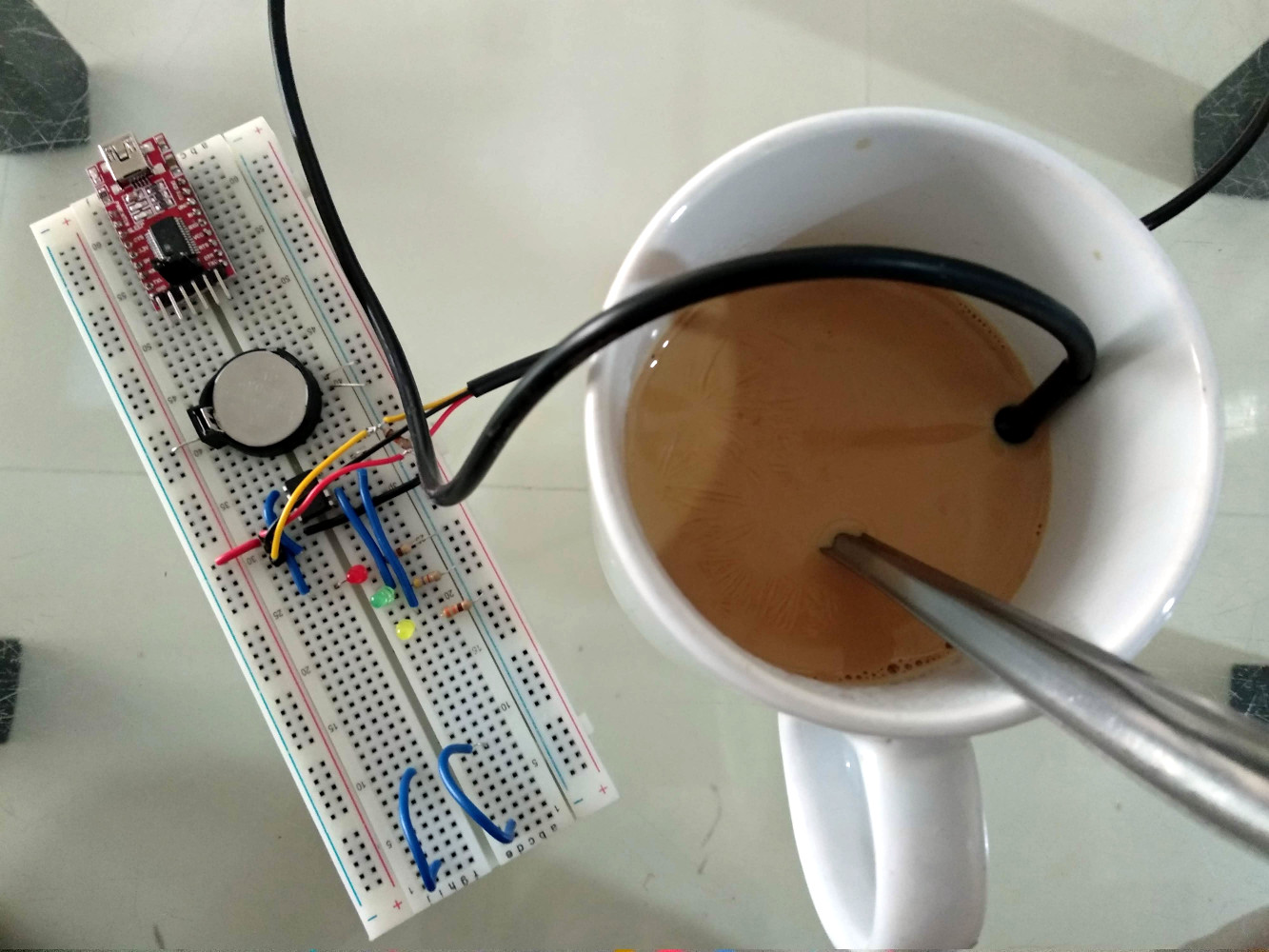
A prototype HotorNot Coffee Stirrer, showing their problem of having to maintain food-safe components.
HotorNot Coffee Stirrer is trying to overcome a problem unique to their food-related project. A hot drink sensor that has to go in the drink itself needs to be food safe, as well as easy enough to clean between uses. A variety of components are discussed including a thermopile on a chip that has the advantage of not requiring contact with the liquid, but sometimes the simplest ideas can be the most effective as Bunnie reminds us that a cheap medical thermometer teardown can tell us a lot about appropriate parts for this application.
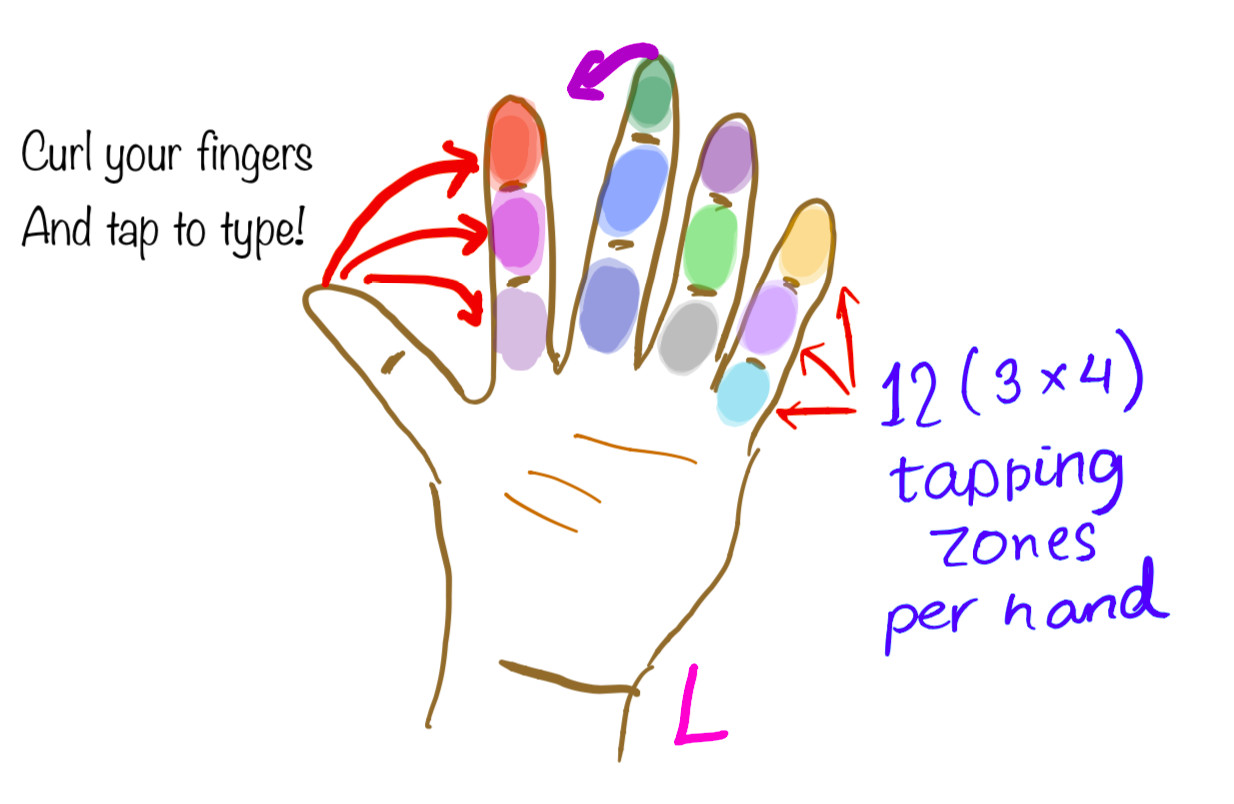
The idea behing PhalangePad is an attractive one, but making those sensors reliable is no trivial eercise.
It’s another component choice problem that vexes PhalangePad, an input device that relies on the user tapping the inside of their fingers with their thumb. It’s a great idea, but how should these “keypresses” be detected? Would you use a capacitive or magnetic sensor, a force sensitive resistors, or maybe even machine vision? Here Bunnie’s encyclopaedic knowledge of component supply comes to the fore, and the result is a fascinating insight into the available technologies.
We all amass a huge repository of knowledge as we pass through life, some of the most valuable of which is difficult to pass on in a structured form and instead comes out as incidental insights. An engineer with exceptional experience such as Bunnie can write the book on manufacturing electronics in China but still those mere pages can only scratch the surface of what he knows about the subject. There lies the value of these mentor sessions, because among them the gems of knowledge slip out almost accidentally, and if you’re not watching, you’ll miss them.
It looks like a ship when it is in port or in transit, and when it use you’d think it’s about to sink. The RP FLIP (for “FLoating Instrument Platform) is an unpowered research buoy with a very special design designed to provide the most stable and vibration-free platform possible for scientists studying the properties of the sea.
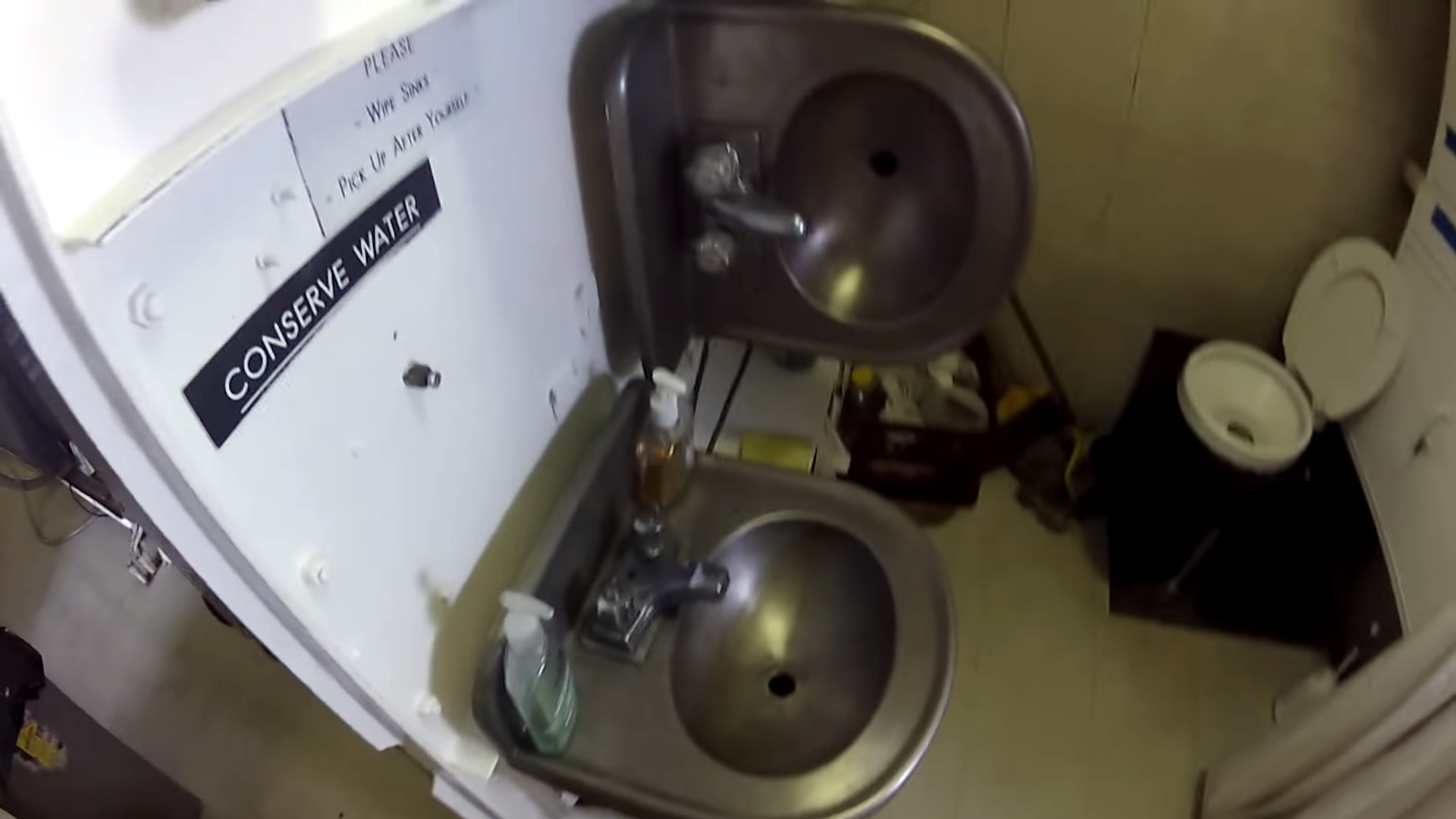
RP FLIP interrior bathroom design has two sinks mounted at 90 degree angles.
Scientific research often places demanding requirements upon existing infrastructure, requiring its own large projects tailored to their individual task. From these unusual needs sometimes come the most curious buildings and machinery. RP FLIP is designed to provide the most stable and vibration-free platform possible for scientists studying the properties of the sea. By flooding tanks in its bow it transfers from horizontal and floating on the surface to vertical and half-submerged when it is deployed. With its stern protruding from the water and pointing skywards it has the appearance of a sinking ship. What’s really neat is that its interior is cleverly designed such that its crew can operate it in either horizontal or vertical positions.
The original impetus for FLIP’s building was the US Navy’s requirement to understand the properties of sound waves in the ocean with relation to their submarines and presumably also those of their Soviet adversaries. Research submarines of the 1950s were not stable enough for reliable measurements, and the FLIP, launched in 1962, was built to address this by providing a far more stable method of placing a hydrophone at depth. Since then it has participated in a significant number of other oceanographic studies as diverse as studying the propagation of waves across the Pacific, and the depth to which whales dive.
The videos below should give a good introduction to the craft. The first one is a glossy promotional video from its operator, the Scripps Institution Of Oceanography, on its 50th anniversary, while the lower of the two is a walkaround by a scientist stationed aboard. In this we see some of the features for operating in either orientation, such as a toilet facilities mounted at 90 degrees to each other.
It appears that FLIP is in good order and with continuing demand for its services that should see it still operating well into the future. Those of us who live near Atlantic waters may never see it in person but it remains one of the most unusual and technically intriguing vessels afloat.
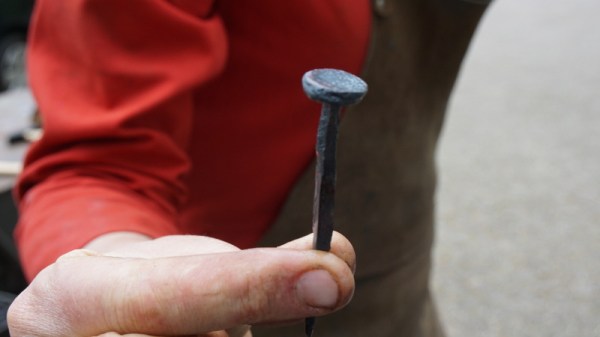
If for some reason I were to acknowledge the inevitability of encroaching middle age and abandon the hardware hacker community for the more sedate world of historical recreation, I know exactly which band of enthusiasts I’d join and what period I would specialise in. Not for me the lure of a stately home in Regency England or the Royal court of Tudor London despite the really cool outfits, instead I would head directly for the 14th century and the reign of King Edward the Third, to play the part of a blacksmith’s wife making nails. It seems apposite to pick the year 1337, doesn’t it.
Why am I so sure? To answer that I must take you to the British Library, and open the pages of the Holkham Bible. This is an illustrated book of Biblical stories from the years around 1330, and it is notable for the extent and quality of its illuminations. All of mediaeval life is there, sharply observed in beautiful colour, for among the Biblical scenes there are contemporary images of the people who would have inhabited the world of whichever monks created it. One of its more famous pages is the one that caught my eye, because it depicts a woman wearing a blacksmith’s apron over her dress while she operates a forge. She’s a blacksmith’s wife, and she’s forging a mediaeval carpenter’s nail. The historians tell us that this was an activity seen as women’s work because the nails used in the Crucifixion were reputed to have been forged by a woman, and for that reason she is depicted as something of an ugly crone. Thanks, unknown mediaeval monk, you really don’t want to know how this lady blacksmith would draw you! Continue reading “Making A Mediaeval Nail”→
Apple released a monitor stand not so long ago with an eye-watering price tag, and in the resulting fuss you might almost be forgiven for missing the news that they also released a new computer. The distinctive grille on the new Mac Pro caused some interest among Hackaday editors, with speculation rife as to how it had been machined. It seems we’re not alone in this, because [J. Peterson] sent us a link to his own detailed analysis.
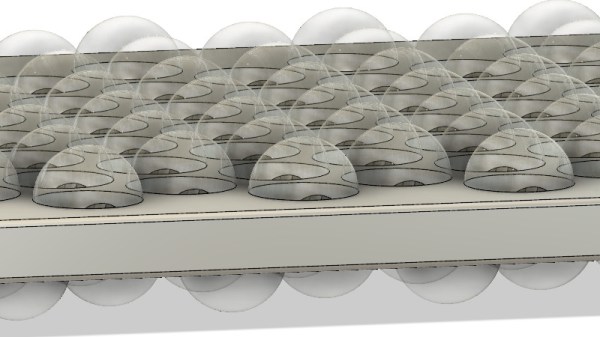
The key to the pattern lies in hemispherical holes milled part-way-through a piece of metal on a triangular tessellation, and intersecting with an identical set of holes milled at an offset from the other side. The analysis was done purely from online information as he doesn’t have a real Mac Pro, but using some clever trigonometry he is able to calculate the required offset as well as the hole depth. There are some STL files on Thingiverse, for the curious.
Should you wish to make your own copy of a Mac Pro grille you should therefore be able to use this information in programming a CNC mill to carve it from a piece of alloy plate. The interesting side of it from a manufacturing perspective though is that this is a complex shape that would be difficult to produce in numbers without either CNC or a very specialist one-off machine tool for this single purpose, and neither is a normal expenditure for a mere grille. Perhaps you might come close by rolling alloy plate between rollers whose profile matched the hole pattern, but in that event you would not equal the finish that they have achieved. Apple’s choice to use a relatively time-intensive CNC process in mass-production of a cosmetic part is probably in a large part a quality statement for their particular brand of consumer, but also sets a high bar to any would-be imitators. We applaud it for its engineering, even if we won’t be shelling out for that monitor stand.

 Commuting through the urban sprawl of a 21st century city brings exposure to significant quantities of pollution. For a Medway Makers member that meant the Isle of Dogs, London, and a drive through the Blackwall Tunnel under the Thames. When you can taste the pollution in the air it’s evident that this isn’t the best environment to be in, but just how bad is it? Time to put together