Large format photography gives a special quality to the images it produces, due to the differences in depth of field and resolution between it and its more modern handheld equivalents. Projecting an image the size of a dinner plate rather than a postage stamp has a few drawbacks though when it comes to digital photography, sensor manufacturersdo not manufacture consumer products at that size.
[Zev Hoover] has created a large format digital camera, and is using it not only for still images but for video. And it’s an interesting device, for the way he’s translated a huge large-format image into a relatively small sensor in a modern SLR. He’s projecting the image from the large-format lens and bellows onto a screen made from an artist’s palette, a conveniently available piece of bright white plastic, and capturing that image with his SLR mounted beneath the large-format lens assembly. This would normally cause a perspective distortion, but to correct that he’s mounted his SLR lens at an offset.
He does point out that since less light reaches the camera there is also a change in the ISO setting on the camera, but once that has been taken into account it performs satisfactorily. The result is a camera that allows something rather unusual, for Victorian-style large-format images to come to life as video. He demonstrates it in the video below, complete with friends in suitably old-fashioned looking steampunk attire.
In parts of the world where it snows a lot and there are requirements for homeowners to keep sidewalks clear, a personal snowblower is it seems an essential piece of equipment. They have traditionally used internal combustion engines, but electric models are also available.
[Joel Clemens] is not impressed by the commercial electric blowers available to him as an American, because their 120 V mains supply just can’t deliver the power to make an effective two-stage design. So he’s built his own using a formerly gasoline-powered blower from a garage sale, and a 240 V industrial motor.
The blower is an impressive piece of equipment even if his running it close to its own cord does look rather hazardous. But the video is also of interest for its examination of the state of access to 240 V outlets for Americans. [Joel] has one for his electric vehicles, and has made a splitter box to give him the required American-style 240 V industrial connector. He makes the point that this is becoming more common as the take-up of electric vehicles gathers pace.
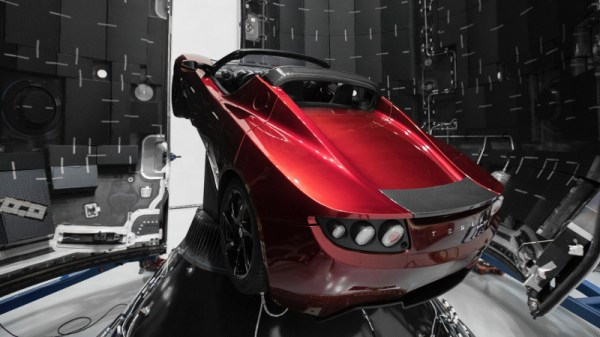
We’ve been having a lively discussion behind the scenes here at Hackaday, about SpaceX’s forthcoming launch of their first Falcon Heavy rocket. It will be carrying [Elon Musk]’s red Tesla Roadster, and should it be a successful launch, it will place the car in an elliptical orbit round the Sun that will take it to the Martian orbit at its furthest point.
On one hand, it seems possible that [Musk]’s sports car will one day be cited by historians as the exemplar of the excesses of the tech industry in the early 21st century. After all, to spend the millions of dollars required to launch the largest reusable space launch platform ever created, and then use it to hurl an electric vehicle into orbit round the Sun seems to be such a gratuitous waste of resources, an act of such complete folly as to be criminal.
Surely even given that there is a reasonable chance of a first launch ending in fiery destruction it must be worth their while canvassing the universities and research institutions of the world with the offer of a free launch, after all there must be a significant amount of science that would benefit from some cost-free launch capacity! It seems a betrayal of the famous “Why explore space” letter from the associate science director of NASA to a nun who questioned the expenditure while so many in the developing world were starving.
Testing
But on the other hand, first launches of rockets are a hazardous endeavour, as the metaphorical blue touchpaper is lit on the world’s largest firework for the first time. Satellites are expensive devices, and it would be a foolhardy owner who entrusted their craft to a launch vehicle with a good chance of a premature splashdown.
Launch of first Arianne 5. Not where you want your pricey satellite.
First launches traditionally carry a ballast rather than a payload, for example NASA have used tanks of water for this purpose in the past. SpaceX has a history of novelty payloads for their test launches; their first Dragon capsule took a wheel of cheese into space and returned it to Earth. We picture Musk looking around a big warehouse and saying, “well, we got a lot of cars!”
There is a fascinating question to be posed by the launch of the car, just what did they have to do to it to ensure that it could be qualified for launch? Satellite manufacture is an extremely exacting branch of engineering, aside from the aspect of ensuring that a payload will work it must both survive the launch intact and not jeopardise it in any way. It’s safe to say that the Roadster will not have to function while in orbit as the roads of California will be far away, but cars are not designed with either the stresses of launch or the transition to zero gravity and the vacuum of space in mind. Will a glass windscreen originally specified for a Lotus Elise on the roads of Norfolk shatter during the process and shower the inside of the craft with glass particles, for example? There must have been an extensive space qualification programme for it to pass, from vibration testing through removal of any hazards such as pressurised gases or corrosive chemicals, if only the folks at SpaceX would share some its details that would make for a fascinating story in itself.
Space Junk
So the Tesla Roadster is a huge publicity stunt on behalf of SpaceX, but it serves a purpose that would otherwise have to have been taken by an unexciting piece of ballast. It will end up as space junk, but in an orbit unlikely to bring it into contact with any other craft. If its space-suited dummy passenger won’t be providing valuable data on the suit’s performance we’d be extremely surprised, and when it is finally retrieved in a few centuries time it will make a fascinating exhibit for the Smithsonian.
Given a huge launch platform and the chance to fill it with a novelty item destined for orbit,the Hackaday team stepped into overdrive with suggestions as to what might be launched were they in charge. They varied from Douglas Adams references such as a heart of gold or a whale and a bowl of petunias should the rocket abort and the payload crash to earth, to a black monolith and a few ossified ape remains to confuse space historians. We briefly evaluated the theory that the Boring Company is in fact a hiding-in-plain-sight construction organisation for a forthcoming Evil Lair beneath the surface of Mars, before concluding that maybe after all the car is a pretty cool thing to use as ballast for a first launch.
It may be reaching towards seven decades since the first space programmes successfully sent rockets beyond the atmosphere with the aim of exploration, but while the general public has become accustomed to them as routine events they remain anything but to the engineers involved. The Falcon Heavy may not have been developed by a government, but it represents every bit as astounding an achievement as any of its predecessors. Flinging an electric vehicle into orbit round the Sun is a colossal act of showmanship and probably a waste of a good car, but it’s also more than that. In hundreds of years time the IoT devices, apps, 3D printers, quadcopters or whatever else we toil over will be long forgotten. But there will be a car orbiting the Sun that remains a memorial to the SpaceX engineers who made its launch possible, assuming it doesn’t blow up before it gets there. What at first seemed frivolous becomes very cool indeed.
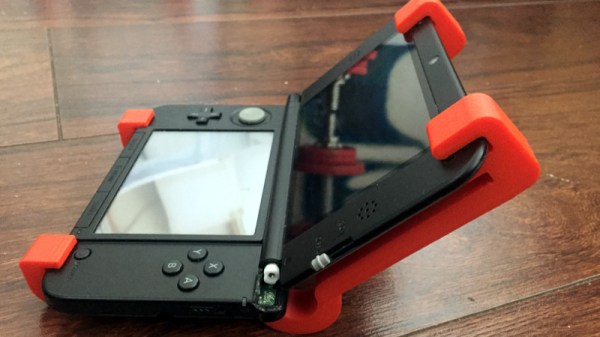
Handheld game consoles have a hard life, and even the most well-built models can sometimes fail. The Nintendo 3DS XL, for example, can fail at its hinge, which is what happened to the one owned by [Mark]. Would he fix the hinge? No, he had a far simpler if a little less flexible solution, a 3D-printed bracket that clips over the whole device.
Sometimes the best pieces of work are also the simplest ones, and this one certainly fits that bill on both counts. When your console dies, you want it fixed, and though this doesn’t extend as far as providing a working hinge action it should allow you to play without further damaging anything. It’s not impossible to imagine that it could be made to incorporate a flexible zig-zag section to produce a closeable hinge, but if your Nintendo is broken you’ll care little for such niceties. The project can be downloaded from its Thingiverse page.
A common failure that we’d expect to accompany a broken hinge would be a faulty flexible ribbon cable. Fortunately, those are fixable on the 3DS, too.
Single-board computers, usually featuring ARM processors, have revolutionized the world of the hardware hacker over the last decade. The computing power you would have found in a desktop computer not so long ago, mounted on a small PCB and powered from a mobile phone charger.
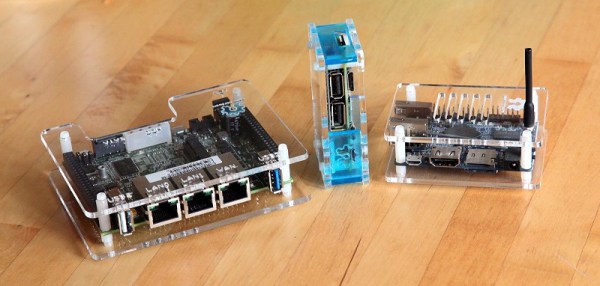
With a few notable exceptions though, these single board computers are just that, boards. No cases in the pack, which has, of course, spawned a huge aftermarket of commercial offerings and a pile of homemade ones of varying sophistication. If these homemade offerings are your fancy then today’s link may be of interest, some very well-designed laser-cut cases from [Nick Smith] for a selection of popular and less well-known boards.
The Orange Pi Lite and Raspberry Pi Zero are both familiar enough, but one of the delights of writing for Hackaday reveals itself in the discovery of the more esoteric Marvell ESPRESSObin, an SBC with multiple network ports and serial ATA.
Scientific instruments are expensive. In a lot of cases, really expensive, so if you have spent any time in a well-equipped lab, the chances are that it would have been one backed up by the resources of a university, or a large company. Those experimenters who wish to pursue such matters outside those environments have traditionally had to rely on obsolete instruments from the surplus market. A fascinating endeavor in itself, but one that can sometimes limit the opportunity to pursue science.
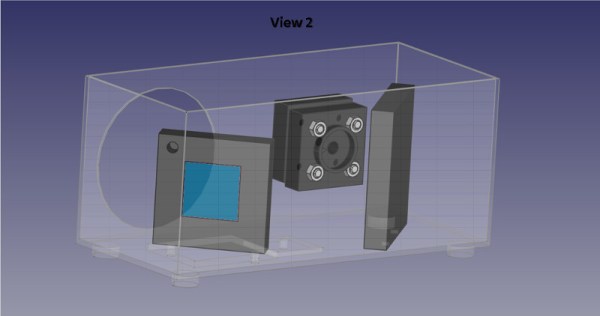
It has been interesting then to see the impact of the arrival of affordable 3D printing on the creation of self-built scientific instruments. A fantastic example has come our way, [David H Haffner Sr]’s 3D printable Raman probe. A Raman spectroscope is an instrument in which the light scattered from the sample exposed to an incident monochromatic source is collected, as opposed to that reflected or transmitted through it. Scattered light can be a huge magnitude weaker than other modes, thus the design of a Raman probe is critical to its success. (If you are curious, read this multi-part explanation on Raman spectroscopy.)
This is a work in progress at the time of writing, but it still makes for an interesting examination of Raman probe design. Interestingly the sensor is a standard DSLR camera, which though not a cheap device is possibly more affordable than a more dedicated sensor.
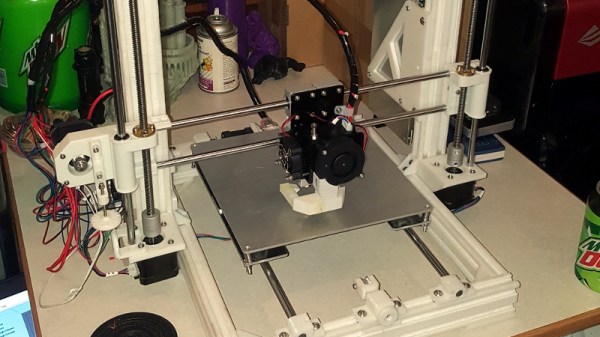
It is over a decade since the RepRap project was begun, originally to deliver 3D printers that could replicate themselves, in other words ones that could print the parts required to make a new printer identical to themselves. And we’re used to seeing printers of multiple different designs still constructed to some extent on this principle.
The problem with these printers from a purist replicating perspective though is that there are always frame parts that must be made using other materials rather than through the 3D printer. Their frames have been variously threaded rod, lasercut sheet, or aluminium extrusion, leaving only the fittings to be printed. Thus [Chip Jones]’ Thingiverse post of an entirely 3D printed printer frame using a 3D printed copy of aluminium extrusion raises the interesting prospect of a printer with a much greater self-replicating capability. It uses the parts from an Anet A8 clone of a Prusa i3, upon which it will be interesting to see whether the 3D printed frame lends the required rigidity.
There is a question as to whether an inexpensive clone printer makes for the most promising collection of mechanical parts upon which to start, but we look forward to seeing this frame and its further derivatives in the wild. Meanwhile this is not the most self-replicating printer we’ve featured, that one we covered in 2015.