TiLDA MKπ, The EMF Camp 2016 Badge

The Scottish Consulate has stamped its last passport, the Dutch fire tower has belched its final flame, and the Gold Members Lounge has followed the Hacienda and the Marquee into clubland oblivion. EMF Camp 2016 is over, so all the 1500 or so attendees have left are the memories, photographs, and festival diarrhoea to remind them of their three days in the Surrey countryside.

Well, not quite all, there is the small matter of the badge.

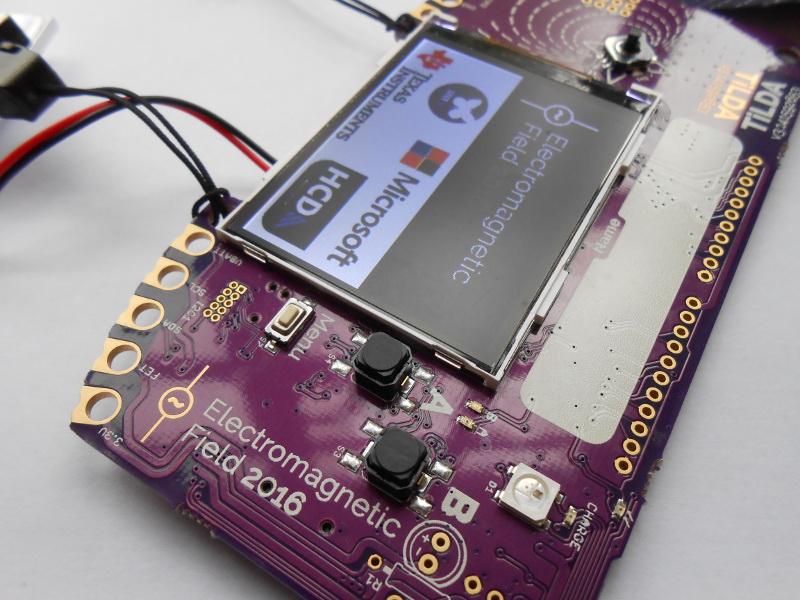
In the case of EMF 2016 it was called TiLDA MKπ, and since there was a point earlier in the year when it seemed the badge might never see the light of day it represents a significant achievement from the EMF badge team.

The badge features an STM32L486VGT6 ARM Cortex M4 running at 80MHz, a 320×240 pixel colour LCD, magnetometer and accelerometer, and a CC3100 WiFi processor. The firmware provides a simple interface to an app store containing an expanding array of micropython apps from both the EMF Camp team and submitted by event attendees. As shipped the badge connects to one of the site networks, but this can be adjusted to your own network after the event. It’s been designed for ease of hacking, requiring only a USB connection and mounting as a disk drive without need for special software or IDE. A comprehensive array of I/O lines are brought out to both 0.1″ pitch pins and 4mm edge-mounted holes. At the EMF Camp closing speeches there was an announcement of a competition with a range of prizes for the best hardware and software uses for the badge.

shane-tweetThe TiLDA causes a sticky moment for our colleague, Tindie scribe Shane.
The TiLDA causes a sticky moment for our colleague, Tindie scribe Shane.

As is so often the case the badge was not without its teething troubles, as the network coped with so many devices connecting at once and the on-board Neopixel turned out to have been mounted upside down. Our badge seemed to have a bit of trouble maintaining a steady network connection and apps frequently crashed with miscellaneous Python errors, though a succession of firmware updates have resulted in a more stable experience. But these moments are part of the badge experience; this is after all an event whose attendees are likely to have the means to cope with such problems.

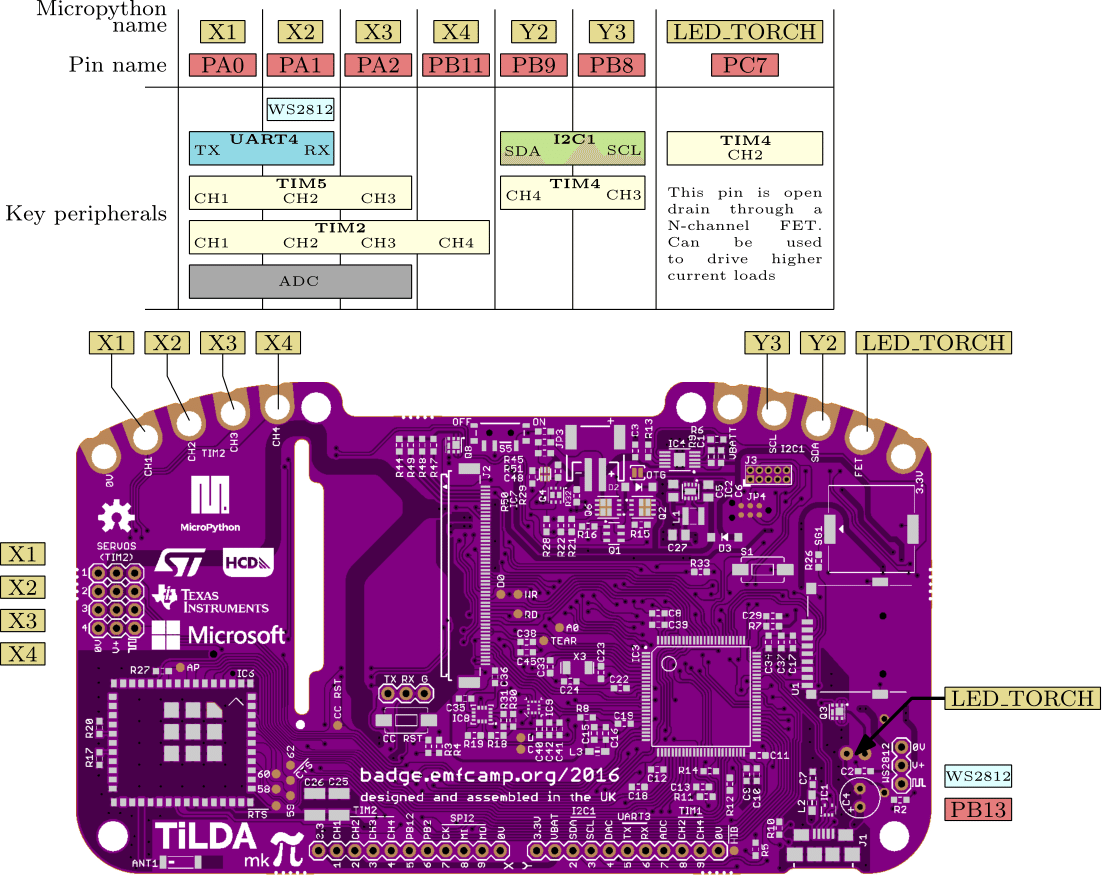
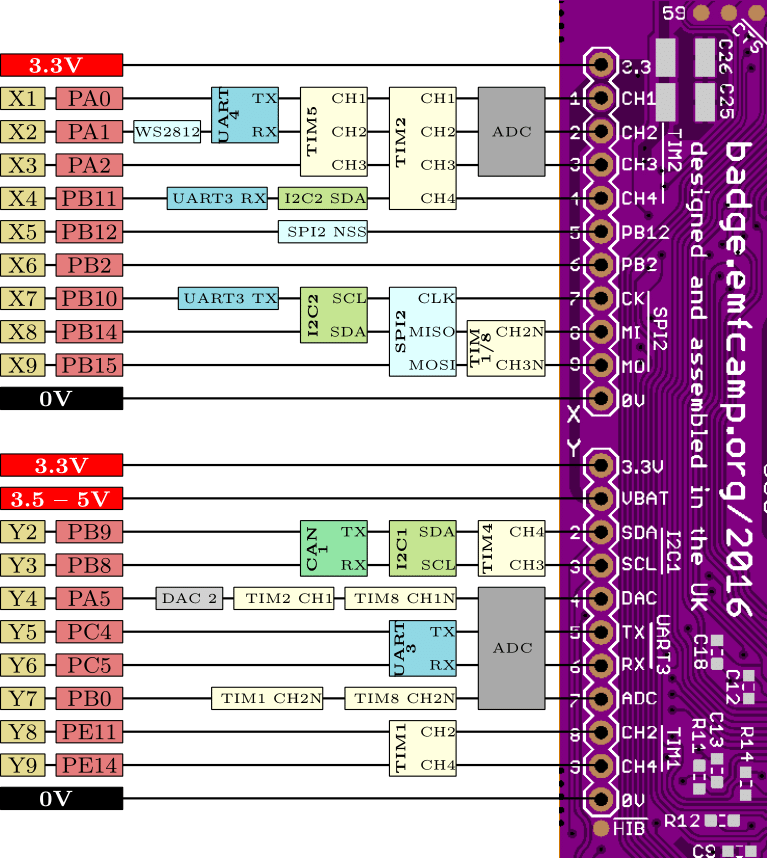
All the relevant files and software for the badge are fully open-source, and can be found in the EMF Camp GitHub repositories. We’ve put a set of images of the board in a gallery below if you are curious. The pinout images are courtesy of the EMF badge wiki.
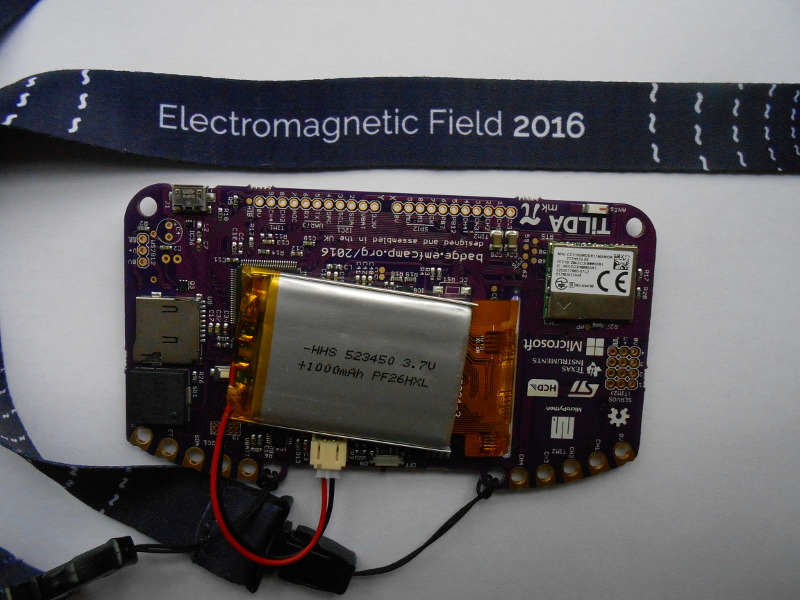
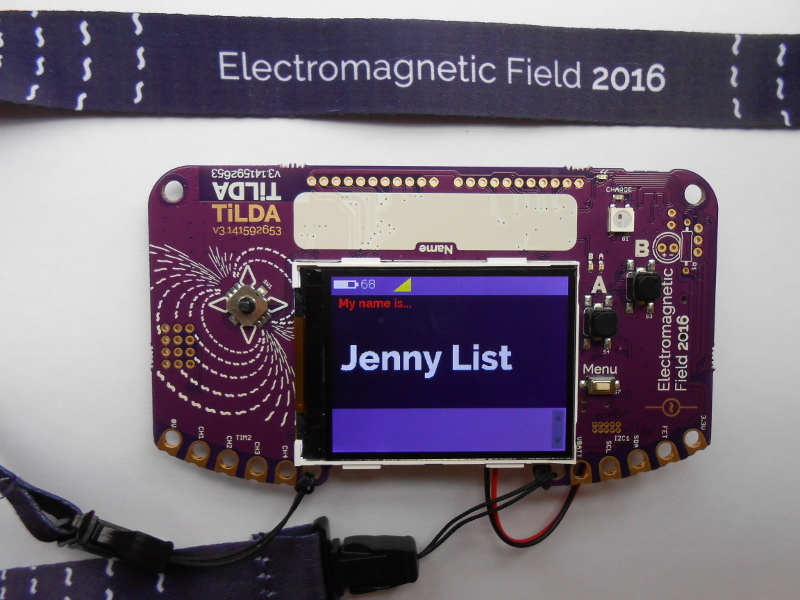
We’ve featured EMF badges before, here’s our look at the EMF 2014 device.
Fail Of The Week: The Pitfalls Of Designing A Wideband Radio

If you are someone whose interests lie in the field of RF, you won’t need telling about the endless field of new possibilities opened up by the advent of affordable software defined radio technology. If you are a designer or constructor it might be tempting to believe that these radios could reduce some of the problems facing an RF design engineer. After all, that tricky signal processing work has been moved into code, so the RF engineer’s only remaining job should be to fill the not-so-huge gap between antenna and ADC or DAC.

In some cases this is true. If you are designing an SDR front end for a relatively narrow band of frequencies, perhaps a single frequency allocation such as an amateur band, the challenges are largely the same as those you’d find in the front end of a traditional radio. The simplest SDRs are thus well within the abilities of a home constructor, for example converting a below-100kHz-wide segment of radio spectrum to the below-100kHz baseband audio bandwidth of a decent quality computer sound card which serves as both ADC and DAC. You will only need to design one set of not-very-wide filters, and the integrated circuits you’ll use will not be particularly exotic.

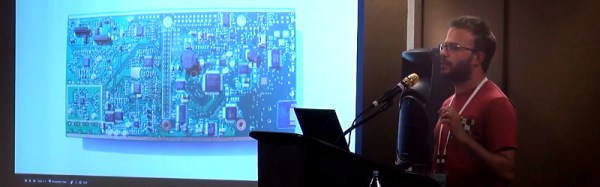
But what happens if the SDR you are designing is not a simple narrow-band device? [Chris Testa, KD2BMH] delivered a talk at this year’s Dayton Hamvention looking at some of the mistakes he made and pitfalls he encountered over the last few years of work on his 50MHz to 1GHz-bandwidth Whitebox handheld SDR project. It’s not a FoTW in the traditional sense in that it is not a single ignominious fail, instead it is a candid and fascinating examination of so many of the wrong turnings a would-be RF engineer can make.

The video of his talk can be found below the break, courtesy of Ham Radio Now. [Chris]’s talk is part of a longer presentation after [Bruce Perens, K6BP] who some of you may recognise from his activities when he’s not talking about digital voice and SDRs. We’re jumping in at about the 34 minute mark to catch [Chris], but [Bruce]’s talk is almost worth an article in itself..

Continue reading “Fail Of The Week: The Pitfalls Of Designing A Wideband Radio”

From Project To Kit: Getting The Hardware Right

In the previous article in this series on making a personal electronic project into a saleable kit, we looked at the broader picture of the kit market for a new entrant, the importance of gauging whether or not your proposed kit has a viable niche and ensuring that it has a good combination of buildability, instructions, and quality. In this article we will look at specifying and pricing the hardware side of a kit, illustrating in detail with an example project. The project we’ve chosen is a simple NE555 LED flasher which we haven’t built and have no intention of assembling into a kit for real, however it provides a handy reference project without the circuit itself having any special considerations which might distract from the job at hand.

Continue reading “From Project To Kit: Getting The Hardware Right”

EMF: You Shall Find Us At The Sign Of The Jolly Wrencher

It’s frustrating, the reluctance of some of my fellow hackspace members to put the cordless drill battery back in the charger after use.  As this is being written I’ve just coaxed enough energy from the drill to make a few holes in a piece of PVC pipe that will form part of an improvised flagpole, and upon that pole will hang Hackaday’s Jolly Wrencher flag at this weekend’s EMF Camp. We’re sharing a village with Oxford Hackspace, and as both your Hackaday scribe and an OxHack member the last week has been a little busy.

In theory it’s a simple enough process, getting a hackspace and all its assorted accoutrements down to Guildford. Three or four members’ cars will be loaded to the gunwales and will set off in good time to have everything under way without still desperately getting ready when the fun begins. In practice it’s been a procession of narrowly averted disasters, from the gazebo someone bought at auction turning out to have five walls and no roof, to the large ball that forms an essential part of one of the projects OxHack will be featuring being a buy-while-stocks-last remaindered product from last years Argos catalogue that only certain stores seem to still have.

We’ll be on the border between camping areas A and B, next to our friends from the Netherlands. I’m told that this location was requested due to likely proximity to a source of stroopwafels.  If you come along on Friday between 6 and 8 PM we’re holding the Tindie bring-a-hack event, at which we’ll be inviting attendees to bring along their hacks to share with the masses. All projects are welcome, but if you have a Hackaday Prize entry, a Hackaday.io project or a Tindie item we’d especially love to see you. My colleague Jasmine assures me that there will be a limited amount of Hackaday and Tindie swag on offer.

If you’re going down to EMF Camp this weekend then please drop by and have a chat if you’re passing our village. Otherwise you’ll probably encounter us on our travels as we try to seek out the interesting projects and hacks to feature on these pages. We hope the British weather doesn’t deliver any unpleasant surprises, and may all your projects work when you demonstrate them in front of the masses!

Jenny List is a director of Oxford Hackspace when she is not writing for Hackaday.

Electrostatic Loudspeakers: High End HiFi You Can Build Yourself

If you have an interest in audio there are plenty of opportunities for home construction of hi-fi equipment. You can make yourself an amplifier which will be as good as any available commercially, and plenty of the sources you might plug into it can also come into being on your bench.

There will always be some pieces of hi-fi equipment which while not impossible to make will be very difficult for you to replicate yourself. Either their complexity will render construction too difficult as might be the case with for example a CD player, or as with a moving-coil loudspeaker the quality you could reasonably achieve would struggle match that of the commercial equivalent. It never ceases to astound us what our community of hackers and makers can achieve, but the resources, economies of scale, and engineering expertise available to a large hi-fi manufacturer load the dice in their favour in those cases.

The subject of this article is a piece of extreme high-end esoteric hi-fi that you can replicate yourself, indeed you start on a level playing field with the manufacturers because the engineering challenges involved are the same for them as they are for you. Electrostatic loudspeakers work by the attraction and repulsion of a thin conductive film in an electric field rather than the magnetic attraction and repulsion you’ll find in a moving-coil loudspeaker, and the resulting very low mass driver should be free of undesirable resonances and capable of a significantly lower distortion and flatter frequency response than its magnetic sibling.
Continue reading “Electrostatic Loudspeakers: High End HiFi You Can Build Yourself”

HardwareX Is A Scientific Journal For Open Hardware

Disruption is a basic tenet of the Open Hardware movement. How can my innovative use of technology disrupt your dinosaur of an establishment to make something better? Whether it’s an open-source project chipping away at a monopoly or a commercial start-up upsetting an industry with a precarious business model based on past realities, we’ve become used to upstarts taking the limelight.

As an observer it’s interesting to see how the establishment they are challenging reacts to the upstart. Sometimes the fragility of the challenged model is such that they collapse, other times they turn to the courts and go after the competitor or even worse, the customers, in an effort to stave off the inevitable. Just occasionally though they embrace the challengers and try to capture some of what makes them special, and it is one of these cases that is today’s subject.

A famously closed monopoly is the world of academic journals. A long-established industry with a very lucrative business model hatched in the days when its product was exclusively paper-based, this industry has come under some pressure in recent years from the unfettered publishing potential of the Internet, demands for open access to public-funded research, and the increasing influence of the open-source world in science.

Elsevier, one of the larger academic publishers, has responded to this last facet with HardwareX, a publication which describes itself as “an open access journal established to promote free and open source designing, building and customizing of scientific infrastructure“. In short: a lot of hardware built for scientific research is now being created under open-source models, and this is their response.

Some readers might respond to this with suspicion, after all the open-source world has seen enough attempts by big business to embrace its work and extend it into the proprietary, but the reality is that this is an interesting opportunity for all sides. The open access and requirement for all submissions to be covered under an open hardware licence mean that it would be impossible for this journal to retreat behind any paywalls. In addition the fact of it being published in a reputable academic journal will bring open-source scientific hardware to a new prominence as it is cited in papers appearing in other journals. Finally the existence of such a journal will encourage the adoption of open-source hardware in the world of science, as projects are released under open-source licences to fulfill the requirements for submission.

So have the publishing dinosaurs got it right, and is this journal an exciting new opportunity for all concerned? We think it has that potential, and the results won’t be confined to laboratories. Inevitably the world of hackers and makers will benefit from open-source work coming from scientists, and vice versa.

Thanks [Matheus Carvalho] for the tip.

Bookbinding workshop image: By Nasjonalbiblioteket from Norway [No restrictions], via Wikimedia Commons.

Your Laundry Is Done!

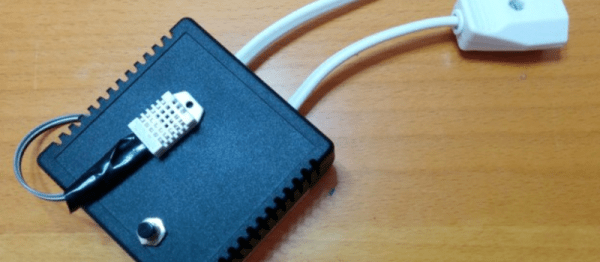
Have you ever put a load of dirty clothing in the washing machine and set the cycle running, only to forget all about it and discover a mouldering congealed mass in the machine a few days later? [Xose Pérez] has more than once, and to stop it happening again he’s got a project that monitors the machine in his basement and notifies him when his wash is done.

At the centre of his washing machine monitor is an ITead Sonoff IoT mains on-off switch. This device contains a 10A mains relay, an ESP8266 chip to control it, and a small mains switch-mode power supply. The Sonoff doesn’t use the ESP’s ADC pins, so he’s broken one of them out on a lead to a current transformer which captures the power level being consumed by the washing machine. The Sonoff is one of those IoT devices that relies on a proprietary cloud service and doesn’t have its own API, so [Xose] has created his own firmware for it incorporating an ESP port of an Arduino current sensing library. To round off the project and because he could, he’s added an ambient humidity sensor to the device.

The resulting boxed-up unit returns minute-by-minute current readings for the entire wash cycle. To spot when the cycle has finished, he waits for a moment when it has been using no power for more than five minutes, at which point his Node-RED system sends him a notification via Pushover.

This project is a very neatly executed hack on an extremely cheap piece of hardware whose capabilities would ordinarily be somewhat curtailed due to its proprietary interface. Surprisingly it’s not the first laundry monitor we’ve seen here at Hackaday, we’ve had this apartment laundry monitor using an accelerometer and a Raspberry Pi, and a notifier for a finicky dryer that insisted on stopping mid-cycle.