Bioluminescent Glowing Petunias Are Now A Thing

Outside of the depths of the ocean, or cartoons, we’re not typically accustomed to plant life glowing or otherwise generating its own light. However, science is helping to change all that. Now, you can order some bioluminescent plants of your very own from Light Bio.

Light Bio is a startup company working in the synthetic biology space. It’s not content to simply pursue research behind closed doors, and is now sharing its work with the public. It has announced it plans to start selling petunias to U.S. customers which literally glow with the magic of bioluminescence.

Petunias don’t normally glow, but with some modifications, it turns out they can be convinced to. It took a large team of 26 scientists to figure out how to boost bioluminescence in plants, by isolating and optimizing genes sourced from various glowing mushroom species.

The plants will be available from April, with Light Bio planning to sell them as “Firefly Petunias.” It might sound like scary sci-fi tech, but the USDA has apparently already signed off on Light Bio selling these to the public.

Something’s been bothering me, though. It’s at the edge of my memory… I think my old housemate played bass for Glowing Petunias back in 2015. Something like that, anyway… video after the break.

Continue reading “Bioluminescent Glowing Petunias Are Now A Thing”
Sonolithography With The Raspberry Pi Pico

You can do some wild things with sound waves, such as annoy your neighbours or convince other road users to move out of your way. Or, if you get into sonolithography like [Oliver Child] has, you can make some wild patterns with ultrasound.

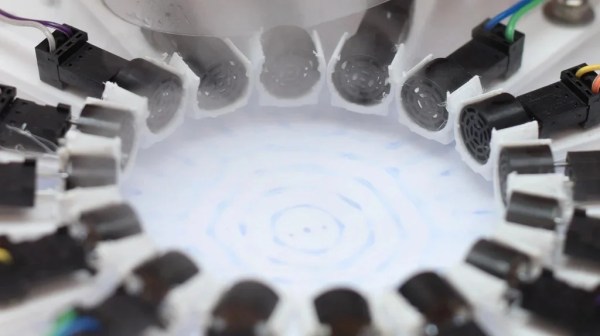
Sonolithography is a method of patterning materials on to a surface using finely-controlled sound waves. To achieve this, [Oliver] created a circular array of sixteen ultrasonic transducers controlled via shift registers and gate driver ICs, under the command of a Raspberry Pi Pico. He then created an app for controlling the transducer array via an attached computer with a GUI interface. It allows the phase and amplitude of each element of the array to be controlled to create different patterns.

Creating a pattern is then a simple matter of placing the array on a surface, firing it up in a given drive mode, and then atomising some kind of dye or other material to visualize the pattern of the acoustic waves.

It could be a useful tool for studying the interactions of ultrasonic waves, or it could just be a way to make neat patterns in ink and dye if that’s what you’re into. [Oliver] notes the techniques of sonolithography could also have implications in biology or fabrication in future, as well. If you found this interesting, you might like to study up on ultrasonic levitation, too!

Change The Jingle In Your Makita Charger Because You Can

Lots of things beep these days. Washing machines, microwaves, fridge — even drill battery chargers. If you’re on Team Makita, it turns out you can actually change the melody of your charger’s beep, thanks to a project from [Real-Time-Kodi].

The hack is for the Makita DR18RC charger, and the implementation of the hack is kind of amusing. [Real-Time-Kodi] starts by cutting the trace to the buzzer inside the charger. Then, an Arduino is installed inside the charger, hooked up to the buzzer itself and the original line that was controlling it. When it detects the charger trying to activate the buzzer, it uses this as a trigger to play its own melody on the charger instead. The Arduino also monitors the LEDs on the charger in order to determine the current charge state, and play the appropriate jingle for the situation.

It’s an amusing hack, and one that could certainly confuse the heck out of anyone expecting the regular tones out of their Makita charger. It also shows that the simple ways work, too — there was no need to dump any firmware or decompile any code.

Continue reading “Change The Jingle In Your Makita Charger Because You Can”

Slime Mold-Powered Smart Watches See Humans Fall In Love With The Goo

Humans are very good at anthropomorphising things. That is, giving them human characteristics, like ourselves. We do it with animals—see just about any cartoon—and we even do it with our own planet—see Mother Nature. But we often extend that courtesy even further, giving names to our cars and putting faces on our computers as well.

A recent study has borne this out in amusing fashion. Researchers at the University of Chicago found that human attitudes towards a device can change if they are required to take actions to look after it. Enter the slime mold smartwatch, and a gooey, heartwarming story of love and care between human and machine, mediated by mold.

Continue reading “Slime Mold-Powered Smart Watches See Humans Fall In Love With The Goo”

The Latest Windows 11 Release Might Not Work On Your Oldest Machines

Everybody knows you can’t install Windows XP on a 386, or Windows 95 on an original IBM PC. But for Windows 11, the goalposts seem to be changing with newer releases of the existing OS. As covered by The Register, it appears the latest Windows 11 24H2 update might be incompatible with older machines.

It’s all down to the POPCNT CPU instruction. As shared on Twitter by [TheBobPony], the instruction appears in a number of Windows 11 system files, including kernel and USB XHCI drivers. Thus, it appears that any CPU not able to run this instruction will not be able to boot Windows 11. POPCNT was first included in AMD’s Barcelona architecture in 2007, and Intel’s Core processors in 2008. It’s an instruction for counting set bits in a word.

Ultimately, the effect is that computers with older CPUs will no longer be able to run the latest version of Windows 11. It could be as simple as Microsoft engineers enabling more modern CPU instructions at compilation time. However, given affected hardware is more than 15 years old, it’s perhaps likely that Microsoft is perfectly willing to cut these machines off from using the latest versions of its main operating system. We’ve talked about this phenomenon before, too.

In any case, keep a close eye on Windows update if you’re running super-old hardware. Let us know if you’ll be affected in the comments.

Thanks to [Stephen Walters] for the tip!

Brushless ESC Becomes Dual-Motor Brushed ESC With A Few Changes

What is a brushless ESC, really? Well, generally, it’s usually a microcontroller with a whole lot of power transistors hanging off it to drive three phases of brushless motor coils. [Frank Zhao] realised that with a little reprogramming, you could simply use a brushless ESC to independently run two brushed motors. Thus, he whipped up a custom firmware for various AM32-compatible ESCs to do just that.

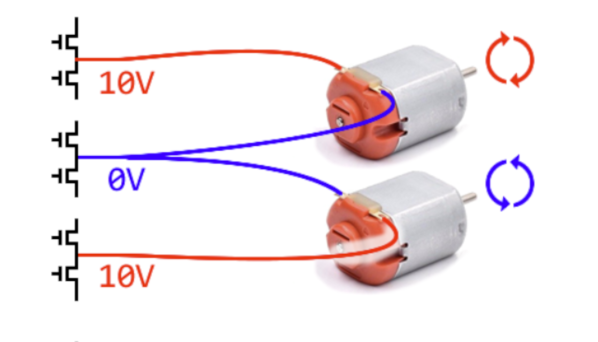
The idea of the project is to enable a single lightweight ESC to run two brushed motors for combat robots. Dual-motor brushed ESCs can be hard to find and expensive, whereas single-motor brushless ESCs are readily available. The trick is to wire up the two brushed motors such that each motor gets one phase wire of its own, and the two motors share the middle phase wire. This allows independent control of both motors via the brushless ESC’s three half-bridges, by setting the middle wire to half voltage. Depending on how you set it up, the system can be configured in a variety of ways to suit different situations.

[Frank’s] firmware is available on Github for the curious. He lists compatible ESCs there, and notes that you’ll need to install the AM32 ESC firmware before flashing his version to make everything work correctly.

The VESC project has long supported brushed motor operation, too, though not in a tandem configuration. Meanwhile, if you’ve got your own neat ESC hacks, don’t hesitate to hit us up on the tipsline!

Sprint: The Mach 10 Magic Missile That Wasn’t Magic Enough

Defending an area against incoming missiles is a difficult task. Missiles are incredibly fast and present a small target. Assuming you know they’re coming, you have to be able to track them accurately if you’re to have any hope of stopping them. Then, you need some kind of wonderous missile of your own that’s fast enough and maneuverable enough to take them out.

It’s a task that at times can seem overwhelmingly impossible. And yet, the devastating consequences of a potential nuclear attack are so great that the US military had a red hot go anyway. In the 1970s, America’s best attempt to thwart incoming Soviet ICBMs led to the development of the Sprint ABM—a missile made up entirely of improbable numbers.

Continue reading “Sprint: The Mach 10 Magic Missile That Wasn’t Magic Enough”