New Part Day: Alexa Connect Kit Now Available For Sale

People who were subscribed to updates on the Alexa Connect Kit (ACK) would recently have received an email informing that this kit is now available for sale. Last time we covered the ACK was back in September of 2018, the ‘release’ moniker meant ‘preview’ and there wasn’t any hardware one could actually purchase.

Over a year a later it seems that we can now finally get our grubby mitts on this kit that should enable us to make any of our projects Alexa-enabled. What this basically seems to mean is that one can spend close to 200 US dollars on an Arduino Zero and an Arduino shield-mounted WM-BN-MT-52 module from USI (though not listed on their site, but similar to the WM-BN-BM-22?) that integrates a 192 MHz Cortex-M MCU and a WiFi/Bluetooth module, as summarized on the Amazon Developer page for the ACK.

Continue reading “New Part Day: Alexa Connect Kit Now Available For Sale” →

Building A 6.5 Digit Voltmeter From Scratch

After initially working to create a modernized replica of a Czechoslovakian 4-digit Metra M1T242 voltmeter, [Jaromir Sukuba] figured that while he was at it, he might as well create a voltmeter that would be slightly more capable. This led to the design and construction of a brand-new, 6.5 digit voltmeter design, which [Jaromir] has documented over at EEVBlog.

Employing an MSP430FR5994 MCU for the digital board, and an Altera/Intel EPM240T100 CPLD plus ADC on the input side, the design has been undergoing validation for a while now. The current revision uses an OPA140 op-amp in an integrating ADC setup in a multi-slope run-up configuration, but [Jaromir] has plans to replace this input board with another op-amp in a more efficient topology in the future.

Continue reading “Building A 6.5 Digit Voltmeter From Scratch” →

How Smart Are AI Chips, Really?

The best part about the term “Artificial Intelligence” is that nobody can really tell you what it exactly means. The main reason for this stems from the term “intelligence”, with definitions ranging from the ability to practice logical reasoning to the ability to perform cognitive tasks or dream up symphonies. When it comes to human intelligence, properties such as self-awareness, complex cognitive feats, and the ability to plan and motivate oneself are generally considered to be defining features. But frankly, what is and isn’t “intelligence” is open to debate.

What isn’t open to debate is that AI is a marketing goldmine. The vagueness has allowed for marketing departments around the world to go all AI-happy, declaring that their product is AI-enabled and insisting that their speech assistant responds ‘intelligently’ to one’s queries. One might begin to believe that we’re on the cusp of a fantastic future inhabited by androids and strong AIs attending to our every whim.

In this article we’ll be looking at the reality behind these claims and ponder humanity’s progress towards becoming a Type I civilization. But this is Hackaday, so we’re also going to dig into the guts of some AI chips, including the Kendryte K210 and see how the hardware of today fits into our Glorious Future. Continue reading “How Smart Are AI Chips, Really?” →

High-Precision Air Bearing CNC Lathe And Grinder

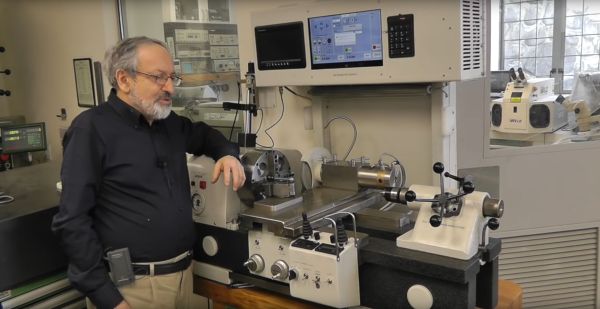
You know you’re in for a treat when you are told that a lathe which can reach a resolution of one micrometer (1×10⁻⁶, a millionth of a meter, or 0.00004″ for people who love zeros) is ‘not hard to build’.  This is one of the opening statements in this video by [Dan Gelbart], as he walks the viewer through the details of a custom CNC lathe which he built. (Video embedded below.)

As it’s a combined CNC lathe and grinder, it uses custom software he had developed specifically for the machine. Much of the high precision of the machine is courtesy of air bearings. All but two of the air bearings were made by [Dan], with the two surplus air bearings he used coming from machines used in the semiconductor industry.

The bed of the machine is formed out of off-the-shelf reference granite, to which the other parts are epoxied, providing a stable base with well-defined dimensions. Though perhaps a few light years beyond most DIY lathe efforts, [Dan]’s videos nevertheless provide a treasure trove of tips and information for lathe builders and users alike. Certainly worth a look.

Thanks [Drew] for the tip in the comments.
Continue reading “High-Precision Air Bearing CNC Lathe And Grinder” →

Brachiograph: A Simple And Cheap Pen-Plotter

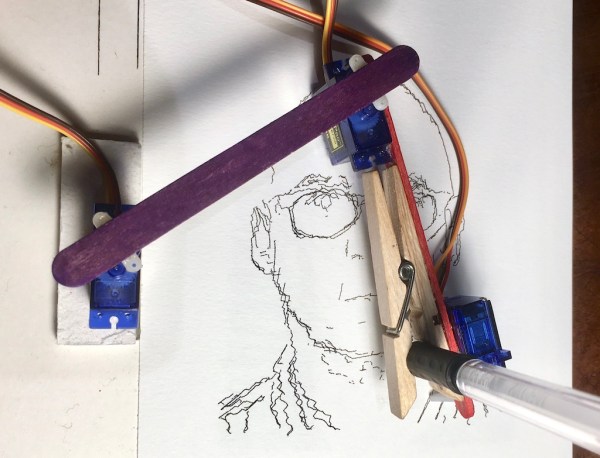
The BrachiGraph project consists out of two parts, the hardware design for a servo-driven drawing arm (pen plotter) and software utilities (written in Python) that allow the drawing arm’s servos to be controlled in order to convert a bitmap image into a collection of lines that can be used to draw an image resembling the original, in a variety of styles. All of the software and designs needed to make your own version can be found on the Github page for the project.

docs/images/readme_combined_image.png

Considering an estimated €14 worth of materials for the project, the produced results are nothing short of amazing, even if the principles behind the project go back to the Ancient Greek , of course. The basic hardware is that of a pantograph, which provides the basic clues for how the servos on the plotter arm are being driven.

The main achievement here is definitely that of minimalism, with three dirt-cheap SG-90 microservos along with some bits of wood, a clothes-peg or equivalent, and of course a pen providing a functional plotter that anyone can assemble on a slow Sunday afternoon from random bits lying around the workshop.


Planting 20 Million Trees, Using Drones, Cannons, And More Unconventional Ways

When YouTuber MrBeast hit 20 million subscribers, it kicked off the promise to plant 20 million new trees by 2020. While seeming rather mad for a single person to attempt such a feat, the channel has begun an organized effort under the banner of ‘Team Trees‘. With many famous and less famous YouTubers and other online personalities pitching in, along with a number of companies and organizations, it seems like it’s not as far-fetched of an idea as it first seemed.

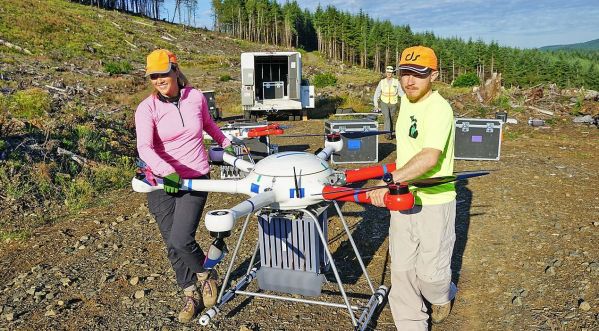
We’ve embedded MrBeast’s video after the break where you’ll also find a video by Mark Rober, who teamed up a company called DroneSeed, who use large flying drones to distribute seeds contained in nutrition pods over large areas. Their focus is on reforestation after large wildfires and other events that leave the land devoid of trees. Of course, this being seeds, it will take quite a while for results to become visible.

The impatient Canadians over at Linus Media Group figured that they’d rather plant tree seedlings at a breakneck pace, cobbling together a nitrogen cannon that fires a nutrition pellet into the soil, creating the hole for the seedling, or alternately firing the pellet and seedling into the soil in one go from the breach-loading cannon. Obviously the results from the latter method are decidedly more questionable, taking a bit chunk out of the about 300 seedlings they were planning to add to the local nature.

Regardless of the method chosen, any significant reforestation around the world could be a crucial part of reducing the global increase of atmospheric CO2, and the climate challenges this creates.  With sources putting the total number of trees in the world today at about 3 trillion, 20 million more doesn’t seem like a lot, yet techniques we’re learning today to speed up the process of reforestation might play a major role in the near future.

Continue reading “Planting 20 Million Trees, Using Drones, Cannons, And More Unconventional Ways” →


The Blessings And Destruction Wrought By Lead Over Millennia

Everyone one of us is likely aware of what lead — as in the metal — is. Having a somewhat dull, metallic gray appearance, it occupies atomic number 82 in the periodic table and is among the most dense materials known to humankind. Lead’s low melting point and malleability even when at room temperature has made it a popular metal since humans first began to melt it out of ore in the Near East at around 7,000 BC in the Neolithic period.

Although lead’s toxicity to humans has been known since at least the 2nd century BC and was acknowledged as a public health hazard in the late 19th century, the use of lead skyrocketed in the first half of the 20th century. Lead saw use as a gasoline additive beginning in the 1920s, and the US didn’t abolish lead-based paint until 1978, nearly 70 years after France, Belgium and Austria banned it.

With the rise of consumer electronics, the use of lead-based solder became ever more a part of daily life during the second part of the 20th century, until an increase in regulations aimed at reducing lead in the environment. This came along with the World Health Organization’s fairly recent acknowledgment that there is truly no safe limit for lead in the human body.

In this article I’ll examine the question of why we are still using lead, and if we truly must, then how we can use this metal in the safest way possible.

Continue reading “The Blessings And Destruction Wrought By Lead Over Millennia” →