Reverse-Engineering The Bluetooth Fichero Thermal Label Printer Protocol

It’s hard to deny that label printers have become more accessible than ever, but an annoying aspect of many of these cheap units is that their only user interface is a proprietary smartphone app connected via Bluetooth. The Fichero-branded label printer that [0xMH] obtained for a mere 10 Euro at a store in the Netherlands was much the same, with an associated app that doesn’t just bind it to smartphones, but also requires no fewer than 26 permissions. Obviously this required some reverse-engineering of the BLE protocol.

The fruits of this reverse-engineering effort can be found in the GitHub repository, with the most interesting part probably being that this Fichero is just one of many relabeling of generic label printers, this one being an AiYin D11, by Xiamen Printer Future Technology. This means that other iterations of this D11 will work exactly the same, as they all use the same ‘LuckPrinter’ SDK.

[0xMH] provides a Web GUI to talk with a local D11 printer, though you can also use the Python scripts, or of course implement the protocol using your favorite language and frameworks, so that you can finally control a cheap label printer from a PC or even BLE-equipped MCU like the software gods intended.

Thanks to [T-ice] for the tip.

How Usable Is Windows 98 In 2026?

With the RAM and storage crisis hitting personal computing very hard – along with new software increasingly suffering the effects of metastasizing ‘AI’ – more people than ever are pining for the ‘good old days’. For example, using that early 2000s desktop PC with Windows 98 SE might now seem to be a viable alternative in 2026, because it couldn’t possibly make things worse. Or could it? As a reality check, [SteelsOfLiquid] over on YouTube gave this setup a whirl.

The computer of choice is a very common Dell Dimension 2100, featuring a zippy 1.1 GHz Intel Celeron, 256 MB  of DDR1, and a spacious 38 GB HDD. Graphics are provided by the iGPU in the Intel i810 chipset, all in a compact, 6.9 kg light package. As an early Windows XP PC, this gives Windows 98 SE probably a pretty solid shot at keeping up with the times. At least the early 2000s, natch.

Of course, there is a lot of period-correct software you can install, such as Adobe Photoshop 5, MS Office 97 (featuring everyone’s beloved Clippy), but a lot of modern software also runs, with the Retro Systems Revival blog documenting many that still run on Win98SE in some manner, including Audacity 2.0. This makes it totally suitable for basic productivity things.

Continue reading “How Usable Is Windows 98 In 2026?”

Restoring A Commodore PET 3032 In Rough Condition

The restored PET/CBM 3032. (Credit: Drygol, retrohax.net)

The Commodore CBM 3032 is a successor to the original Commodore PET 2001, yet due a conflicting trademark issue with Philips these first European PETs were called ‘CBM’ instead. Hence the labeling on the CBM 3032 that [Drygol] had in for a restoration, which would have been produced somewhere between 1979 and the cessation of its manufacturing a few years later. This former machine of the University of Szcezecin in Poland had languished in a basement until a local demoscene group came across it and wanted to use it, after a restoration.

Although at first glance from just the front it didn’t look too shabby, problems were apparent from just a walkaround, including rusty and buckled paneling, showing that the time spent in storage had not done it any favors. Internally there was decades worth of dust, along with a dodgy potentiometer, cold joints and some PCB-level bodges that may or may not have been there from the factory.

The main case was disassembled by drilling out the rivets to gain full access to every nook and cranny, allowing for a good cleaning and repainting prior to putting in fresh rivets. On the PCB side of things, a potentiometer and an LM340KC-12 linear regulator in a TO-3 package had to be replaced, after which the system managed to boot reliably once in every three attempts.

Fixing this took basically cleaning all contacts and IC sockets, as well as refurbishing the keyboard, with corrosion and the occasional broken trace causing a lot of grief. Ultimately the system was restored and ready to be put into demoscene service.


Building A Super-Compact Cistercian Numerals Clock

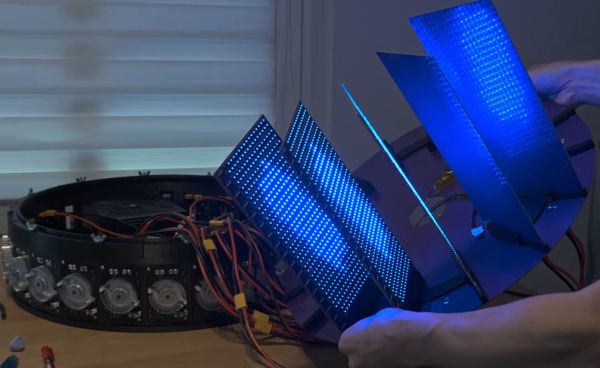
Around the thirteenth century CE, European society was in the midst between transitioning from Roman numerals to the Arabic numerals that we use today. Less remembered are the Cistercian numerals, which [BigCrimping] used for their most recent project in the form of a rather unique clock.

The Cistercian numeral system was developed by the Cistercian monastic order in the 13th century, forming a rather unique counterpoint to the Arabic numeral system. Although Arabic numerals are already significantly more compact than Roman numerals, Cistercian numerals up the ante by being capable of displaying any number between 1 and 9,999 with a single glyph.

Although for a simple 24-hour clock you don’t need to use more than a fraction of the possible glyphs, there is the complication of the Cistercian numerals not having a zero glyph, but that invites an even better take. For the version that [BigCrimping] made there are namely two glyphs that encode date and time, with the left glyph a counter for blocks of two hours and the right for seconds from 1 through 7200.

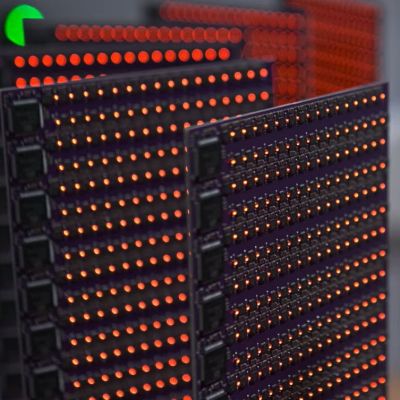
The clock is based around MAX6969 LED drivers and an ESP32 MCU on a custom PCB, with the design files including the 3D-printed enclosure available in the repository.

Continue reading “Building A Super-Compact Cistercian Numerals Clock”

How The Chornobyl NPP Got Modernized In The 1990s

During the 1990s the Chornobyl Nuclear Power Plant – formerly the Chernobyl NPP – continued operating with its remaining three RBMK reactors, but of course the 1970s-era automation with its very limited SKALA computer required some serious modernization. What was interesting here is that instead of just replacing this entire Soviet-era mainframe with a brand-new 1990s one, the engineers responsible opted to build a new system – called DIIS – around it. This is detailed in a recent video by the [Chornobyl Family] on YouTube.

This SKALA industrial control system was previously detailed in a video, covering this 24-bit mainframe computer and its many limitations. It wasn’t quite a real-time control system, but it basically did what it was designed to do. Since at the time it was not clear for how long these three RBMKs would be kept running, they didn’t want to go overboard with investments either.

Ultimately Unit 2 only was active until 1991 due to a turbine fire, Unit 1 until 1996 and Unit 3 was shutdown for the last time in 2000, so this a sensible decision. During those years, an auxiliary information-measurement system (DIIS) was the big upgrade, which got bridged into SKALA via a Ukrainian-made SM-1210 minicomputer, with the latter connected to an 80386 PC which itself was connected to an ARCnet hub.

Continue reading “How The Chornobyl NPP Got Modernized In The 1990s”

The Tragic Demise Of The Technirama Prism-Based Anamorphic Lens

A commercial Delrama prism-based anamorphic lens for large cameras. (Source: Mathieu Stern, YouTube)

Although to the average person a camera lens is just that bit of glass you stick on the front of the camera to make stuff appear in focus, there’s a whole wide world out there of lens designs and modifications with enough variety to make your head spin. Some of these designs make a big impact, while others fade away again, sometimes at the whims of film makers and photographers. Prism-based anamorphic lenses are an oddity that recently [Mathieu Stern] got his hands on. (Video, embedded below.)

During the 1950s and 1960s there was a bit of a competition between anamorphic formats, which use special lenses that ‘squeeze’ a larger image so that widescreen movies could be recorded on standard 35 mm film. By using the same lens for recording and playback, the result was a mostly distortion-free image. Here the Technirama format by Technicolor who teamed up with Dutch company De Oude Delft (‘Old Delft’) to produce the prism-based Delrama lenses that fit on existing lenses for cameras and projectors.

The last gasp of the Delrama anamorphic lenses. (Credit: Mathieu Stern, YouTube)a

Despite having a clearly superior, distortion-free image than the cylindrical lenses of the competition, Technirama got pushed out of the commercial market, leaving De Oude Delft to try and interest the consumer market for Delrama with 8 and 16 mm adapters. These latter are the ones that [Mathieu] got his hands on and tried out with a DSLR camera.

Troublesome with these Delrama adapters is that their silver mirrors tend to degrade over time, and they also turned out to be rather fragile, which are both things that made consumers sour on them. Another challenge was the fixed four meter focus that’s great when you’re using it with a projector, but terrible for up-close shots. All of these issues resulted in Delrama fading from the market by the 1970s until all that remains are these remnants of a format that once was used to film some of the biggest Hollywood movies.

Continue reading “The Tragic Demise Of The Technirama Prism-Based Anamorphic Lens”

Fixing An Onkyo Receiver With Multiple Faults

Modern-day receivers are miracles of digital audio and video processing, but compared to their more analog brethren, they can come with a host of new and fascinating faults. The Onkyo TX-SA806 and SR806 receivers were released back in 2008, with [Tony359] recently getting the latter variant in for repair. Described as having weird digital distortion on the audio outputs, this particular issue got fixed by recapping the PCB with all the digital processing in the first video on this receiver, but this left the second issue unaddressed of a persistent hum, which is the topic of the second video on this repair.

Capacitor C5662 in the Onkyo TX-SR608 receiver with a slight bulge. (Credit: Tony359, YouTube)
Capacitor C5662 in the Onkyo TX-SR608 receiver with a slight bulge.

With the easy fix of recapping of the digital board already tried, next was a deep-dive into the receiver’s schematics to figure out where this low-frequency hum was coming from. With it sounding very much like mains frequency hum bleeding through, this was the starting point. Presumably somewhere on the power rails the normal filtering had broken down, so all rails had to be identified and checked for this interference.

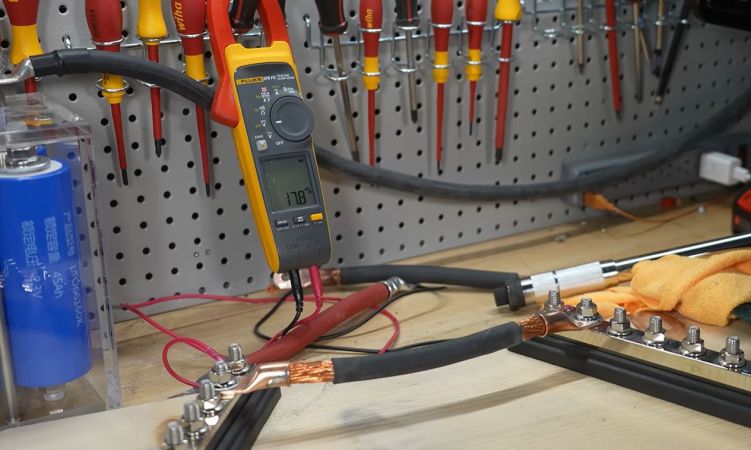
With ripple on the 10V and 12V rails as well as the others seemingly in order, it wasn’t clear where the 100 Hz hum was coming from, but people on the BadCaps forum offered some help. After some back and forth it was deduced that the problem was the +15 VA rail, with heavy ripple on it due to a dead capacitor on the +22 V rail that comes straight from a transformer.

Continue reading “Fixing An Onkyo Receiver With Multiple Faults”