Update: Battlezone On Vector Display Step-by-Step

When we ran the story of Battlezone played on tube displays earlier this week there were immediately questions about recreating the hack. At the time the software wasn’t available, and there is also a bit of hardware hacking necessary to get the audio working. You asked and [Eric] from Tubetime delivered. He’s posted a pair of articles that show how to get an STM32F4 Discovery board to play the classic game, along with instructions to build the firmware.

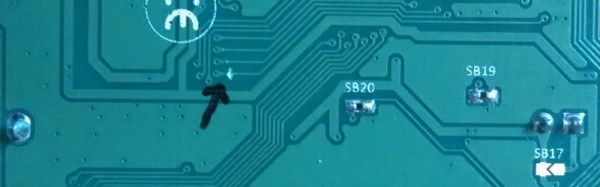
The hardware hack in this case is untangling the pinout used on the discovery board. It seems that one of the lines needed to get sound working for this hack is tied to one of the two DACs. If you read the original coverage you’ll remember that both of the DACs are used to drive X and Y on the vector display. The image above shows a cut trace on the bottom of the board. You’ll then need to route that signal to an alternate pin by soldering a jumper wire from the chip to a resistor on the board.

This (as well as one other alteration that bridges two of the chip pins) is a great example of work you should be unafraid to do on your own dev boards. We’ve had to do it with the Launchpad boards to get at the functionality we needed. We’d like to hear your own epic stories of abusing dev boards to do your bidding. Let us know in the comments.
Solder Any Expansion Directly To Your Computer’s Memory

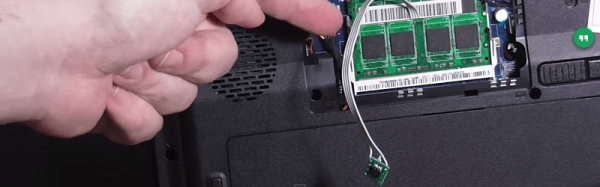
Heat up that iron, you’re going to want to try this one: [Hugatry] is adding hardware to his laptop by tapping into the i2c lines on the memory module. We love this because the penalty for borking memory during the soldering process is much lower than when soldering directly to a motherboard!

Until we watched the video after the break we hadn’t realized that memory modules usually have an i2c EEPROM on them. This is actually a standard called Serial Presence Detect which allows the BIOS to poll the memory and configure automatically. It seems ironic that we knew the Raspberry Pi HAT standard uses this same trick but didn’t know it was on computer memory as well.

Hardware-wise this provides an easy method of soldering your own equipment to the bus. From there it becomes a software hack. Linux, of course, makes this quite easy and that is demonstrated by [Hugatry] with an LM75 temperature sensors. We would like to hear from our Windows and OSX using readers on how the i2c bus can be accessed within those OS’s.

Continue reading “Solder Any Expansion Directly To Your Computer’s Memory”

Give Me A Welder And Rod Stock And I’ll Build You The World

Metal fabrication is a an art that often goes under appreciated. The ability to take common stock in the form of sheet, pipe (square or round), and in this case rod, and make it into anything is intoxicating for the artist and super villain inside of each of us. Recently [asciiArtVandaly] took on an interesting job and was thoughtful enough to make a photo album of the process. He literally created the world out of metal.

The build is a wire-frame globe. The latitude and longitude rods are rolled to the proper arc, but holding them in place is a bit of a trick. This image shows the welding jig built just for this project. It has large and small nobs to match the increasing spacing of the rods, with washers holding down ever other joint. If you want to see an example of rod-rolling check out the unrelated How It’s Made segment found after the break.

This jig is visually stunning to look at, but the math used to lay something like this out is only mildly interesting compared to the work done to add the continents to the piece. Each of these were cut out and then hand hammered to match the curve of the globe before being welded in place and outfitted with lighting for cities. That’s a skill you can’t get without a lot of practice — and get this, [asciiArtVandalay] does it as a hobby. Who knew robot engineers needed hobbies?

The finished globe is about eighty pounds of stainless steel. The build ends up being corporate art for a company sure to turn [Tyler Durden’s] eye.

Continue reading “Give Me A Welder And Rod Stock And I’ll Build You The World”

Battlezone Played On Vector Display With Hand-Wound Yoke

We’ve been admirers of the work [Eric] and friends have been doing over at TubeTime for years. One of the earliest we can remember is the decatron kitchen timer, and we still tell the story of [Eric] purposely leaving out button debouncing in order to make his vector flappy bird even harder.

TubeTime is back at it this year and we had the opportunity to speak with them at Bay Area Maker Faire. The group specializes in working with old tube displays and this year’s offering was spectacular in many ways. First off, the software side of things is an emulator running on an STM32 F4 Discovery board. The chips on these boards have a pair of 12-bit DACs which are driving the X and Y of the vector displays. Code to run the original ROMs was ported from existing projects, but the audio for the games was kind of a hack to get working.

This particular display is where things get really fascinating. The tube itself was originally manufactured as test equipment for television repairmen. What’s fascinating about this is that [Eric] had to rewind the deflection yokes himself to get it working again. Luckily he documented quite a bit about his initial research into this process and his experiments to remedy some distortion issues he encountered once it was working.

Make sure to head on over to TubeTime and read their overview of the Battlezone machine. After the break we’ve also embedded a few of our own pictures as well as the interview at BAMF.

Continue reading “Battlezone Played On Vector Display With Hand-Wound Yoke”

A Mountain Of Prizes For Projects Using These Parts

Here’s your chance to bring some great stuff home from The Hackaday Prize. For the next 3 weeks we’ll be looking for the best entries using Atmel, Freescale, Microchip, and Texas Instruments parts.

Each of the four contests (yes, four running concurrently) will award the top 50 projects. That’s 200 in total being recognized. The odds are really in your favor — currently some of those lists have less than 50 projects on them — so enter yours right away! Scroll down to see the mountain of prizes that we have for this epic run.

Make Sure We Know About Your Entry

There are two things you need to do to be eligible for this pile of awesome stuff:

  1. Enter your project in the 2015 Hackaday Prize
  2. Leave a comment here with a link to your project and we’ll add it to the list

Do this by the morning of Monday, June 29th to make sure you’re in the running. We’ve been diligent about adding entries to the lists for Atmel, Freescale, Microchip, and Texas Instruments but at the rate new entries have been coming in it’s easy to miss one here or there. Don’t be bashful about asking to be added to these lists!

The prerequisite is to be using a part from one of these four manufacturers. We’ll be looking at these lists for projects using great ideas which have also been well-documented. Tells us why you’re building it, what it does, how you came up with the idea… you know, the whole story!

The Loot

Up for grabs in each of the 4 contests are:

3x Mooshimeters which is a multimeter that uses your smartphone as a wireless readout.

2x DS Logic analyzers which [Adam] reviewed a few weeks back.

15x Stickvise to hold your PCBs (and other things) in place while you work

A continuation of what we’re giving away in each of the 4 contests:

10x Bluefruit LE Sniffers to help you figure out what’s being transmitted by your BTLE devices

10x Cordwood Puzzles; grab your iron and tackle this head-scratching soldering challenge

10x TV-B-Gone is an iconic invention from [Mitch Altman]; one button turns off all TVs


The 2015 Hackaday Prize is sponsored by:

Meet Us In Shenzhen

Hackaday Prize Worldwide is coming to Shenzhen, China at the end of next week! There’s lots to do, join us for as much of it as you can:

zero-to-productZero to Product Workshop

RSVP now for our Zero to Product workshop on Friday, June 19th. This is created and presented by [Matt Berggren] who shares his experience designing and laying out printed circuit boards professionally. A basic knowledge of electronics is all you need to get going and to lay out the dev board shown here!

Meetup and Share Your Hacks

logic-noise-booth-artHolding down an awesome booth at Maker Faire all day makes us weary. We’ll recharge our batteries on Saturday, June 20th starting at 7pm. Join us at Bionic Brew (please be kind and tell us you’re coming). As always, when we hang out we like to see, and show off, hacks. Bring something along if it’s easy to store in a pocket or backpack.

Build some Logic Noise at our SZMF Booth

Yep, we already mentioned it… we’ll be camped out at Shenzhen Maker Faire teaching people how to make music with logic chips. We’ve based the activity off of [Elliot Williams’] fantastic Logic Noise Series. Stop by, say hello and grab some stickers!


The 2015 Hackaday Prize is sponsored by:

Startup Bus: Hardware Hacking On The Highway

Get this, 30 people piled aboard a bus today and will spend the next 72 hours hacking their way to a successful startup idea. Oh and the bus will be moving the entire time; like the hacker version of Speed. Well, kind of.

What’s missing from this description? Hardware! That’s where Hackaday comes in. Just like with the NYC Hackathon, Hackaday wants to bring hardware to hackathons everywhere. We have a Hackathon page for StartupBus to document their builds and shipped them a box overflowing with Texas Instruments hardware (one of our illustrious Hackaday Prize sponsors). All that’s left is for the sleep (and shower) deprived passengers to hack together the next great thing.

Scheduled stops on the journey include Detroit (6/4), Pittsburgh (6/5), and their final destination of Nashville. We’ll be keeping our eye out for project updates from the contestants. But if you are one of the 30 hackers on the bus we’d love to see some pictures. Tweet your photos to @hackaday!

[Photo Source: Entrepreneurship Club]