No Nonsense Guide For Patching Into A Gaming Controller

patching-into-a-gaming-controller

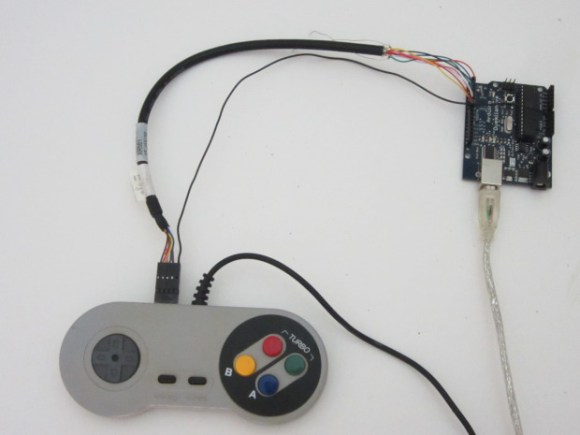
Here a straight-forward guide for tapping into the buttons on most gaming controllers. Why do something like this? Well there’s always the goal of conquering Mario through machine learning. But we hope this will further motivate hackers to donate their time and expertise developing specialized controllers for the disabled.

In this example a generic NES knock-off controller gets a breakout header for all of the controls. Upon close inspection of the PCB inside it’s clear that the buttons simply short out a trace to ground. By soldering a jumper between the active trace for each button and a female header the controller can still be used as normal, or can have button presses injected by a microcontroller.

The Arduino seen above simulates button presses by driving a pin low. From here you can develop larger buttons, foot pedals, or maybe even some software commands based on head movement or another adaptive technology.

Continue reading “No Nonsense Guide For Patching Into A Gaming Controller”
Gas, Water, And Electricity Monitoring

???????????????????????????????

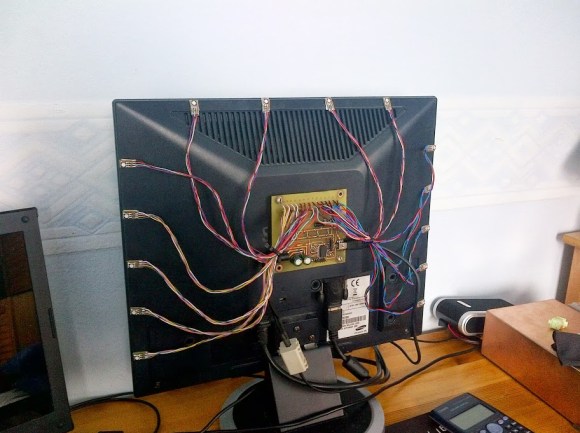
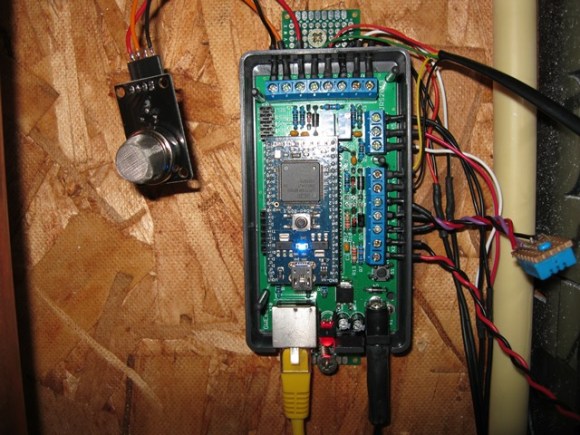
From the look of this you can tell that [Jasper Sikken] has some pretty interesting stuff going on to monitor the utilities in his home. But it’s important to note that this is a rental home. So adding sensors to the gas, water, and electric meters had to be done without making any type of permanent changes.

The module above is his own base PCB which accepts an mbed board to harvest and report on usage. His electric meter has an LED that will flash for every Watt hour that is used. He monitors that with a light dependent resistor, crafting a clever way to fasten it to the meter using four magnets. The water meter has a disc that makes one revolution for each liter of water that passes through it. Half of the disc is reflective so he uses a photoreflective sensor to keep track of that. And finally the gas meter has a reflective digit on one of the wheels. The sensor tracks each time this digit passes by, signifying 10 liters of gas used. He also monitors temperature which we’re sure comes in handy when trying to make sense of the data.

[Thanks Stephen]


Computer Monitor Ambilight Clone Shows Remarkable Performance

ambilight-project-discreet-led-boards

Check out this fantastic Ambilight clone for a computer monitor which [Brafilus] has been working on for a few years. It’s actually the third revision and watching the demo video below left our jaws agape.

Details are only available as comments on the YouTube page. But he’s given us just enough to be satisfied. His self-etched board hosts a PIC 18F14K50 microcontroller. It is talking to each of the 28 LED pixels which themselves live on tiny hunks of diy PCB as well. He wrote his own PC software in C# to capture the colors around the edges of the screen. He also worked hard to ensure there are plenty of tweaks available for true color matching between the monitor and what your eye sees bouncing off of the wall.

If you’re looking for something like this on your television set go back a couple of days and check out that standalone unit.

Continue reading “Computer Monitor Ambilight Clone Shows Remarkable Performance”

A Different Type Of Arduino Internet Shield

different-arduino-internet-shield

The cost of an Ethernet shield for an Arduino isn’t horrible; generally between $17 and $32 depending on which one you buy. But have you seen the cost of a WiFi shield? Those are running North of $70! [Martin Melchior] has a solution that provides your choice of Ethernet or WiFi at a low-cost and it’ll work for most applications. He’s using a WiFi router as an Arduino Internet shield.

This is the TP-Link WR703N which has been very popular with hackers because of its combination of low price (easy to find at $25 or less) and many features: the USB is super hand and, well, it’s a WiFi router! The Arduino Pro Mini shown dead-bug style is talking to the router using its serial port. [Martin] wires a pin socket to the router, which makes the rest of assembly as easy as plugging the two together. The rest of his post deals with handling bi-directional communications with Arduino code.

If you really just need that direct Ethernet pipe consider building an ENC28J60 chip into your designs.

Adding A Digital Timer To A Cable Release Camera

slr-cable-release-timer

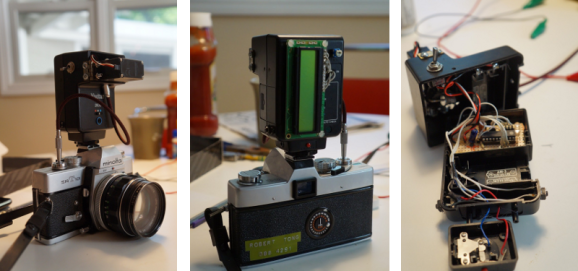
Here’s a completely non-invasive hack for a classic Minolta SLR camera. [Robby] wanted to add to the options available when it comes to remote shutter release. He ended up building a cable release add-on that mounts on the hot shoe.

He drew some of his inspiration from a similar project we saw back in March. He took the engineering example from that project which uses a small servo motor to actuate the cable release. But along the way added his own features.

The system centers around an ATtiny4313 microcontroller. It provides feedback using the character LCD on the back of the auxiliary flash body. That flash body also offers a battery compartment which provides power for the control circuitry as well as the servo motor. Right now it functions as a count-down timer, and also can hold the shutter a specified amount of time. But we could see this extended to work with external sensors to trigger at a set light level, when sensing motion, or from a remote control.

The Most Advanced Microwave You’ll Ever Own

raspberry-pi-microwave

Voice activation, one-touch cooking, web controls, cooking settings based on UPC… have you ever seen a microwave with all of these features? We sure haven’t. We thought it was nice that ours have a reheat button with three different settings. But holy crap, what if you could actually program your microwave to the exact settings of your choice? You can, if you let a Raspberry Pi do the cooking.

This hack run deep and results in a final product with a high WAF. Nathan started by taking apart his old microwave. He took pictures of the flexible sheets that make up the control button matrix in order to reverse engineer their design. This led him to etch his own circuit board to hook the inputs up to a Raspberry Pi board and take command of all the appliance’s other hardware. Because it also drives the seven segment display you’ll never see the wrong time on this appliance again. It’s set based on NTP.

We mentioned you can tweak settings for a specific food. The best way of doing this is shown in the demo video. The web interface is used to program the settings. Recalling them is as simple as using the barcode reader to scan the UPC. Amazing.

Now you can keep that old microwave working, rather than just scraping it for parts.

Continue reading “The Most Advanced Microwave You’ll Ever Own”

Web Based Automation Courtesy Of Raspberry Pi

web-based-automation-via-rpi

This project is a great example of the Raspberry Pi’s ability to eclipse Arduino when it comes to interaction. [Fall Deaf] mentions that he used to use an Arduino board with an Ethernet shield to add extensible interactivity to his project. But this one, which is a home automation lamp project, uses a Raspberry Pi instead. The concepts end up being very similar. But the cost of the hardware is less and the coding work is arguably orders of magnitude easier.

Don’t get us wrong, the hardware is fundamentally different. When you move from Arduino to RPi you lose some I/O pins and the low level control of them isn’t quite as straight-forward. But you also don’t have to program the thing in C. The Linux kernel handles the low level control which means you can write your scripts using Python. Because Python is an interpreted language the testing and debugging is much faster — no need to flash new code, just run the script again.

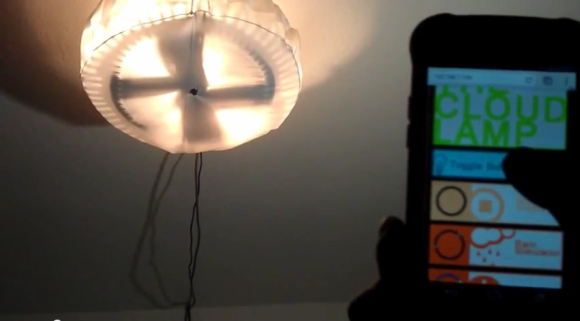
This project used the RPi GPIO to drive a strip of LEDs which use the WS2801 protocol. The board includes a NIC which makes it a snap to use as a web server. The smart phone controls seen above are served up from the Pi using jQuery. Right now there’s a cord running out of the lamp. But there should be plenty of room to use a screw-in outlet adapter and to hide the RPi and its PSU inside.

The board still has enough juice to drive other automation features too, like acting as a web radio server.

Continue reading “Web Based Automation Courtesy Of Raspberry Pi”