Salvaging Lithium Cells And Circuits

Lithium cells outperform Nickel Cadmium and Nickel Metal Hydride in almost every way. But they also need a little bit more babysitting to get the most out of them. That comes in the form of control circuitry that charges them correctly and won’t let them get below a certain voltage threshold during discharge. We enjoyed reading about [Carlos’] Lithium cell salvage efforts as it discusses these concerns.

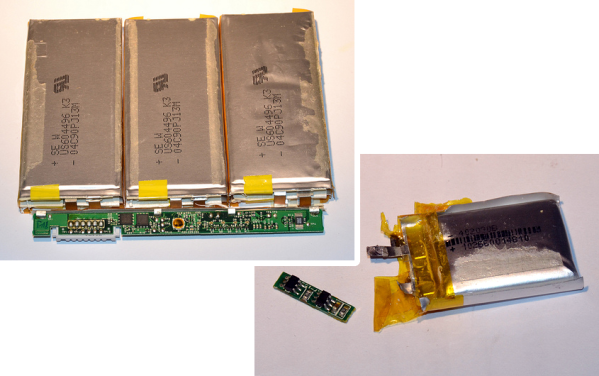
He wanted to salvage a Lithium power source for his projects. He had the three cell pack from a dead Macbook Pro seen in the upper left, as well as the single blown cell from a digital picture frame shown on the right. The three-pack didn’t monitor each cell individually, so the death of one borked the entire battery. He desoldered them and probed their voltage level to find one that was still usable. To prevent his project from draining the source below the 2.7V mark he scavenged that circuit board from the digital picture frame. A bit of testing and the system is up and running in a different piece of hardware.

Don’t be afraid of this stuff. If you learn the basics it’ll be easy to use these powerful batteries in your projects. For more background check out this charging tutorial.
USB Sniffing With The BeagleBoard-xM

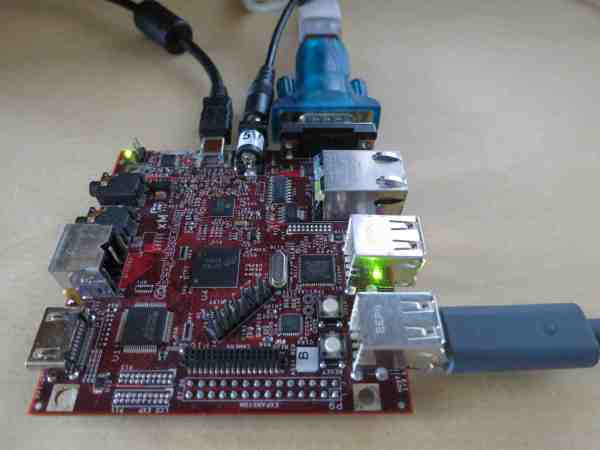
[Matlo] wrote in to share his USB sniffing project using the BeagleBoard-xM. It builds on the Google Summer of Code project from 2010 that used the non-xM version of the hardware to build a pass through USB sniffer. [Matlo] couldn’t get it to work back then, but recently revisited the project. He’s cleaned up some scripts and generally made it a bit easier for others to pull off as well.

The ARM-based BeagleBoard seen above acts as man-in-the-middle. You connect your target USB device to the board and the board to a computer. The board emulates the target device, passing packets in either direction while also logging them. The captured data is in the correct format for display using WireShark, the de facto standard for making sense of captured communication packets.

This is great for figuring out how to use USB devices on non-standard systems, or vice versa.

Briefcase Mill

briefcase-mill

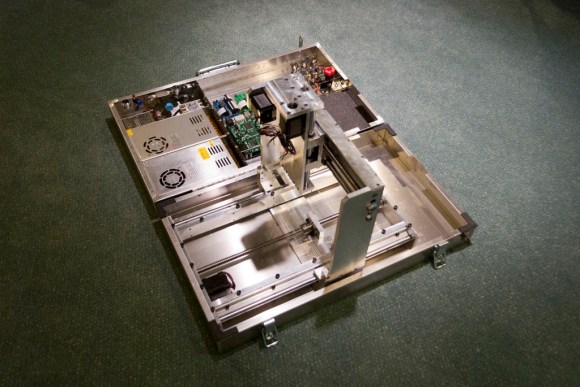
Take the machine shop with you; that’s the mantra which drove [Ryan] to build this CNC mill in a briefcase. That album will give you a taste of the final product. But you’ll want to dig through two pages of his forum thread starting with this post in order to behold the build process.

The image above is only part way through the fabrication, but we thought it gave the best overall view of his work. It’s missing the cables which connect to the control circuitry in the lid. The bed has also not been installed and this was before he fabricated the protective case for the PCBs.

Getting everything to fit inside of a folding case was quite a trick. Of course he used CAD to make sure it was possible. There are several places where the clearance when closed is about 2mm. We’re shocked by the build quality of the mill itself. It’s a novel idea to make it portable, but the accuracy and reliability of the machine didn’t suffer for the concept.

If you need a desktop mill that’s not quite as portable here’s a project which will dish out some inspiration.

Raspberry Pi Automates Your Tomato Farm

rpi-tomato-farming

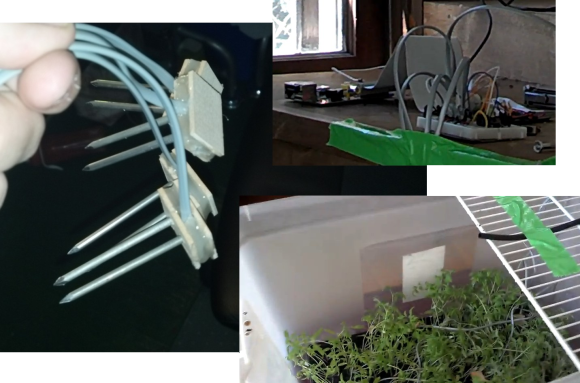
Check out the tomato plants [Devon] grew using a monitoring system he built himself. It’s based around a Raspberry Pi. As far as grow controllers go it falls a bit short of full automation. That’s because the only thing it can actuate is the black water line seen hovering above the plants. But [Devon’s] work on monitoring and collecting sensor data should make it easy to add features in the future.

The moisture sensors pictured above monitor the soil in which the plants are growing. But he also has temperature and light sensors. These are very important when growing from seed and could be used in conjunction with a heating mat for plants that require higher soil temperatures (like pepper plants). The tomatoes are also pretty leggy. Now that he’s monitoring light levels it would be good to augment the setup with a grow light. A long term goal could even be a motorized bed which could raise the plants right up to the bulbs so they don’t reach for the light.

Don’t let the stars in our eyes distract you though. He’s done a ton of work on the project both with the physical build, and in plotting the data collected by the system. Great job!

Continue reading “Raspberry Pi Automates Your Tomato Farm”

Build Your Own Steel Reinforced Storm Shelter

build-a-steel-reinforced-storm-shelter

The last few years have seen a lot of dangerous storms rip through middle section of the United States. We’re surprised to hear that many residents in that part of the country don’t have basements to take refuge in when in imminent danger. But a resourceful hacker will always be able to find a way to improve their own situation. This example is particularly useful. It’s a steel storm shelter which opens into the garage.

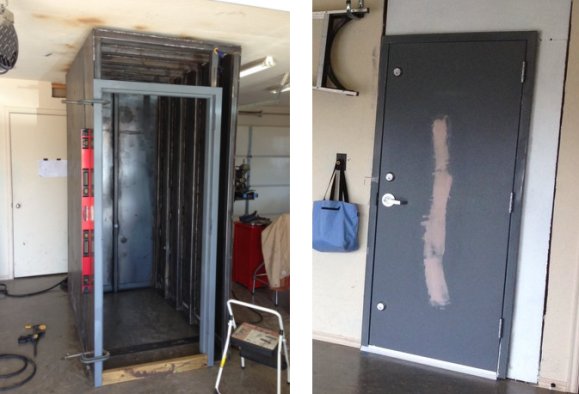
It all starts with a cage made of square tube. With the skeleton fully assembled it is wrapped in steel plate, adding weld joints running nearly the entire length of each of the cage’s ribs. The image at the left shows the steel door frame clamped in position. Check out the finished version on the right after the shelter has been slid into place and bolted to the concrete slab.

The Reddit discussion includes a debate on whether the door should swing in or out. Swinging out means you could be trapped if the opening is blocked by debris. But there may be scientific research that proves this is a better orientation. Either way, we hope the three dead bolts, door latch, and heavy-duty hinges will stand up to the pressure if this is ever used.

Hackaday Links: Sunday, June 30th, 2013

hackaday-links-chain

The race is on to squeeze cycles out of an 8MHz AVR chip in order to better drive the WS2811 LED protocol.

[Asher] doesn’t want to buy charcoal aquarium filters if he can just build them himself. He filled a couple of plastic drink bottles with charcoal, cut slots in the sides, and hooked them up to his pump system. A gallery of his work is available after the break.

Is the best way to make microscopic sized batteries to 3d print them? Harvard researchers think so. [Thanks Jonathan and Itay]

The Ouya gaming console is now available for the general public. [Hunter Davis] reports that the Retrode works with Ouya out-of-the-box. If you don’t remember hearing about it, Retrode reads your original cartridge ROMs for use with emulators.

Making a cluster computer out of 300 Raspberry Pi boards sounds like a nightmare. Organization is the key to this project.

Hackaday alum [Jeremy Cook] is working on an animatronic cigar box. Here he’s demonstrating it’s ability to listen for voice commands.

A Kelvin clips is a type of crocodile clip that has the two jaws insulated from each other. [Kaushlesh] came up with a way to turn them into tweezer probes.

Continue reading “Hackaday Links: Sunday, June 30th, 2013”

Air-powered Gripper Design Makes Them Easy To Produce

air-powered-gripper

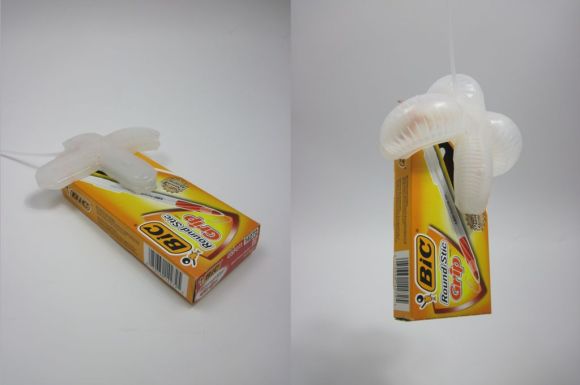
This invertebrate gripper uses air pressure to grab onto objects. The secret is all in the design. But you don’t have to reinvent the wheel. If you’ve got a 3D printer you can follow this guide to make your own.

The gripper is made of silicone. The trick is in designing an inner structure that deforms in one direction when pressurized. To make one or one hundred, simply download the design files and 3D print a mold. The process from there is much like the silicone band prototyping process we looked at back in March. The two-part silicone is mixed and poured in the mold. You also need to pour some on a flat surface. We were under the impression that uncured silicone would not stick to cured silicone but we were wrong. The two parts are glued together with a fresh batch of the mix. After everything has set up you can pierce the bladder with a hose in order to inject air.

Below you can see the star-shaped version being tested. There’s also a Harvard research video which shows a similar design lifting an egg.

Continue reading “Air-powered Gripper Design Makes Them Easy To Produce”