Cooling A Photomultiplier Tube

photomultiplier-tube-cooling-rig

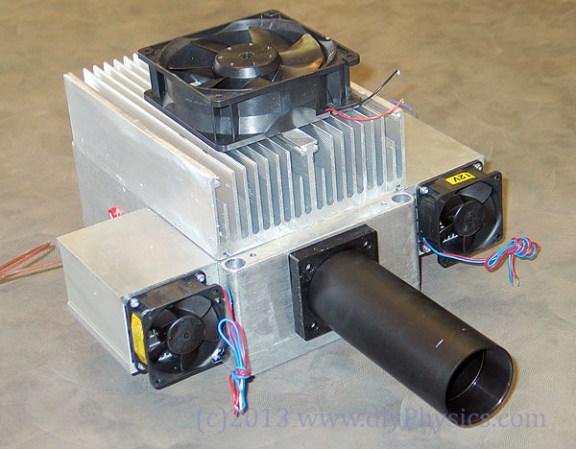
A photomultiplier tube is a device used to measure very low levels of light. It’s a common tool of particle physics when trying to detect just a few photons. It turns out that running a tube at room temperature will not provide the best results. To improve the accuracy and sensitivity of his equipment [David Prutchi] built this thermoelectric photomultiplier tube cooling rig.

You can’t actually see the tube in this image but it looks similar to a vacuum tube or Nixie tube. The difference being that the components inside the glass dome make up the detector instead of an amplifier or filament display. To make a physical interface with the glass [David] wrapped it in magnetic shielding and finished with a layer of aluminum foil tape. This cylinder was then snugly fit inside of an aluminum heat sync. two Peltier coolers were attached to the outside of the heat sync, using Arctic Silver thermal compound to help transmit heat. A thermocouple was also added to monitor the temperature of this first stage of cooling. All of this fits into an aluminum enclosure which was filled with expanding spray foam before having a trio of fan-cooled heat syncs attached to it.
Kindle Weather And Recycling Display

kindle-weather-and-recycling-display

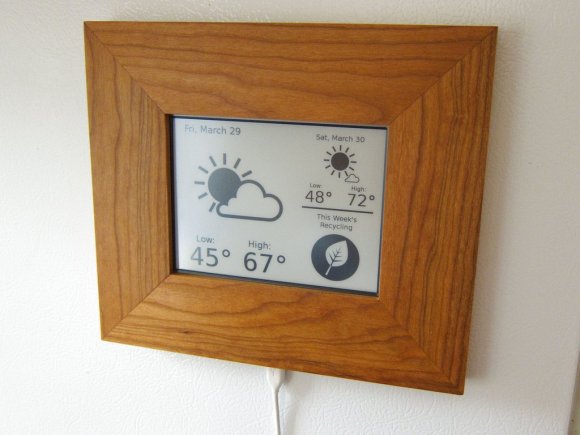
We’ve seen a fair number of hacks like this one that reuse a Kindle basically just for its ePaper display. [HaHaBird] has this device hanging on his refrigerator to display the weather and remind him about recycling day. It kind of make us wonder why we’re not seeing cheap ePaper modules on the hobby market?

The concept isn’t new, but [HaHaBird] does move it along just a little bit. He started by following the guide which [Matt] wrote after pulling off the original Kindle weather display hack. It uses a separate computer running a script that polls the Internet for weather data and generates a vector graphic like the one seen above. The Kindle then loads the image once every five minutes thanks to a cron job on the rooted device. But why stop there? [HaHaBird] tweaked the script to include a reminder about his municipality’s irregular recycling schedule.

Don’t overlook the quality of the hardware side of this hack. With its prominent place in the kitchen he wanted a nicely finished look. This was achieved by building a frame out of cherry and routing passages on the back to make room for the extension cable (so it could hang in landscape orientation) and a toggle to hold the Kindle firmly in place. Additional information on the build is available here.

Visualize Twitter With An LED Matrix

visualizing-twitter

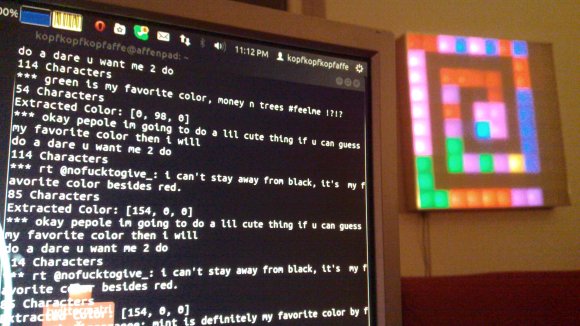
What’s your favorite color? Don’t tell us, Tweet it to [Sebastian’s] favorite color Twitter display and you’ll be contributing to the artwork hanging on his wall.

This answers a very important question, what do you do with your projects after they’re completed? For us the best part is the planning and building. Once it’s done the thrill is pretty much gone for us. We haven’t even switched on our Ping Pong clock in over a year. But [Sebastian] recently dusted his 10×10 LED matrix for this project.

Tweets are parsed by a Python project he wrote to try out the Twitter API. It looks for a set list of colors . He asserts that people aren’t that creative when you solicit their favorite color but to prove him wrong we’re going to say our favorite is Amaranth. After it finds the color it pushes it to the next pixel in the spiraling pattern shown above. But wait, there’s more! To give the pixels a but if extra meaning he uses the total length of the tweet to set intensity.

If you need a Titter enabled hack that displays a bit more specific data you’ll want something that can actually display what was Tweeted.

Building RAM Into Veronica – The 6502 Computer

ram-for-veronica

It seems strange that RAM is being added to a computer so late in the build, but [Quinn Dunki] must have had it in the back of her mind the whole time because it turns out to be a rather painless experience. For those of you keeping score, this makes her Veronica project Turing complete.

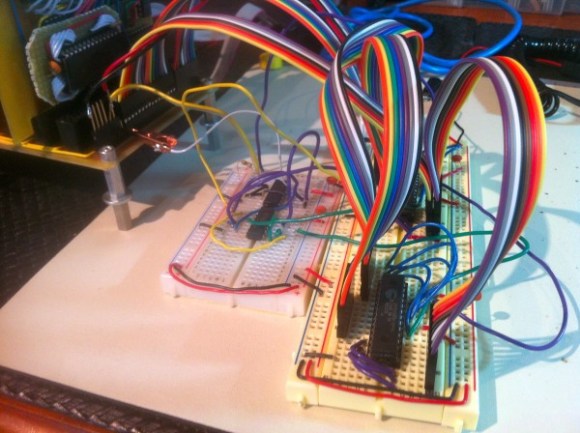
The brightly colored rats nest pictured above connects the new components to the 6502 computer backplane seen in the upper left. [Quinn] decided to go with two 32K SRAM modules which need very little in the way of drive hardware (it’s hanging out on the breadboard to the left). The RAM module will simply listen for its address and react accordingly. There is one hitch regarding a two-phase clock and the need to protect the RAM from erroneous data during the first of those phases.

Getting this all to work actually pointed out a bug in the ROM module she had long ago completed. After picking up on the problem she was able to correct it simply by cutting traces and soldering in jumper wires.

Images Carrying An Encrypted Data Payload

encrypted-data-image

This is a tidy looking banner image. But according to [Ian] it contains 52KB of source code. You can’t just read out all of that data. Well, you can but it will be gibberish. Before hiding the bits in plain sight he encrypted them with two different keys.

He’s using AES-256 encryption to keep his data away from prying eyes. But if that wasn’t enough, he also wrote a PHP program to hide the bits in a PNG image. Not just any picture will do (otherwise your eye will be able to see something’s awry). The post linked above focuses mainly on how to choose an image that will hide your data most easily. We asked him if he would share his techniques for actually merging the encrypted file with the picture and he delivered. Head on over to his repository if you want to take a look at the generator code.

Add Features (that Should Have Already Been There) To An EPROM Programmer

extending-an-eprom-programmer

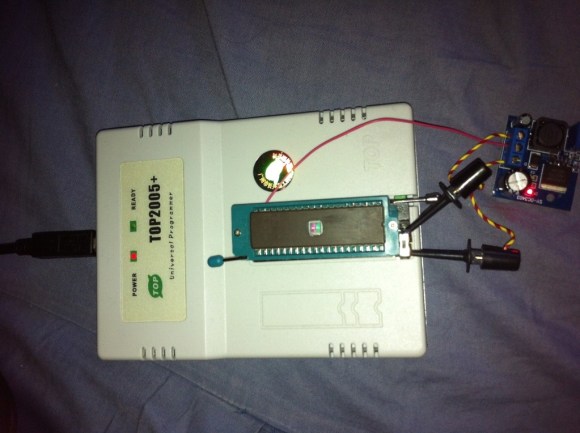
[Morten Overgaard Hansen] has a cheap EPROM programmer which he uses to program chips for retro gaming (among other things). He was surprised that although the device includes a 40-pin ZIF socket it seems to lack the ability to program 16-bit chips. He figured he could get it to play ball if he put in a little effort. Above you can see that a few add-on parts enabled 16-bit programming on the device.

If you look inside the case you may be surprised to find it uses an FPGA. [Morten] searched around and found a few others online who had been looking to stretch the functionality of these types of programmer. Specifically, he came across a Python program for this programmer’s bigger bother that already implemented the functions necessary to program the larger chips. He used it as a guide when writing his own programming application.

On the hardware side of things he needed to feed a higher voltage to the VCC pin, which is done with the boost converter seen to the right. He also added some jumper wires to manage the output enable signal. To make the whole thing modular he ordered a ZIF socket with long pins and soldered the alterations in place. Look closely and you’ll see two levers for ZIF sockets. The one on the right is for the original socket, the one on the left is for the adapter.

Treasure Trove Of Swarm Robotics Research

swarm-robotics

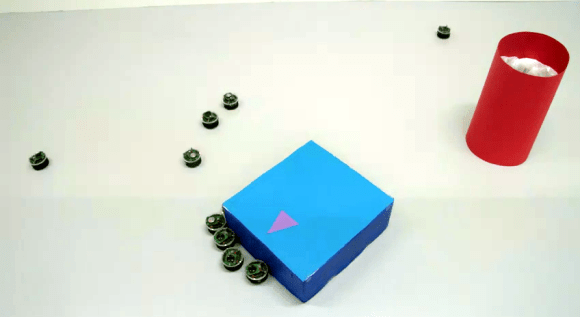
The screen capture above shows a group of swarm robots working together to move the blue box from the left side of the frame over to the right. It’s just one of many demonstrations shown in the video clip after the break. The clip is a quick sampling of the many swarm robotics research projects going on at the University of Sheffield’s Natural Robotics Lab.

The main focus for all of the research is to see what can be accomplished by getting a large group of relatively simple machines to work together. Each device has a microcontroller brain, camera, accelerometer, proximity sensors, and a microphone. By mixing and matching the use of available components they can test different concepts which will be useful in creating utility robot swarms for real-world tasks. The video shows off the robots grouping themselves by like characteristic, a test called segregation (the purpose of this didn’t resonate with us), and group tasks like moving that box. The nice thing is that a series of white papers is available at the post linked above (click on the PDF icon) so that you may dig deeper if these projects are of interest to you.

Continue reading “Treasure Trove Of Swarm Robotics Research”