Versatile Motion Dolly For Time Lapse Photography

time-lapse-motion-system

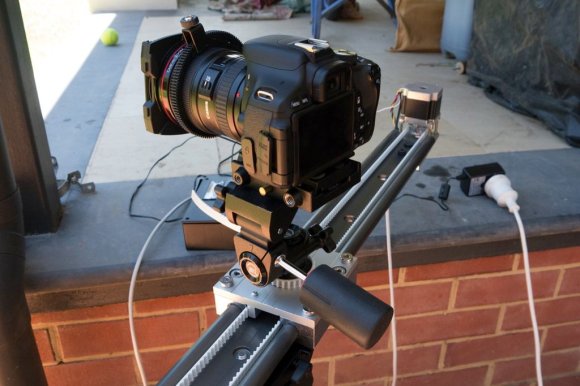
This beautiful build is a motion dolly for making time-lapse videos. It is at a point where you could consider it complete. After all, the segments featured in the video after the break look marvelous. But [Scottpotamas] has a few additions planned and it sounds like it won’t belong before he accomplishes his goals.

The build is a linear rail on which the camera rides. In the image above you can see the stepper motor which moves the camera mounted at the far end of the rig. This is controlled by an Arduino. Currently the camera is responsible for timing the capture of the images, but [Scottpotamas] says the firmware is nearly ready to hand this responsiblity over to the Arduino. The system is modular, with a simple setting for the length of the track. This way he can swap out for a longer or shorter rail which only takes about five minutes. He also included support for a panning mount for the camera. It allows the control box can be programmed to keep the subject centered in the frame as the camera slides along the track.

Continue reading “Versatile Motion Dolly For Time Lapse Photography”
Bubble Wrap Cure For Nexus 7 Speaker Distortion

nexus-7-bubble-wrap-fix

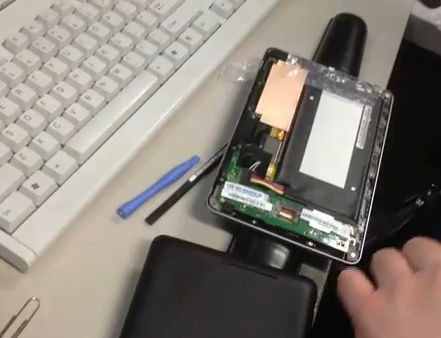
[Home Brand Cola] is quite happy with his Nexus 7 with the exception of the built-in speaker. It produces fairly good audio quality until he reaches about 50% volume level. Anything above that produces distortion. He figured out how to fix it using a small piece of bubble wrap.

The eureka moment came when he was using his Nexus 7 and discovered he could fix the distortion by gripping the top and bottom parts of the case strongly between his finger and thumb. This led him to realize that the speaker unit is a bit loose and the unwanted noise is produced when it vibrates against the case. The video after the break shows the fix, which places a strip of bubble wrap (looks to be about 1″ by 3″) on top of that speaker unit. When the case is snapped back together the packing material helps hold everything in place and now he can use his tablet at full volume without any problems. One of the comments on the Reddit thread asks about heat problems with the addition of this plastic. He’s been using it for a few weeks and so far no issues there.

Continue reading “Bubble Wrap Cure For Nexus 7 Speaker Distortion”

Electric Imp Makes A Cat Door Tweet Its Activities

electric-imp-tweeting-cat-door

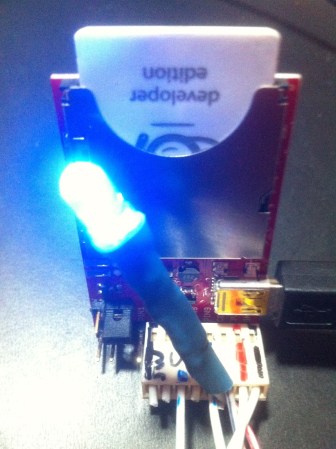
This Tweeting cat door uses the Electric Imp to read a sensor and report back to the server. The hardware is pretty neat. The board hosts an ARM Cortex-M3 processor and gets on your home network via WiFi. The mini-USB cable simply provides the power. Programming is done over the network. Our own [Brian Benchoff] had a chance to try the Imp out earlier in the Fall.

Monitoring a cat door is as good a reason as any to undertake a project. The hardware added to the board includes a reed switch mounted on the jamb along with a magnet on the door itself. There is also a blue LED that gives a bit of user feedback. The software isn’t quite as easy but it still wasn’t that bad. As with most web-connected projects getting all the parts to talk to each other was a bit of a chore. The Imp reports back to a server on the local network which then activates a PHP script that uses Sen.se to push out a Tweet.

[Thanks Pat]

Is Entropy Slowing Down Your Android Device?

071210_1705_AndroidDev11.jpg

[Lambgx02] got tired of his Android device getting bogged down and decided to dig down to the cause of the issue. His investigation led him to believe that entropy is causing the slowdown. He believes that his workaround reduces 90% of the lag on the average Android device.

So how is it possible that entropy is causing the problem? It seems there is a bottleneck when an app requests a random number from the Linux kernel running at the lowest level of the device. Android is set up to use /dev/random for all random number requests, but [Lambgx02] says that location has a very shallow pool of numbers available. When they run out the kernel has to reload with a new seed and this is blocking the app that requested the data from continuing.

His solution was to write his own app that seeds /dev/random once every second using a number from /dev/urandom. He mentions that this might cause a security vulnerability as seeding the random data in this way is not quite as random. There may also be issues with battery life, so make sure to monitor performance if you give it a try.

[via Reddit]

Estimate Velocity Using Quadrature Encoder Data

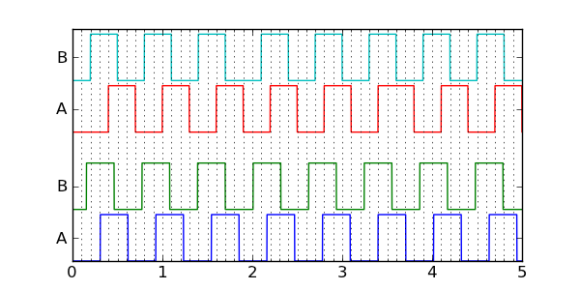
quadrature-encoder-velocityMany motors offer a quadrature encoder that give feedback on whether, and in which direction, the motor shaft is moving. But if you’re clever about analyzing the data you can use a quadrature encoder to estimate motor velocity. [Jason Sachs] makes the case that it’s fairly easy to get this wrong. Lucky for us he has carefully laid out his process of extrapolating velocity from the two edge-trigger data sources.
The process starts with reading from the encoder. Many chips have peripherals that will interface with a rotary encoder, but hardware lacking that built-in helper can still be used by monitoring pin-change interrupts. Once connected samples are taken over time and the rest is left to the quality of your algorithm.

What can this velocity data be used for? That’s up to you. But we can think of a couple of projects. It may be useful in a spinning POV display like this FPGA-based beauty. You also find quadrature encoders in exercise equipment. Knowing the velocity will help if you’re building your own computer to replace what came with that Stairmaster.

[via Reddit]

Dedicated Pandora Player Plus AirPlay Built Around The Raspberry Pi

rpi-pandora-radio

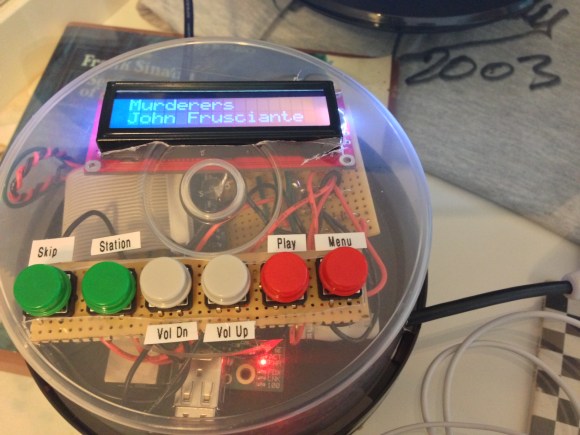
[Shaun Gehring] wanted an Internet radio player. Although he did have some troubles along the way, the final project turned out very well. Housed inside this case which used to house a spindle of bland CDs is a Raspberry Pi that plays Pandora radio and serves as an AirPlay receiver.

The GPIO header of the RPi makes this project a lot easier. [Shaun] used Adafruit’s breakout board to solder connections for the six buttons and the character LCD screen. Plug some speakers into the audio jack and the hardware end of the deal is finished. The software side of things is very similar to the BeagleBone Pandora player we looked at in September. It uses a Linux distribution (Rasbian Weezy) and the Pianobar package.

Pianobar is very versatile. You can control it using a First-In First-Out file. Once [Shaun] figured out how to use mkfifo to set up the file, he was able to control it from a script by monitor button presses and echoing the associated command to the FIFO. The finishing touch was to add AirPlay support via the shairport package.

Van De Graaff Generator Built For A Few Dollars

2-dollar-van-de-graaff-generator

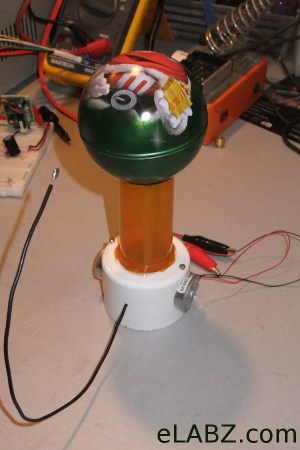
This Van de Graaf generator was built using mostly parts on hand. The only thing that was purchased for the project was the Christmas ornament shaped M&M candy tin that serves as the collecting sphere. We didn’t include the in-action shot in the banner because it’s so dark. But sure enough, this will generate the visible sparks that make the device famous.

The gist of the device is that it uses rotating belt to generate static electricity. This potential is stored in the metal collecting sphere on top until a path for discharge is provided. They’re an awful lot of fun in middle-school science class as long hair can be made to stand on end if you touch one while your body is insulated from ground. This build uses a long rubber band as the belt. The band is moved by the motor from a DVD drive tray which is housed in the PVC base. An empty prescription pill bottle bridges the gap between the base and the metal sphere.

If this one is too small for you consider moving to a 900,000 Volt version.

[via Hacked Gadgets]