Ironman Replica Twofer

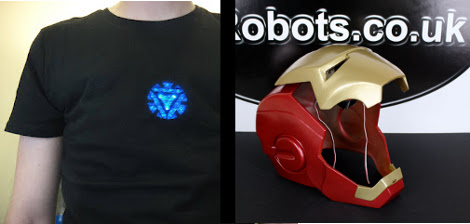
We think it’s a bit to late to show up for a screening of The Avengers in full costume, but an arc reactor T-shirt would be pretty cool. [4ndreas] built a chest strap that looks much like [Tony Stark’s] chest-mounted power source. It has a 3D printed enclosure which hosts the ATmega8 and 22 LEDs which provide the pulsing goodness. The thin cellphone battery helps to keep the size of the package to a minimum and a strategically placed hole in a black T-shirt completes the look. It’s even bright enough to shine through the fabric of this black T-shirt.

But if you insist on head-to-toe regalia you’ll appreciate [James Bruton’s] Ironman suit replica build. Not only does he look the part, but he’s trying to build as much functionality into the project as possible. Most recently he finished the helmet. It’s got a motorized faceplate and LED edge-lit eye plates to impress hackers and cosplay fans alike.

Find video of both projects after the break.
Continue reading “Ironman Replica Twofer”

Hot Glue Appendages May Be Predecessor To The Flow Metal Of The T-1000

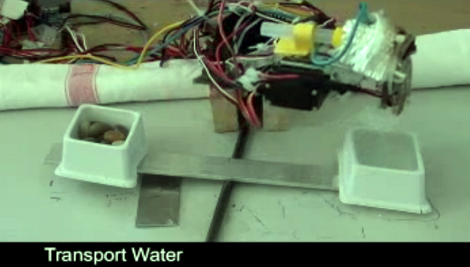
The T-1000 was the shape-shifting robot from T2 (the second Terminator movie). It was so amazing because it could assume the form and texture of anything; humans, piercing weapons, inanimate objects. This robot doesn’t even compare, except for one small trait. When it needs a tool, it can build it as its own appendage. This really is nothing more than making tools with a 3D printer. However, the normal boxy infrastructure is missing.

The print head is mounted on a single robot arm, and the tool is printed using hot melt glue in order to stick to a plate which makes up the business end of robot arm. In this case the robot needed to transport some water. It sets down the plate, uses the hot melt extruder to print a cup on that plate, then picks it up again and uses it to move water from one bowl to the other. You can see it all in the video clip below the fold.

Sure, it’s just baby steps. But hot melt glue sticks are light weight, and don’t require much energy to melt. This makes for a perfect combination as a portable tool shop.

Continue reading “Hot Glue Appendages May Be Predecessor To The Flow Metal Of The T-1000”

Rebuilding A Fried Fan Motor

The fan motor on [Pete’s] oscillating tower fan conked out on him. It’s a shame to throw away the whole thing, but it’s near impossible to source parts for a small appliance like this one. So he set out to rebuilt the motor and get the thing working like new.

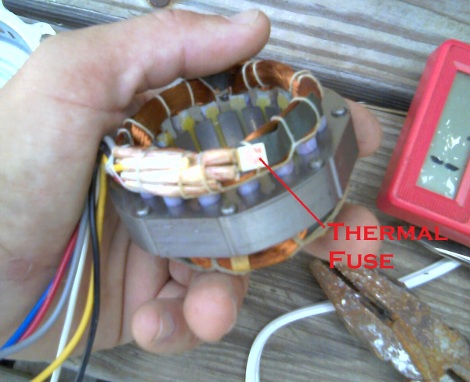
The motor in question is of the brushless AC variety. [Pete’s] gut told him that the failure was due to bad lubrication of the bearings at the factory. It stopped working because the commutator could no longer rotate freely. A check of the continuity of each of the coils led him to this thermal fuse. When the motor seized the AC current built up a lot of heat. This fuse is made to burn out before a fire can start but now it needs to be replaced. With a new one in place he reassembled the motor, making sure to pack the bearings with some quality lubricant. Now he’s once again ready for a long hot summer.

The Engineer Guy Explains How MEMS Accelerometer Chips Work

There’s a good chance that you use a MEMS accelerometer every single day. It’s the small chip that let your smart phone automatically adjust its screen orientation. They’re great chips, and since they’re mass-produced you can add them to your projects for a song (if you can abide the tiny packaging). But we have no idea of how they are made and only a inkling of how they work. [Bill Hammack] has filled that knowledge gap with this explanation of how MEMS accelerometers are made and how they function.

Our base knowledge comes from the acronym: Micro Electro-Mechanical Systems. There’s something in the chip that moves (so much for solid state electronics; and it makes us wonder if these wear out). [Bill] includes a diagram in his video after the break which shows the silicon-based system that moves as it is affected by gravity. This changes the capacitive properties of the structure, which can be measured and reported to a microcontroller for further use. The structure is built using an intricate etching process which we never want to try out at home.

Looking for a project in which to use one of these devices? We’ve always been fond of this POV device.

Continue reading “The Engineer Guy Explains How MEMS Accelerometer Chips Work”

Viper Flight Simulator (a La Battlestar Galactica) Finished

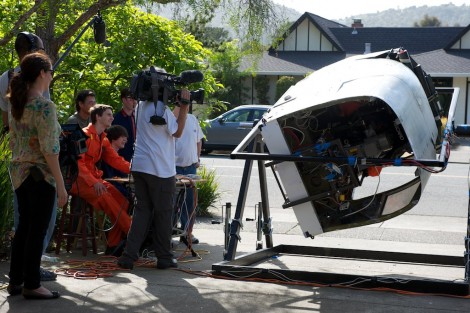
Here’s a story about some guys who set out to build a flight simulator for the Viper from Battlestar Galactica. The goal is to bring a grand project to the Maker Faire. This is a recurring challenge for the group, which has participated over the last several years. But this year they decided to go big and mounted a successful Kickstarter campaign to help with the cost.

The best place to get the build details is their progress updates page. Each week the cadre of teenagers tried to post some info about their progress, and we’ve got a big grin on our faces after reading through them. The simulator aims to provide you with as much of a space flight experience possible given the restraints which gravity imposes. The cockpit can roll and pitch a full 360 degrees in each direction. Of course safety is a concern and they were careful with their frame design and pilot restraint system. But so much more goes into this than just the physical build. There’s sound, lighting, and the virtual simulator, all of which have been complete at an impressive quality level. There’s a ton of video posted and we’ve embedded one short clip after the break showing off the cockpit’s dashboard.

Continue reading “Viper Flight Simulator (a La Battlestar Galactica) Finished”

Gyroscopically Stabilized Car/motorcycle Thing

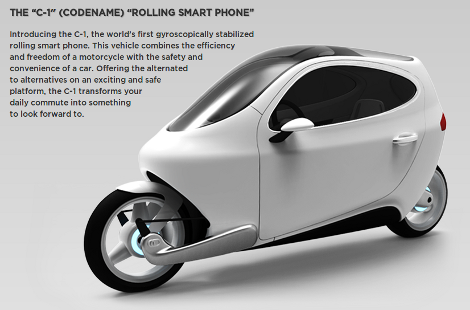
So yeah, this thing exists. Well, at least some pretty interesting looking prototypes of it do. It’s the C-1 from Lit Motors (anyone else think that’s a reference which belongs in /r/trees?). The idea here is that the small form-factor of a motorcycle is very efficient and easily maneuverable. But the cage protecting the passenger from harm, and the canopy keeping the elements out give it some of the desirable traits of a car.

Design aside, check out the video after the break. The prototype uses two horizontally positioned gyroscopes placed beneath the passenger seat, just in front of the rear wheel. The builders take it out on a hockey rink and give it a few kicks and slide a few tires into it. Sure, it reacts to the impact but it doesn’t fall over.

Want to see some fast-motion welding of the C-1? Right now there’s a one-minute clip up on the company’s main page.

Continue reading “Gyroscopically Stabilized Car/motorcycle Thing”

Update: Using Your Forearms As A UI

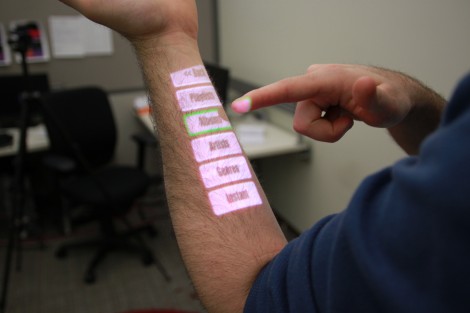
This image should look familiar to regular readers. It’s a concept that [Chris Harrison] has been working on for a while, and this hardware upgrade uses equipment which which we’re all familiar.

The newest rendition, which is named the Omnitouch, uses a shoulder-mounted system for both input and output. The functionality is the same as his Skinput project, but the goal is achieved in a different way. That used an arm cuff to electrically sense when and where you were touching your arm or hand. This uses a depth camera to do the sensing. In both cases, a pico projector provides the interactive feedback.

There’s a couple of really neat things about this upgrade. First, it has a pretty accurate multitouch capability. Second, it allows more surfaces to be used than just your arm. In fact, it can track moving surfaces and adjust accordingly. This is shown in the clip after the break when a printed document is edited in real time. Pretty neat stuff!

Continue reading “Update: Using Your Forearms As A UI”