Bananaphone Lets You Use Fruit And Other Things As Switches

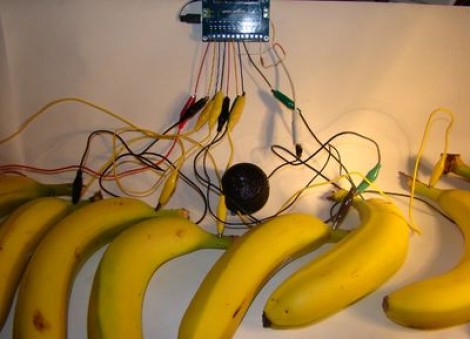
We’re used to [Sprite_TM] rolling out his own hacks hot on the heels of new concepts. Now we’re glad to see that [Jeff Ledger] is doing the same thing here. He was inspired by a Kickstarter project which vows to let you use fruit, clay, and a number of other common (but weird for this use) substances to interface with electronic projects. The mess you see above is the Bananaphone, a synthesizer played with touch sensitive bananas. Think of them as keys on a piano.

The interface works by measuring R/C decay. Each banana is connected to its own input pin on the Propeller board. The capacitance of the bananas rise when you touch them, and this results in a longer R/C decay measurement. Calibrate the target decay period, and you’ve got a reliable capacitive touch sensor which also happens to be delicious. Check out the results which [Jeff] achieves in the video after the break.

Continue reading “Bananaphone Lets You Use Fruit And Other Things As Switches”
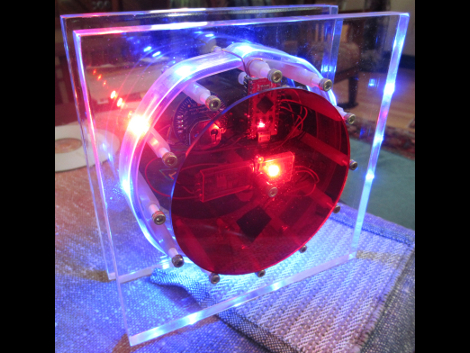
Time And Date Clock Does It With RGB LED Strips

[Craig’s] color clock really came together quite nicely. The majority of the body is acrylic, with two large clear squares and a pair of colored discs. All are held in place by a ring of hardware with spacers in them, and the RGB LED strip that is used to display time and date wraps around those spacers. This hides the components in the center, with a USB cord connecting to the Arduino compatible board to power the device.

Hours are displayed in red, with minutes shown in green, and blue used as a background color. In the center you can see one of two red LEDs which alternate like a pendulum to mark the passing seconds. There are timed events every ten , fifteen, and thirty minute. At the fifteen minute mark the clock switches to display the date. The other two events are animations to keep things interesting. All of the settings for the clock are accessed using just two momentary push buttons mounted on the back of the clock.

Continue reading “Time And Date Clock Does It With RGB LED Strips”

Mother’s Day Heart Chaser

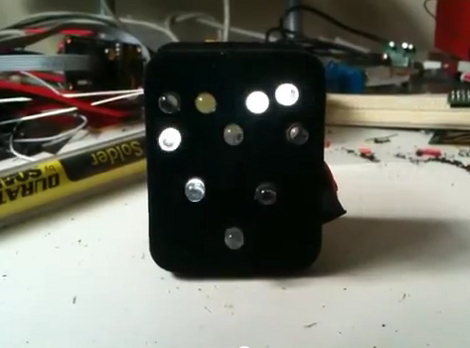
[Robert Mibus] took on a project which his kids could present to Mom on Mother’s Day. It’s an LED heart built into a ring or necklace box. The series of white LEDs are animated in a chase pattern. The project let [Robert] push his comfort boundaries by moving past a stock Arduino board.

Inside you’ll find an ATtiny85. He picked up the chip to try running Arduino sketches on smaller hardware. But the total of five available I/O pins presented an issue with driving the LEDs. Ten LEDs are used here and even a standard multiplex display would need no less than seven to control them without additional chips or the need for Charlieplexing. His solution was to drive two opposite LEDs at once, which cuts the need down to his five available pins.

Once he got it all soldered together he realized that he had made a coding error. But a few soldered wires let him reflash it in place using ISP.

Continue reading “Mother’s Day Heart Chaser”

Motion Sensitive RGB Lamp Can Standby For 3 Years

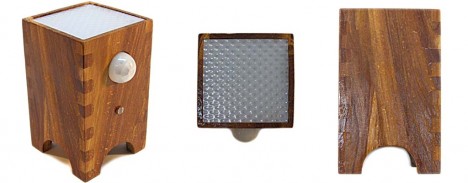
Ooooh, nice enclosure! This is a little motion sensing lamp which [Krazatchu] built a few years back as a Mother’s Day gift. The PIR sensor is easy enough to see as the white dome on the front of the case. But look closely below that and you’ll see the LDR which it uses to keep the thing asleep during the day. This is intended to save on batteries but the original version still ate through them like crazy. This year he gutted it and worked out a much more power-friendly design.

He moved to a TLC1079 OpAmp which greatly reduced power consumption when reading from the PIR sensor. The microcontroller was also upgraded from an ATtiny13 to an ATmega328, making the new version Arduino compatible. It puts itself to sleep and keeps the lights out during the day, drawing just 0.08 mA. When driving the RGB LED the lamp pulls about 50 mA. That should still last a while on three AA batteries but we’d still recommend using rechargeables.

Continue reading “Motion Sensitive RGB Lamp Can Standby For 3 Years”

A Simpler Sous-vide Hack

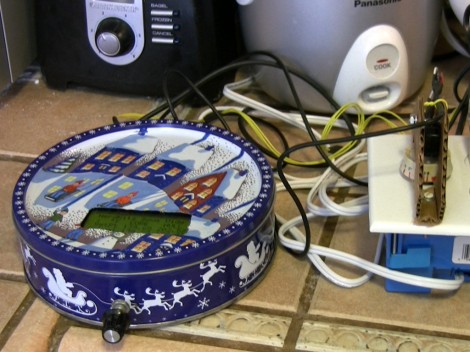
Here are the contronl modules for a sous-vide project over at Nerdkits. [Humberto] and crew continue doing a great job of focusing a project on one goal, then explaining the steps needed to get there. In this case they wanted to build their own sous-vide appliance that was cheap, and didn’t really require the user to deal with mains voltage. We like it because most of the parts can be found at a hardware store and big box store.

He started with a slow cooker, which is pretty standard. Next he needed a way to switch power to the device. Instead of using a solid state relay, he went for a standard dimmer switch. It’s build into a double gang electrical box, and controls an outlet which is occupying the second position in that box. Now current to the slow cooker is limited by the position of the dimmer. The next task was to add a cardboard frame which marries a servo motor to the dimmer’s knob.

With the control scheme in place [Humberto] needed a feedback sensor. He built his own water proof temperature probe by covering an LM34 temperature sensor with shrink tube and sealing the ends. Just one probe in the cooking water isn’t very reliable so he added a second between the slow cooker’s base and ceramic vessel to improve the performace of the PID algorithm. He goes into detail about that in the video after the break.

Continue reading “A Simpler Sous-vide Hack”

IPhone Wielding Guitar Adds Tip Of Your Finger Or Tip The Instrument Control

[Rob Morris] has been hard at working improving his guitar augmentation techniques. Here he’s demonstrating the use of an iPhone to control the effects while he plays. This builds on the work he shared a few years ago where he strapped a Wii remote to the body of his ax.

Just like the Wii remote, the iPhone includes an accelerometer. As you would expect the best parts of the older hack made it into this one, but the inclusion of the touch screen adds a lot more. In the clip after the break he starts by showing off the screen controlling a whammy bar functionality. But we really love the octave offset feature that comes next. This kind of sound manipulation simply can’t be done using a purely physical method (like the whammy bar can). But he’s not done yet. The demo finishes with a Theremin feature. You’ll notice he plucks a string but no sound comes out until he starts touching the screen. This turns it into an entirely different type of instrument.

The only info we have about putting this together is the list of packages he’s using:  TouchOSC, Max/Msp, and GuitarRig

Continue reading “IPhone Wielding Guitar Adds Tip Of Your Finger Or Tip The Instrument Control”

Prototyping A Solar Charger For Your Truck

[Bryan] got his hands on a solar panel and decided to take it on the road rather than throwing it on the roof of the house. On sunny days it will top off the car battery, letting him use his stereo in the middle of nowhere without needing to keep the engine running. Instead of buying a ready-made solution he chose to design and build his own charging circuitry.

The charger uses an Arduino, which draws its own power from the panel via a regulator. It senses the voltage level of the battery and the available juice from the panel, connecting or disconnecting it from the electrical system as necessary. The system includes a set of LED indicators, which he installed in the dashboard near the cigarette lighter. This also gave him an excuse to install a voltmeter which uses a 2.5 digit seven segment display to read out the battery voltage. You can see a brief overview after the break.

Continue reading “Prototyping A Solar Charger For Your Truck”