Sliding Camera Mount Is Good Enough For Amateur Photography

[Unihopper] built this sliding camera mount to add some motion to his freestyle unicycle videos. It’s extremely simple, but still pulls off a pretty nice effect as you can see in the clip after the break.

The image above shows the mount without a camera attached.  You can see the threaded peg on the block in the foreground which is used for that purpose. Felt has been wrapped around the base of the block, which rides in a wooden channel. The string, which connects to an eye hook in the wood block, is attached to a spool on the far end of the plank. A K’nex motor drives that spool, slowly sliding the camera toward it.

Unlike other toy-based sleds, the use of a track system helps to maintain proper orientation of the camera. Obviously this isn’t going to achieve the perfectly smooth and precise motion you’d get out of a sled system like this rail and linear bearing version. But honestly, most of us don’t have cameras of the quality to warrant that type of high-end system. Continue reading “Sliding Camera Mount Is Good Enough For Amateur Photography”
Working Tachikoma Brings The Manga To Life

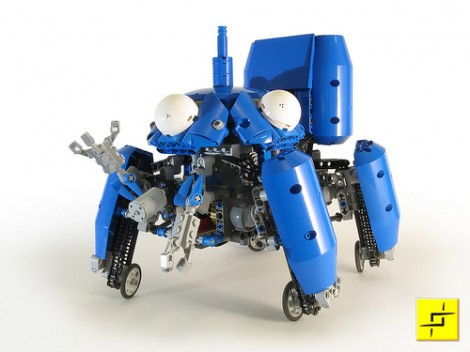
This Lego Tachikoma drives and walks just like in the TV program. You simply must take a peek at the video after the break. We’ve watched it several times and don’t think there’s any editing magic going on. But the movements are so intriguing part of us thinks there’s something fishy about it.

Each leg has a wheel that is connected to a motor via chain drive. But the little guy isn’t constrained to smooth hard surfaces. When the going gets rough, he struts his stuff like an eight-year-old crossing the lawn in roller skates.

This is not just for show and you can build it yourself if you like. The link at the top has assembly instructions. You will need several specialized parts though, not the lest of which is the cement mixer drum halves that make up the rounded blue chassis pieces.

Not sure what the heck this thing is? Don’t feel bad, you’d need to be a fan of Ghost in the Shell to recognize it.

Continue reading “Working Tachikoma Brings The Manga To Life”

Old Timey UAV Cameras

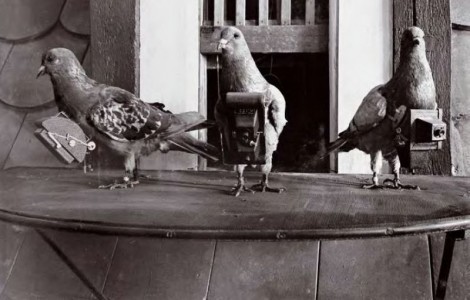
These brave birds are weapons of war. Well, not these actual birds… they’re just models used for this photograph courtesy of a taxidermist. But their living relatives were used to take spy photographs during World War I. [Dr. Julius Neurbronner] didn’t suddenly jump into the field of avian photography. He, like his father before him, used homing pigeons to deliver prescription drugs in loads of up to 75 grams. This makes us wonder if the birds are ever used in modern drug running?

The inspiration came when the doctor found out about subminiature cameras available at the turn of the twentieth century. Those cameras included a tiny roll of film, allowing for several images to be taken. He figured out a way to make a timer that used a pneumatic system to trigger the shutter in the camera. You can see a diagram of the timer mechanism here. The idea is that the birds will always be able to find their way home. So if you take them to a starting point that puts the enemy lines in between them and home base, they’ll fly over and get some juicy recon in the process.

That’s pretty old school. But we’re still tying things onto birds these days. Here’s some modern tech that uses sun-up/sun-down to track travel habits.

[Thanks F via The Atlantic]

Whistle Controls For You Home Electronics

You know how to whistle don’t you? You just put your lips together and blow. But do you know how to make the electronics around you react to your whistled commands? Well [Befi] figured out a system that allows him to assign a whistled command to various home electronics.

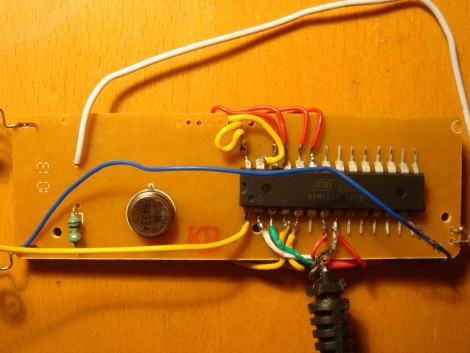
He’s using a set of RF remote control outlets to switch power to various devices like a desk lap, or a turn table. The board you see in the image above is the remote control that came with the system, but that chip is an ATmega8 which he added to give round-about USB connectivity using a serial-to-USB converter. The technique is simple enough that we’d bet you can get this to work with an ATtiny2313 and the V-USB project but that’s another story.

The additional piece is the use of embedded Linux to detect and process whistled commands. In the video after the break [Befi] explains that he’s using a Dockstar along with a microphone to capture audio input. It uses a Fast Fourier transform algorithm to process the clip and pushes commands to the remote control after processing is complete. Continue reading “Whistle Controls For You Home Electronics”

Slide Rule For Musical Scales

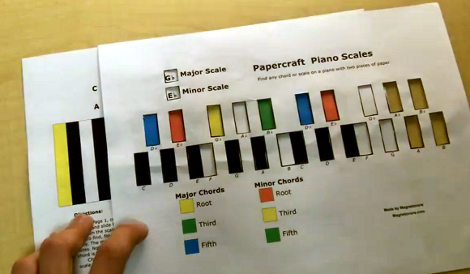
For all those engineers who dabble in music [Magnetovore] has your back. Musicians simply must know their scales and he came up with a papercraft slide rule for major and minor scales.

The system is very easy to use. He’s uploaded PDF files that let you print out the mask for the top layer and bar chart and directions for the bottom layer. The top layer is laid out like a piano keyboard, with windows for each key and a couple of windows to identify the major and minor scales being displayed. Just slide the mask until each key is a solid color. The color codes show the tonic, third, and dominant for each key so you know where to start. In the video after the break you can see how it works by playing all of the non-black keys in order. But wait, if you order now you’ll get the slide rule for Cello scales at the same low-cost; free!

This is a fun quick-reference, but you really should know your Circle of Fifths. Continue reading “Slide Rule For Musical Scales”

Sand Flea Literally Leaps Tall Buildings In A Single Bound

The hidden abilities of this robot that is no larger than a dinner plate are quite impressive. It doesn’t let an obstacle like a building get in its way. The Sand Flea, like its namesake, posses a remarkable jumping ability. When it encounters a tall obstruction two levers incline the front of the robot and it launches itself up to thirty feet in the air. In the case of a one-story build this means it will end up on the roof, and it’ll do so much quicker and more reliably than any wall climber we’ve seen.

It’s being developed for the US Army by Boston Dynamics, and this isn’t the first time we’ve seen the concept. But the video after the break gives a much better look than the grainy twenty-second clip from last year. Of course they’re not giving up too many details so we have to guess a bit. We’d wager the launching mechanism is a solenoid, but at about eleven pounds you need a lot of juice to get that much of a jump. We suppose it’s also possible that there’s an explosive system like the butane combustion used in a framing nailer. The video summary mentions that there’s a stabilization system to keep the body oriented during flight. That’s got to be a gyroscope. Let us know what you think in the comments. Continue reading “Sand Flea Literally Leaps Tall Buildings In A Single Bound”

Wireless Camera Mount Offers Pan And Tilt Functions

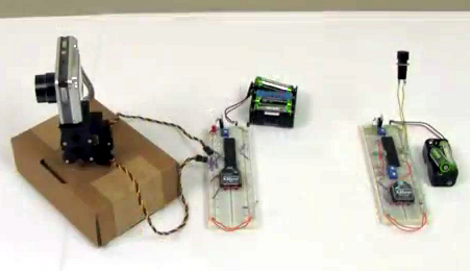
[Chris] put together a bunch of common components to create this wireless pan and tilt system for a security camera or a robot.

The motorized base is simple enough, using two servos to make up a mount for the digital camera. In this case he used a parts package which is designed to mount the servos perpendicular to each other. You could also 3D print, our build your own brackets quite easily. The control circuitry consists of a pair of PIC 18LF4520 microcontrollers and a set of Xbee modules. This is where the wireless connectivity comes in.

On the transmitter side, a pair of potentiometers are read by the microcontroller’s ADC and translated into position values. The receiver takes those values and drives the servo motors accordingly. In the clip after the break [Chris] is using micro trimpots which require a screw driver to adjust. You might want to hit the parts bin and see if you can get some that have a more user-friendly shaft or knob.

Unfortunately this system doesn’t transmit video. But WiFi webcams are getting quite affordable so that might be a good option in this case. Continue reading “Wireless Camera Mount Offers Pan And Tilt Functions”