HTML Based AVR Compiler Aims To Make Arduino Development On IOS Possible

It’s surprising what lengths people will go to in order to bring functionality to their smart phones. In this case, [Tadpol] wanted a way to develop for his Arduino on an iOS device like an iPad or iPhone. He figures it’s possible to rewrite the IDE as HTML5, but since that’s a pretty large mountain to climb, he started by building a browser-based AVR compiler. It’s an interesting concept, and he’s got a working prototype up on Github for you to test. Perhaps you can throw your hat in the ring and help him with development?

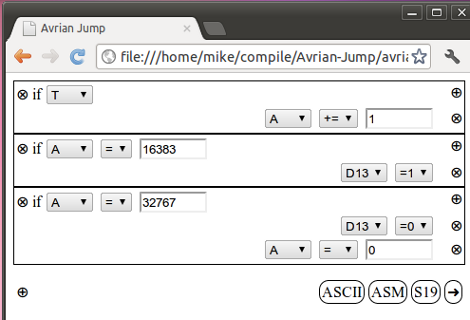
The web interface uses boxes to add to the code. What you see above is three sets of commands which will blink an LED. The project, named Avrian Jump, uses a simple ladder language to feed the compiler, with several different options for output. The most interesting in our mind is a WAV file which can be used to program an AVR from the audio out of your device. That would make programming as simple as connecting the specially modified AVR to your headphone jack. There’s also an ASCII output which allows you to save your programs for later alteration, S19 output for AVRdude programming, and an assembler output for debugging purposes. It’s hard to see where this project might go, but we have to admit that the concept is intriguing.
UPS With Dead Batteries Reborn As A Whole-house Power Backup

[Woodporterhouse] must deal with regular power black outs in his area. He recently converted a rack-mount uninterruptible power supply to feed a portion of his mains wiring. This one is not to be missed, since he did such a great job on the project, and  an equally remarkable job of documenting it. It’s one of the best examples we’ve seen of how to use Imgur as a project log.

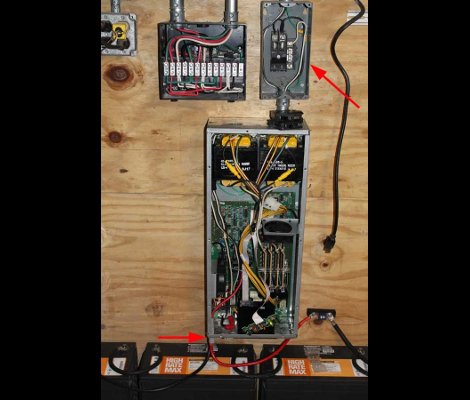
The UPS still needs to have a case, but it doesn’t need room for batteries as he’s going to use a series of high-end sealed lead-acid batteries. So he cut down the enclosure to about half of the original size. That’s it mounted just above the new batteries. For this to work you need some type of transfer switch which can automatically patch between incoming line voltage, and the battery backup. He already had one of these switches in place for use with a generator, that’s it in the upper left. The entire system powers a sub-panel responsible for his essential circuits — the electronics in the home and a few lighting circuits (we’d assume this includes utilities like the refrigerator).

One really great feature that the reused UPS brings to the project is a monitoring card with a NIC. This way he can check the server to see if the UPS is being used, and how much of the 14 battery life remains.

[Thanks Ross via Reddit]

Resizable ARM Dev Board; Just Take Some Off The Top

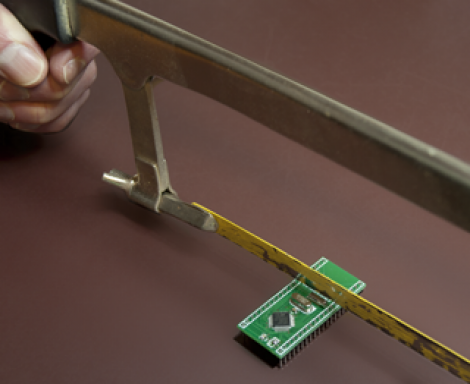
[Bob Alexander’s] most recent project is a hack saw resizable ARM breakout board. He wanted to start using more ARM microcontrollers in his projects and went for a breadboard friendly design. It uses a 40-pin dip package, but if you need the horsepower but not the I/O you can literally cut it down to size. We might recommend grabbing some tin snips, which can cut through a PCB like butter, but to each his own.

The board is based around an STM32 chip. You’ll find a crystal oscillator for the system clock, and a clock crystal if you need it. On the other side of the chip he included a footprint for a voltage regulator. This setup provides a remarkable range of input voltages, accepting from 2 to 3.6 volts without the regulator, and up to 16 volts if the regulator is present. He designed a package footprint that can be easily bridged if there’s no SMD part there. Just make sure you insulate that pad if you are using one with a conductor on the bottom. He explains this in detail in his writeup.

You’ll need a programmer to work with the board. He uses an STM32 Discovery Board for this but there are quite a few other options out there too.

Apartment Entry Morse-code Lock

[Bozar88] lives in an apartment building that has a buzzer at the front security door. Guests find your name on the panel next to that door, and press a button to ring the phone just inside the entry of each apartment unit. He decided to extend the built-in capabilities by adding a morse-code entry password which unlocks the security entrance automatically (translated).

He designed a circuit and etched his own board which fits nicely inside of the wall-mounted phone. It uses an ATtiny2313 to implement the coding functions. The device attaches to the intercom line in order to detect incoming button presses from the entry panel. There’s some protection here to keep the signal at or below 5V. The output is two-fold. The microcontroller can drive the microphone line using a transistor, which gives the user audio feedback when the code is entered. To unlock the door an opt-isolated triac (all in one package) makes the connection to actuate the electronic strike on the entry door.

The video after the break is not in English, but it’s still quite easy to understand what is being demonstrated.

Continue reading “Apartment Entry Morse-code Lock”

Harvesting And Graphing Wireless Household Utility Meter Info

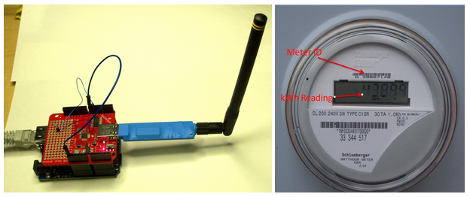
Both our electrical meter and our gas meter are located in the basement of our house (we recently had the gas meter moved outside though). When people see this they always ask if the meter readers have to come inside once a month. The answer is no, these meters broadcast usage data which is picked up once a month when a utility company vehicle drives down the street. If you have wireless meters in your house, here’s a way to harvest and graph the wireless data so that you can analyze your usage patterns.

The hardware used here is a special USB dongle. This has a 900 MHz radio which picks out the packets from a reasonably large list of meter types, and pushes them through the USB interface. In the image above you can see that an Arduino with a USB host shield is used, but there are also drivers if you want to connect this directly to your computer.

We looked around and didn’t find any specifics on the hardware used on that board. But it can’t be all that hard to make one of these at home… the populated board seems to have just two ICs and a few passive components. Anyone up to the challenge of hacking together their own packet sniffer? We wonder if the Next HOPE badge could pull down the data?

[Thanks Chris]

Recorder Controlled Snake Game Played On A Nokia 6110

Dig out an old cell phone, hit the dollar store for some plastic recorders, and build this sound controlled snake game for your next party. The project will be a snap for those comfortable working with microcontrollers, and a great learning experience if you’re looking to try your first Arduino project.

[László] and his friend call the project the Snake Charmer. As shown in the clip after the jump it uses music notes to direct the path of the solid line in the classic cellphone game of snake. But this isn’t just some PC-based rip-off. They’re playing on the actual cellphone. A camera points at the screen to project it for the enjoyment of spectators. The control scheme uses relays soldered to the pads of the four directional buttons. The pitches are being detected by a Max/MSP program, with the corresponding commands pushed to the Arduino via USB. Yep, it’s overkill but the point was to get this up and running quickly and with a minimum of work. We’d say they succeeded.

Actually, now that we think of it, this isn’t a two player game. Perhaps the recorder control concept needs to be applied to a more modern version of the game.

Continue reading “Recorder Controlled Snake Game Played On A Nokia 6110”

Who Needs Mecanum Wheels?

Skills are all that’s needed to solve a problem. Take this four-wheeled robot as an example. [Michal Zalewski] wanted it to be omnidirectional but wasn’t very satisfied with the concept of mecanum wheels and the like. So he designed a chassis with wheels at each corner that can pivot as one to change orientation. The image may look like a rendering at first glance, but this is actually the physical prototype. See what we mean about skills?

Okay, so the robot design is pretty cool. But we’re more excited about the build process. We’ve looked at [Michal’s] work before. He wrote a thorough guide about CNC mold making. These parts are all cast from epoxy. This starts with a rough milled mold, which is given a second pass for the fine details before being painted with a release agent and used to make a silicone mold. From this the parts are produced. Check out the Flickr set showing the casting process for the planetary gear box on each motor. If only these results were as easy to achieve as he makes it look.

[via Reddit]