Gif Player Does It Using Paper Medium

Ditch that fancy wide-format LCD monitor and go back to the days when animation was made up of moving frames played back by a specialized device. [Pieterjan Grandry] built this gif player which does just that. The frames of the animation are printed on a paper disk. When spun and viewed through a looking hole the same size as one frame an animated image is formed.

If you know a thing or two about how movie projectors work you might have a raised eyebrow right now. To make the animation smooth you need a way to hide the changing of the frames. With a projector there’s usually a spinning shutter (like a fan) that covers the transition between frames. In this case, [Pieterjan] has mounted the case of the gif player far enough in front of the paper disk that the image is in shadow, making it hard to see. A microcontroller responsible for the speed of the spinning disk flashes some white LEDs with precise timing which gives light to each frame at just the right time.

This is really a 2D equivalent to the 3D stroboscope we saw a few days ago.

[Thanks Agtrier]

Auto-Focus Assist Hack Keeps Improving

[Adrian Onsen] keeps making improvements on his auto-focus assist hack for DSLR cameras. The module seen above is version 3.0, which makes a few changes to the previous hardware and also presents a much more finished look.

With version 2 [Adrian] was using a defocused laser to illuminate dark subjects so the DSLR auto-focus could be used. It worked, but wasn’t really ideal. This time around he’s swapped out the laser diode for an autofocus assist lamp salvaged from a Canon 550EX he picked up ‘as is’ on eBay. It is mounted on the front of his project enclosure, using two alkaline batteries for power. It sounds like [Adrian] is struggling a bit with his circuit design. He want’s to make it work with either alkaline or rechargeable AA batteries (just two, down the from four AAAs used in version 2) but so far the rechargeable are a no-go. They power the circuit, but must not put out enough light for the sensor to work.

Future plans include getting rid of the external cords by adding a hot shoe connector.

C Bit Field Structures For Microcontroller Multitasking

So you’re getting better at programming microcontrollers and now you want to do several things at once? You know better than that, microcontrollers are only capable of processing one thing at a time. But if you’re clever with your coding you can achieve something that behaves as if several things are going on at once. The most common way to do this is to set a flag using an interrupt, then use the main loop to check for that flag. [S1axter] posted a tutorial on this topic where he uses bit field structures to help simplify time sensitive events.

We think [S1axter] did a fantastic job of explaining this moderately difficult topic clearly and quickly. In the video after the break he begins by explaining what a bit field is and how it is defined. Basically you’re using a C structure to track a flag using just one bit of storage. This way the flag is either set or not. We suggest you pay careful attention to how he declares the structures as volatile, so you don’t have unexpected behavior when you try it yourself.

Continue reading “C Bit Field Structures For Microcontroller Multitasking”

Kitchen Hacks: Sous Vide Builds Don’t Need To Cost An Arm And A Leg

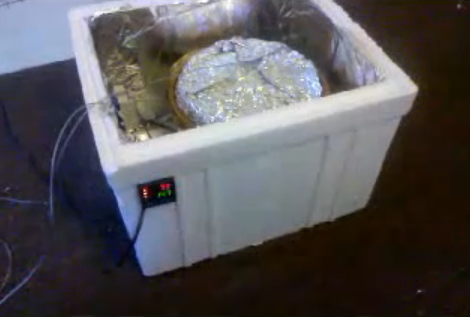
It’s not that we haven’t seen inexpensive Sous Vide builds. It’s just that we enjoy the fact that [Kelvin’s] Sous Vide machine gives new life to unused things. The cooking vessel is a crock pot which he acquired for just $3. He housed it in a large Styrofoam box which he got for free through his local freecycle program. The circulation pump is a $0.99 fish tank part that pushes about ten gallons per hour.

He even hunted around to find the best prices on the control circuitry. The PID controller is obviously the most important part, as it will regulate the cooking temperature. He found a greatly discounted module that set him back just over $30. It even has a self-learning feature that sounds like it’s handy (not sure if all of these have that though).

Check out the video after the break. We like the use of his old RAM heat sinks to help dissipate heat from the solid state relay that drives the heating element. Since that SSR is inside of the foam box we could see heat becoming an issue. This way it’s dissipated, but not wasted.

Continue reading “Kitchen Hacks: Sous Vide Builds Don’t Need To Cost An Arm And A Leg”

Human Flight At 190 MPH With No Steering

It’s been a while since we looked in on a TED talk but this one is fantastic. [Yves Rossy] is interviewed about his jet-powered flight wing at the TED conference. He designed the unit as a form of personal flight. He straps it on, jumps out of a plane, then flies across the sky until he runs out of fuel. There’s no steering mechanism; it’s more of a fixed-wing hang glider plus jet turbine engines. But the pilot can affect the direction of the wing by moving his body.

We’ve embedded the video after the break. The first five minutes are all flight footage (which you’re going to want to watch… we specifically kept the banner image vague so as not to spoil it for you). After that, you’ll enjoy the interview where details about the hardware and its operation are shared.

The wing itself is about 2 meters across, hosting four kerosene-powered turbine engines. There’s about eight minutes worth of fuel on board, which [Yves] monitors with a clock while also keeping an eye on the altimeter. Landings are courtesy of a parachute, with a second on board as a backup. If things go badly–and they have as you’ll hear in the interview–an emergency release frees the pilot from the machine.

Want to build your own? Maybe this will get you started.

Continue reading “Human Flight At 190 MPH With No Steering”

I’ll See Your Launchpad Controlled Arm And Raise You Arduino Controlled Autonomy

This OWI robot arm has been hacked to add position sensors and Arduino control. [Chris Anderson] took one look at the Launchpad controlled OWI from earlier today and said “wait a minute, I’ve already posted my own version of that project”. Well, that will teach him not to tip us off about his hacks!

The position control is a really nice addition. Potentiometers added to each of the joints (shoulder, elbow, and wrist) can be read by the ADC pins on the Arduino. Just a bit of calibration will let the microcontroller board know the position of the arm at any given time. The control technique is the same as the Launchpad hack, with one glaring drawback. [Chris] is using the Adafruit motor driver shield. It uses L293D H-bridge chips, but it only has four channels. There are five motors on this arm, so the video after the break shows it moving around without any outside instruction, but you won’t see it grab onto anything since the Arduino can’t move the gripper!

Still, the position feedback makes the case for this version. Just remember to order an extra chip if you want full control.

Continue reading “I’ll See Your Launchpad Controlled Arm And Raise You Arduino Controlled Autonomy”

Junkyard Tube-amp Gold!

Why, oh why, oh why do people toss out awesome retro hardware?? Luckily, [Dino] visited the junk depot himself at just the right time. Even though you’re not supposed to take things others have dropped off he poached the retro portable turntable that was just sitting there. He cracked it open and figured out how to turn it into this great tube guitar amp without going to all that much trouble.

The original turntable used to be where the front grates are in the image above. The guitar amp version sits the case on end, which works perfectly since the carrying handle is now on the top. This orientation would have put the amplifier hardware upside down, so [Dino] pulled it out and flipped it around. The speakers for the turntable were made to sit separately and be connected with wires. But they also doubled as a lid for the unit. This makes them the perfect size to fit side-by-side in the void left by the turn table.

[Dino] records his own music for the build video after the break using his new hardware. Sounds great, looks great, and it was saved from being needlessly buried in the ground. Fantastic!

Continue reading “Junkyard Tube-amp Gold!”