Houses To Go From Leftover Scraps

[Derek Diedricksen] builds nomadic houses from left over building materials. Some are large enough to haul behind a vehicle or, in the case of the one above, small enough to tote around like a wheelbarrow. We love them because not only do they reuse material that might commonly hit the landfill, but they look good. Check out the first couple of episodes from the Yellow House series after the break. Then take some inspiration from [Derek’s] success and see if you don’t already have enough in your junk pile to get started.

Continue reading “Houses To Go From Leftover Scraps”

Tank Drone With Automatic Targeting And Tracking

Humankind is making some great advances toward our own destruction with this tank drone. It’s got a powerful set of treads with an Airsoft rifle perched atop. Thanks to the cameras and the laser this thing can accurately target based on color. The hardware is controlled by a collection of Arduino boards connected via XBee so that Processing can be used on a computer. Just combine this with the facial recognition from yesterday and you’ve got the first generation of Terminators. Watch the clip after the break and you’ll realize that we’re doomed. Continue reading “Tank Drone With Automatic Targeting And Tracking”

Links Expanded: Snake On LED Matrix

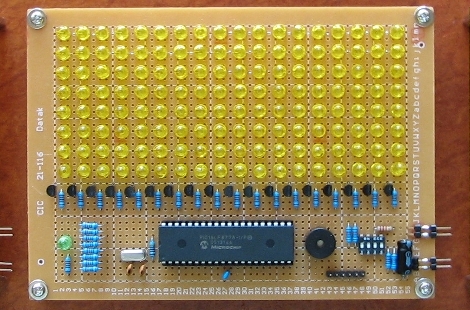
[Yosh] came through with a link to the Snake playing LED matrix that he read about in our links post from yesterday. It seems that [Arty Fart] actually built three of these in green, yellow, and red. You can see him throw one together (an 8-10 hour job) in the video after the break. In addition to playing Snake the PIC 16F877A can also scroll messages, play a mean game of Tetris, and show a Pong screen saver on the 144 LED display. We love the clean build and the urge to make another LED matrix is becoming irresistible.

Now off to eBay for a good deal on a bulk LED order. Continue reading “Links Expanded: Snake On LED Matrix”

DTG Using A Stock Printer

[youtube=http://www.youtube.com/watch?v=qc3OrrsnMHs]

Here’s a Direct-to-Garment device that uses a stock printer. [Jeff German] used an Epson R1900 with the stock firmware to get the results seen in the video. His hardware modifications involve adding two buttons to the printer’s circuit board. For DTG beginners this certainly lowers some of the obstacles to getting started. [Jeff] is working on detailed instructions but for now take a look at our own How-to for building a DTG printer.

Audible Tuner For The Blind

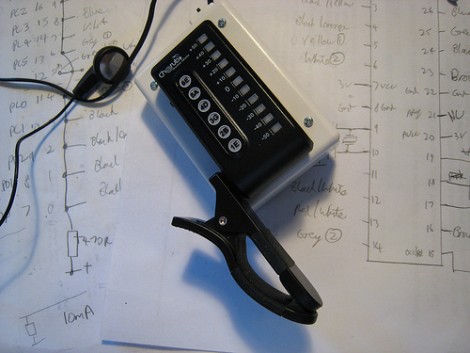
[Lain Sharp] modified this guitar tuner so it can be used by his blind friend. In the picture above you can make out a small white project box that houses the additional electronics. Inside is another battery and an ATmega168 providing a connection for an earphone. The AVR chip connects to each LED on the tuner and converts the visual tuning meter to an audio cue. Check out the demonstration clip after the break to see how it works.

Now if we could just figure out how to get our strings in tune with our built-in keyboard.

Continue reading “Audible Tuner For The Blind”

Hackaday Links: June 27, 2010

Precision CRT manufacture

Here’s a great video from Tektronix about building a precision cathode ray tube. The tube manufacture method was developed to use in oscilloscopes and we’d guess it dates back to the early 1960’s. [Thanks Bill]

Snake on an LED matrix

We would have done a full post o this beautifully built LED matrix but we just couldn’t find much information on it. For now, enjoy the video of the device playing the classic game of Snake. [Thanks Xdr]

Wire bundling

We’re not sure if this is brilliant or just snake oil. Here’s a method of bundling wires together by twisting them with an electric drill. We’ve always just used our hands but we’ve never really worked in any kind of volume either. [Thanks Kacper]

CD Controlled Lawn Mower

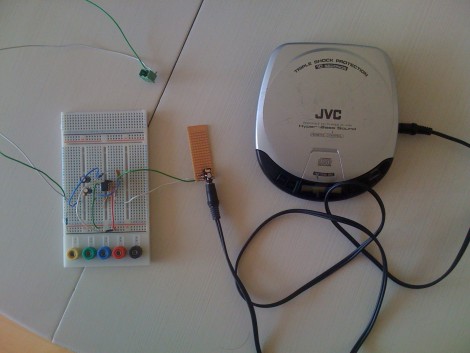
[Oliver Nash] was enlisted by his parents to fix their robotic lawn mower. They owned a Robomow which happily navigated their yard to keep the grass at a nice level. These robots rely on a perimeter wire with a special signal running through it to ensure they are inside of the mowing area. Confronted by a dead perimeter module, [Oliver] ordered a new unit and disassembled the old module to study the components. He also measured the signal generated by the replacement unit. In the end he was able to produce a replica of the signal using audio software, burn it to a CD, and playback the recording using the perimeter wire. It’s a bit of a zany idea but it worked.