phone_mixer

Convert An Old Busted Phone Into A Voice-altering Prank Machine

Have you ever wanted to be someone else, at least over the phone? Do you dream of turning the tables on telemarketers, making them hurry to get off the line instead of you? If so, [Brad] over at LucidScience has the project for you.

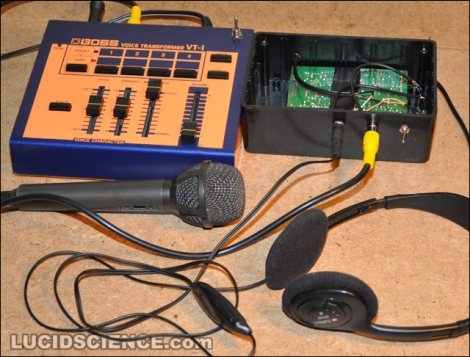
A bit of a prankster at heart, he walks through the conversion of a normal telephone into a Data Access Arrangement device (DAA), allowing you to interface it with either hardware or software-based audio mixers.

The process can be completed in a relatively short time period, and doesn’t require much more than an old telephone, a handful of tools, and some miscellaneous switches and jacks. He disassembled a telephone and trimmed off all of the unnecessary circuitry while retaining most of the original functionality. Line in and out jacks were then installed in place of the handset microphone and speakers, respectively. The final result is a compact box that relays altered audio from any kind of mixing device to person at the other end of the call. Since the majority of the phone remains intact, your calls still sound natural as they pass through the phone’s existing voice filter and preamp circuitry.

Once the DAA is complete, you can use any number of effects on your voice, limited only by your audio mixer. [Brad] says he has long-time friends that don’t even recognize his voice after he has run it through his effects machine, so get started on yours before April Fool’s day arrives!


Surplus Military Gear Keeps Your Hands Free, Calls Private

heli_helmet

[Julian] was rummaging through a military surplus store when he spotted a pair of old helicopter pilot helmets that he absolutely had to have. At $25 they were a steal, but pretty useless in their current state. He decided to modify one of the helmets for use while playing video games, but he didn’t stop there.

The helmet had two decent speakers built-in so he kept them, but tweaked the wiring from a mono-only configuration to accept stereo input. A RF wireless headset was disassembled and wired into the helmet so he could use it for playing video games while his wife is asleep. As an added bonus, the headset he used happened to have an AM/FM receiver built in, so he can enjoy music while sitting around with his helmet on as well. A Bluetooth cell phone headset was also torn down and wired into the helmet for gaming and handling phone calls. The Bluetooth mic was extended into the original mic stem built into the helmet, keeping things authentic-looking.

Overall it’s a quite a useful recycling of some old military junk. It’s a great idea though the helmet looks like it could be a touch cumbersome after awhile.

Real-time Wireframe Video Effect Overlay With Kinect

linedance

[Francois] over at 1024 Architecture has been working on a project we think you’ll be likely to see in a professional music video before too long. Using his Kinect sensor, ha has been tracking skeletal movements, adding special effects to the resulting wire frame with Quartz Composer. While this idea isn’t new, the next part is. He takes the QC tweaked video stream and then projects it back over the performer using MadMapper to match the video to the body movements, recording the resultant display.

The project started out with a few hiccups, including a noticeable delay between the body tracking and the display. It caused the performer to have to move more slowly than he would like, so things had to be tweaked. [Francois] first tested the latency between his computer and the projector by displaying a timecode representation on the screen as well as via the projector. He found the projector to have a latency of 1 frame at 60 fps, which wasn’t too bad. This led him to believe the culprit was his Kinect, and he was right.  There was a 6 frame delay, so he locked the video output to 30 fps in hopes of cutting that delay in half.

The effect is slightly reminiscent of Tron, but with more distortion. We can’t wait to see more projects similar to this one in the future.

The resulting video embedded below is pretty cool in our opinion, but you can judge for yourself.

Continue reading “Real-time Wireframe Video Effect Overlay With Kinect”

Remote-controlled Tank Tread Robot Will Walk The Dog For You

remote_controlled_robot

Instructables user [IAMTHEBOT] recently finished building his robot which can be controlled by a human using an R/C transmitter, via a PC, or through its built-in object avoidance system. The robot doesn’t seem to have a name, though Johnny Five might be appropriate.

The robot was built using plenty of erector set parts, as well as a Lynx motion tank tread kit. The robot is crammed full of controllers, including a Propeller USB servo controller which operates the arms, and a pair of Parallax motor controllers to manage the tread movement. A pair of Parallax Stamp controllers are used to drive these controllers as well as to manage the remainder of the robot’s functions.

The robot’s head consists of a custom pan and tilt wireless camera system, which allows him to drive it around from the comfort of his home, while watching the video stream on his PC. The robot also has the ability to roam around autonomously, avoiding objects using a ping sensor that can be mounted where the camera is currently located. It seems all that’s missing is Steve Guttenberg.

As you can see in the videos below, the robot manages pretty well on all sorts of surfaces, and even walks this guy’s dogs.

Continue reading “Remote-controlled Tank Tread Robot Will Walk The Dog For You”

Terapixel Images And See-through Cameras: Real Or Fake?

invisible_camera_lol

Once again it’s time for you, the sharp-eyed readers of Hack a Day, to decide whether the following video demonstrates technology at its finest, or if it is complete hogwash. This edition of Real or Fake? is brought to us by Hack a Day reader [Wizzard] who sent us a link to “The Invisible Camera

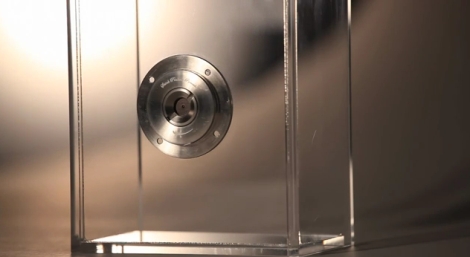
Watch the video embedded below to see the unveiling of this camera as well as a discussion of its new, revolutionary technology by its creator – photographer Chris Marquardt. The camera is composed of a simple, non-moving lens mounted in a completely transparent box made of specially polarized glass. This glass is supposed to align the ambient lighting, which amplifies the energy coming through the lens, in order to expose the special film they created for the camera.

The film was developed using standard film “combined with innovations in chemistry” to produce ultra-low sensitivity image media, which the creators are calling “Directionally Desensitized” film. This film can be handled in full light, as it is only sensitive to the high-energy light directed on its surface by the aforementioned lens. It is claimed that due to this special film, the camera goes beyond the Megapixel, past the Gigapixel, and captures images in Terapixels.

Now, call us skeptical, but isn’t it a bit early for April Fools jokes? We just can’t imagine any scenario where holding a piece of film in the sun as shown in the video would not cause it to be exposed in at least some areas due to the massive amounts of reflected light in the environment.

What’s your take?

Continue reading “Terapixel Images And See-through Cameras: Real Or Fake?”

Hackaday Links: March 22, 2011

3D holographic fog display

3d_fog_display

Some researchers in Japan are hard at work building a 3D volumetric fog display that would allow you to live out some of your Leia-related Star Wars fantasies. Using a column of fog and three projectors, they were able to create a display that looks three-dimensional from any angle. It might be a while before the technology hits your living room, so don’t clear your calendar just yet, Obi Wan. [via Neatorama]

The Claw – a three-fingered robotic gripper

the_claw

Instructables user [AntMan] has been hard at work revising his robotic claw gripping mechanism. Laser cut from wood, this servo-driven claw can easily grasp small objects with little effort. We can’t wait to see someone build a version from milled aluminum!

Ben Heck’s retro Xbox 360

ben_heck

[Ben Heck] is at it again, and has recently given the Xbox 360 a sweet retro makeover. Taking inspiration from gaming consoles of the 70’s, he converted an Xbox 360 into a laptop-style portable (again), but this time with the look and feel of an old Atari 2600. Retro gamers rejoice, you can now get your Xbox on while enjoying the sweet simulated wood-grain you grew up with.

Rocket-based ice fishing notification system

ice_rocket

What fun is ice fishing if you have to sit outside freezing your butt off? We’re assuming that was the driving thought behind [Mike’s] rocket-based ice fishing rig. A model rocket is attached to his fishing sledge, which is triggered when a fish is detected on the line. Using a low-tech detonator, the rocket lets him know it’s time to check the lines. Now only if we could get the fish to fillet themselves…

Case modding video series hits the web

modmen_logo

The “Mod Men” is a fairly new web series that takes you out of the basement and into the garage for some professionally constructed case mods. Described as “American Chopper for geeks with a dash of This Old House”, the creators aim to showcase over-the-top case mods with a professional flair. They already have three episodes under their belt, all of which are available on their site.

Birthday Gift Is A Constant Reminder Of Impending AARP Membership

birthday_countdown_timer

Sometimes milestone birthdays can be a bit depressing. 30 is rough, and 40 tougher – but 50…that’s a big one!

[Ryan’s] uncle is going to be turning 50 shortly, and in the interest of good-natured fun, he has constructed a handy birthday countdown timer for his uncle, lest he forget (or tries to avoid) the big day.

The device displays the amount of time left before his uncle’s birthday, playing an audio clip of “Don’t fear the Reaper” when the clock strikes 00:00. This is accomplished by using the MSP430’s internal clock to keep time, while also interfacing with a Nokia 3310 LCD panel to display the countdown timer. The music is provided by the circuit board from a greeting card he gutted for the project, which was wired to the LaunchPad in order to be triggered at the right moment. Everything was crammed inside an Altoids tin, as you can see in the picture above.

Though not overly complicated, it’s a fun little project, and we’re hoping his uncle gets a big kick out of it. Once his birthday has come and gone, [Ryan] plans on converting the piece into a permanent desktop clock for his uncle.