DrunkenNES Makes A Game Out Of Getting Hammered

drunkenNES_cart

While handheld breathalyzers are pretty novel to have around while drinking with friends, there’s nothing exciting about a $50 off the shelf unit. If you really want to grab people’s attention, you have to get creative and built something like [Batsly Adams] and his friends did.

One evening, he was casually drinking with some friends and playing around with an electronic alcohol sensor. They quickly put together a NES ROM that would play sounds, changing the pitch depending on how much alcohol the sensor detected. It quickly became apparent to them that a full-fledged breathalyzer video game was in order. In no time, he and his friends had compiled graphics, a soundtrack, and the code to drive their game, DrunkenNES.

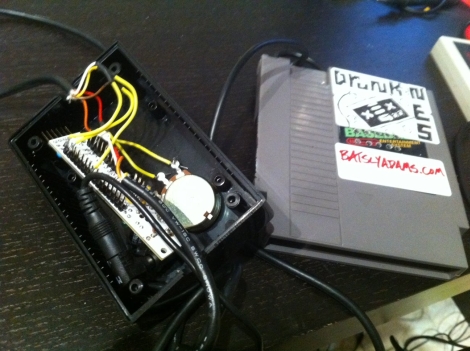
To play the game, each player must blow into a gutted NES cartridge that has been fitted with the alcohol sensor. The Nintendo computes the player’s BAC, reporting how intoxicated they are using simple graphics and cheesy animal puns. We don’t know when the code and schematics will be made available, but when they are, you can guarantee we will be building one for “research” purposes to pair with our Power Hour shot glass.

Keep reading to see some in game video of DrunkenNES

[Thanks Adam]

Continue reading “DrunkenNES Makes A Game Out Of Getting Hammered”
Old School LED Light Show

programmable_lightshow

Building LED arrays that can display all sorts of different patterns is pretty easy these days. Hook up an Arduino, do some charlieplexing, and off you go. When [Viktor] was younger he didn’t have all those fancy schmancy microcontrollers and circuit simulation software you kids have these days. In fact, last we heard, he had to walk to school uphill both ways – in the snow.

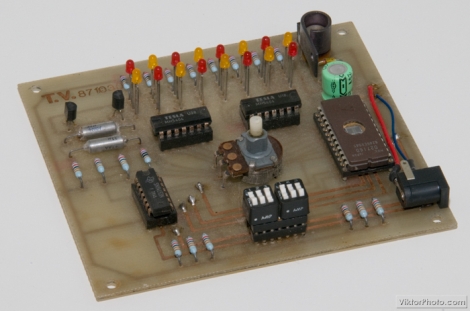
That didn’t stop him from building this gem of a project back in 1987. His LED chaser/light show does not use any microcontrollers at all, rather it relies on an EPROM to store predefined display programs. A series of switches are installed on the front of the flasher, allowing him to easily switch between the programs, and a pot is mounted to the front of the device to control the speed of the LEDs.

His light show is pretty slick, even for a project built over 20 years ago. Sometimes you just can’t beat a good, old-school hack.

Continue reading for a video demonstration of [Viktor’s] programmable light show.

Continue reading “Old School LED Light Show”

Endless Fun With LED Dominoes

le_dominoux

Toppling dominoes is great fun for about 30 seconds at a time, when you are not busy setting them up for another run. [Randy] thought it was about time they got an electronic makeover to allow for constant, immediate gratification. Armed with a few simple electronic components, he has created Le Dominoux.

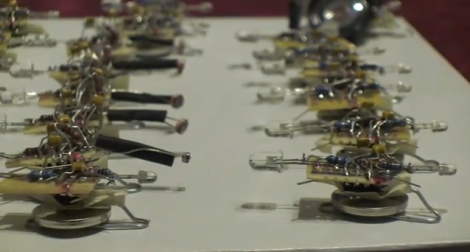
These LED-based electronic dominoes are actually quite simple to build. Each basic Le Dominoux is constructed on a small square of protoboard and consists of either a photo cell or phototransistor, a 555 timer, and an LED, all powered by a coin cell battery. The 555 timer, which is configured as a one-shot, is triggered when the photosensitive component on the back side of the domino is exposed to a bright enough light. The LED on the front end of the domino is then illuminated one time. This process is the electronic equivalent of a single domino toppling over.

He has constructed several variants of the Le Dominoux to act as flashing triggers, for outputting sound, as well as for turning tight corners. These variants allow the dominoes to be configured in many different ways, creating self-sustaining light shows. If anyone is looking for a fun project to introduce kids to electronics, this would definitely be it. Stick around to see a video of Le Dominoux in action – we bet you can’t stop watching it.

This is of course [Randy’s] entry in the 555 Design Contest, which ends tonight at midnight EST.

[Thanks Jeri]

Continue reading “Endless Fun With LED Dominoes”

Fly Like Superman Using The Force

infinity_simulator

At one point or another, who hasn’t had a dream in which you could fly, simply by thinking about it? [Yehuda Duenyas, aka XXXY] is currently working on a project at Rensselaer Polytechnic Institute which can allow you to do just that.

As part of a thesis project dubbed the “Infinity Simulator“, he has constructed a system that allows people to fly about using the elaborate rigging system at RPI’s Experimental Media and Performing Arts Center. His project allows users to glide through the air, walk up walls, and otherwise live out their flying fantasies, with mere thoughts.

An EEG headset is placed on the user, along with other wearable sensors which enhance the audio and visual experience of the person in flight. With enough concentration, the rigging system sweeps people off their feet, sending them soaring anywhere their mind desires. It sounds a bit like pretending to be Superman while using The Force to us, however the installation is described on the EMPAC web site as a “live-action stunt show crossed with a video game.” Either way, sign us up!

Hopefully we will see some video of the completed project in the near future, but in the meantime keep reading to see a behind-the-scenes preview of the flying rig in action.

Continue reading “Fly Like Superman Using The Force”

Super Winch Makes Sledding 100% More Fun

sledding_winch

As every kid quickly finds out, sledding in the winter is awesome until you have to trudge back up to the top of the hill. If your sledding run is reasonably short, this isn’t a problem, but if you sled on huge hills like [Josh], you need to figure something out.

He had a go kart motor sitting around, so he figured he might as well put it to good use as a sledding winch. The winch runs a continual loop of over 1000 feet of rope, and is able to pull 3 adults up a 30 degree incline fairly easily. They say that necessity is the mother of innovation, but at some point you have to ask, “Does sledding really require an 8 HP motor and a continuously variable transmission?” The answer, of course is a resounding “Yes!”

Not only does this winch allow [Josh] and his friends to get back to real business of sledding in a hurry, it actually makes sledding fun in both directions.

Keep reading to see a video of the winch in action, and be sure to check out some other fun uses for winches we have featured in the past.

[via Neatorama]

Continue reading “Super Winch Makes Sledding 100% More Fun”

iphone_universal_ir_dongle

IPhone-based Universal IR Remote

If you have a reasonable home theater setup in your living room, odds are you have up to half a dozen remotes sitting around. Short of trying to get your cable receiver’s remote to control everything or laying down some cash for a Harmony remote, what’s a hacker to do?

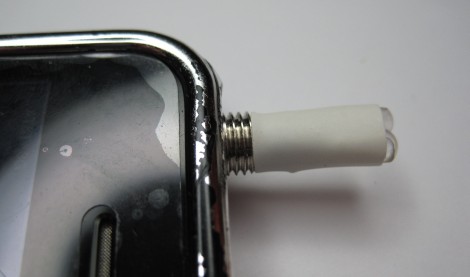
[Andrey] decided he wanted to use his iPhone as a universal IR remote, but he didn’t want to pay very much to do so. Instead of buying a dongle at the store, he soldered some IR LEDs to an old headphone plug, creating a mini IR dongle to control his equipment. After studying IR signaling a bit, he got to work encoding IR remote commands into wav files using Python. The files are then played on his iPhone, allowing him to submit certain commands to his TV set.

Unfortunately, the process of manually converting IR codes to audio files doesn’t quite seem like the most efficient way of doing things. There are other IR dongles currently on the market that utilize the headphone jack, most of which provide pretty robust software for free. These might make a good alternative to manually creating audio files for each IR command. We honestly haven’t seen any teardowns of these retail IR dongles posted online, but it would be interesting to see how they compare to what [Andrey] has put together.

Encase Yourself In Carbonite With Kinect

kinect_plastic_renders

There never seems to be a lull in the stream of new and novel hacks that people create around Microsoft’s Kinect. One of the more recent uses for the device comes from [Interactive Fabrication] and allows you to fabricate yourself, in a manner of speaking.

The process uses the Kinect to create a 3D model of a person, which is then displayed on a computer monitor. Once you have selected your preferred pose, a model of the image is rendered by a 3D plastic printer. Each scan results in a 3cm x 3cm plastic model complete with snap together dovetail joints allowing the models to be combined together. A full body scan can be constructed with three of these tiles, resulting in a neat “Han Solo trapped in Carbonite” effect.

Currently only about 1/3 of Kinect’s full resolution is being used to create these models, which is pretty promising news to those who would try this at home. Theoretically, you should be able to create larger, more detailed images of yourself provided you have a 3D printer at your disposal.

Keep reading for a quick video presentation of the fabrication process.

Continue reading “Encase Yourself In Carbonite With Kinect”