FareBot – Android NFC Proof Of Concept

farebot_logo

Upon learning that the Nexus S smartphone was equipped with a Near Field Communications NFC) radio, [Eric Butler] decided he would put the newly released Gingerbread SDK to good use.  Focusing initially on ORCA fare cards used by several Washington state transit systems, he built an open-source application he calls FareBot, which can read data from any MIFARE DESFire branded cards.  Utilizing the NFC radio in the Nexus S, he was able to dump all of the unprotected information from the fare cards, including  the remaining card balance and the last 10 locations where the card was used.

The author hopes that his proof of concept application encourages other developers to expand on his project and to explore the data stored on transit cards around the world. While it is in its early stages, [Eric] would ultimately like to see this project expanded to allow the use of NFC-enabled smartphones as transit cards themselves via downloadable apps.  He suggests that helping people understand the amount of data which can be freely obtained from these cards will eventually force the manufacturers to better inform consumers of the existing system’s shortcomings, which in turn might spur on smartphone-based transit initiatives.
Chroma – Mesmerizing LED Driven Fractal Display

chroma in action

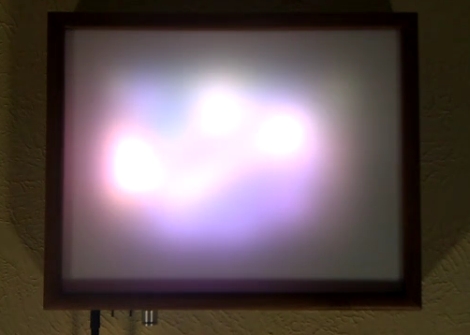
A big fan of generative art, [Andrew Magill] wanted to build an LED display for his wall that constantly displayed images from the Electric Sheep project.  After discounting the possibility of generating these fractals on the fly, he settled on using prerecorded video clips gathered over a year’s time by Electric Sheep users.  With thousands of video clips in hand, he wrote some custom software that enabled him to sequence these 5-second video clips into just over 6 hours of video, which he later downsampled to fit his 24×16 pixel display.

Now that he had some impressive video put together, [Andrew] began designing the LED panels he would use to show off his creation.  After choosing TI TLC5947 drivers to control the LED arrays, he got to work on designing the PCBs, soldering in all of the components, and testing the displays.  Initial testing completed, he wrote some more custom software to direct the individual LED boards from a master controller, and mounted everything in a frosted-glass adorned picture frame.

Be sure to check out mesmerizing video of Chroma in action after the break.

Continue reading “Chroma – Mesmerizing LED Driven Fractal Display”

Hamster Powered Strandbeest

hamster_strandbeest

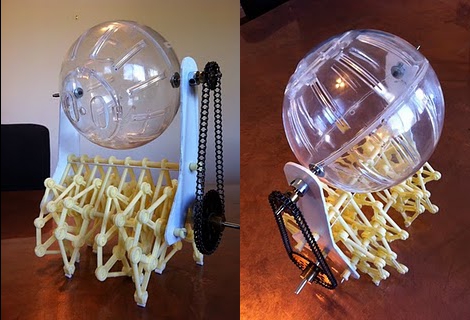
Gakken magazine featured a miniature wind-powered Strandbeest recently, converting it to run on everything from rubber bands to solar power. [Crabfu] thought it would be worthwhile to hack the Strandbeest kit that shipped with the magazine as well, so he started to brainstorm.  Well-known for his steam powered hacks previously featured here, he did originally consider adding a steam plant to the walker.  In the end, he scrapped that idea due to concerns about heat and weight.  Thinking about it further he settled on something he considered ridiculous, even stupid: A hamster powered Strandbeest.

[Crabfu] added a few components including a hamster ball and a simple chain drive from a Meccano building set before testing the device with a toy train as the power source.  Once he was certain that he had the proper gear ratio set, in went a friend’s hamster.  The device worked wonderfully, much to the delight of his nieces, as you can see in the video on his site.

Simple RFID Access System Clone

rfidbboards

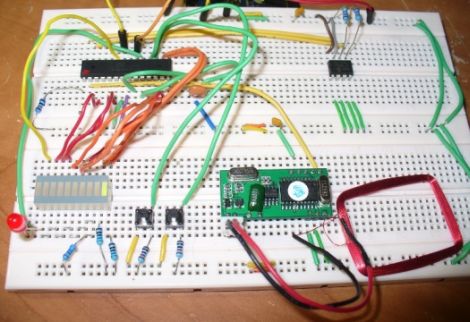
A few months back, [John] was reading an article about a simple RFID security system kit, and decided he would like to build one himself.  While many of the system’s details, including full schematics were provided, he was dismayed to find that the source code for the project was not published as it was held under copyright by the manufacturer.  Believing that open source is better, he modified the original design, replacing their PIC controller with an ATmega328 armed with an Arduino bootloader.

His system replicates all of the original kit’s functionality, while offering plenty of opportunity for modification beyond the initial design.  The article contains a complete parts list, wiring schematic, and the Arduino code required to get things up and running.  He even has a video of his clone at work, demonstrating the acceptance and rejection of RFID tags as well as the system’s learning mode.

Switched Mode Power Supply Repair Guide

switched_mode_power_supply_repaiir

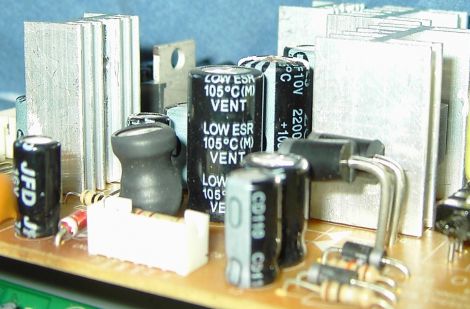
[Erich] spotted a broken DVD recorder at a local amateur radio meeting and decided to see if he could restore it to working order. While he was fortunate enough that someone labeled it as having a bad power supply, things aren’t always that easy. He gives a broad explanation as to how switched mode power supplies work as well as discusses some of the reasons these devices tend to fail. He identifies a few common components and areas that one should check while diagnosing a non-functioning power supply. While obvious bulging capacitors are easily identifiable, he discusses the need for an ESR meter and uses a kit-built model to test capacitors that do not have any visual signs of damage. While some of his walkthrough might be basic knowledge for readers who have experience in recapping circuit boards, it serves as a nice guide for those who are new to the world of electronics troubleshooting and repair.

The Energy Detective TED 5000-G Teardown

Ted 5000-G Teardown

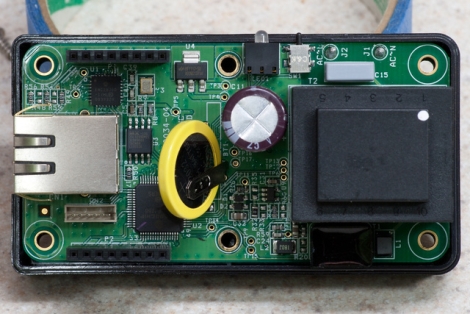
Before [Steve] realized that it didn’t play nice with his network, he dismantled his Energy Detective TED 5000-G to see what made the device tick. He put together a nice teardown with high-res pictures throughout.  Each component of the TED 5000-G is dissected, with the exception of the current transformers, which he claims are pretty boring anyhow.  The gateway module is particularly interesting as it contains both an Ethernet interface as well as a 802.15.4 radio for wireless communications.  While the device is still a bit expensive at the moment, the gateway module could be useful in projects requiring PLC or ZigBee communications some time down the road, once prices ease a little.

N64 Advance Portable Gaming System

n64_advance

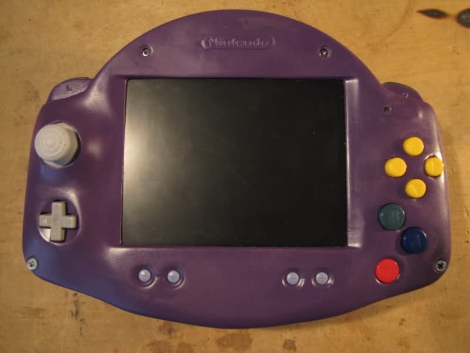
Like many people [Kyle] loves the Nintendo 64 and decided he wanted a portable version of his beloved console so he could play games while on the move.  One year, two PSOne screens, and three N64 consoles later, his vision is complete.  A Game Boy Advance travel case was gutted and used to house the console, hence the “N64 Advance” moniker.  Like many others, his project uses a PSOne screen for the display, and a Li-Poly battery pack that provides up to 3.5 hours of playing time.  He made sure to include other members of the Nintendo family in his build by adding a pair DS Lite speakers to the mix.

This build also includes some nice “extras” such as having the N64 RAM expansion pack built-in, headphone and A/V out ports (with a screen kill-switch for TV use), and an external controller port that can be used by either the first or second player. Be sure to check out the video of his build after the jump.

Continue reading “N64 Advance Portable Gaming System”