Perfecting The Shape-Changing Fruit Bowl

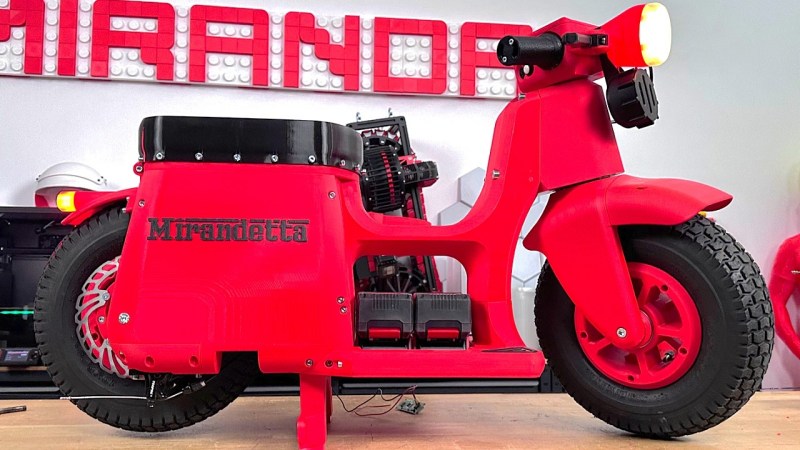
Fruit bowls have an unavoidable annoyance– not flies and rotten fruit, those would be avoidable if your diet was better. No, it’s that the bowl is never the right size. Either your fruit is sad and lonely in a too-large bowl, or it’s falling out. It’s the kind of existential nightmare that can only be properly illustrated by a late-night infomercial. [Simone Giertz] has a solution to the problem: a shape-changing fruit bowl.

See, it was one thing to make a bowl that could change shape. That was easy, [Simone] had multiple working prototypes. There are probably many ways to do it, but we like [Simone]’s use of an iris mechanism in a flat base to allow radial expansion of the walls. The problem was that [Simone] has that whole designer thing going on, and needs the bowl to be not only functional, but aesthetically pleasing. Oh, and it would be nice if expanding the bowl didn’t create escape routes for smaller fruits, but that got solved many prototypes before it got pretty.

It’s neat to see her design process. Using 3D printing and CNC machining for prototyping is very familiar to Hackaday, but lets be honest — for our own projects, it’s pretty common to stop at “functional”. Watching [Simone] struggle to balance aesthetics with design-for-manufacturing makes for an interesting 15 minutes, if nothing else. Plus she gives us our inspirational quote of the day: “As much as I feel like I’m walking in circles, I know that product development is a spiral”. Something to keep in mind next time it seems like you’re going around the drain in your own projects. Just be warned, she does have a bit of a potty mouth.

We’ve featured [Simone]’s design decisions here, if you’re interested in seeing how she goes the rest of the way from project to product. We’re pretty sure her face-slapping-alarm clock never made it into the SkyMall catalog, though.

Continue reading “Perfecting The Shape-Changing Fruit Bowl”

Replicating A Nuclear Event Detector For Fun And Probably Not Profit

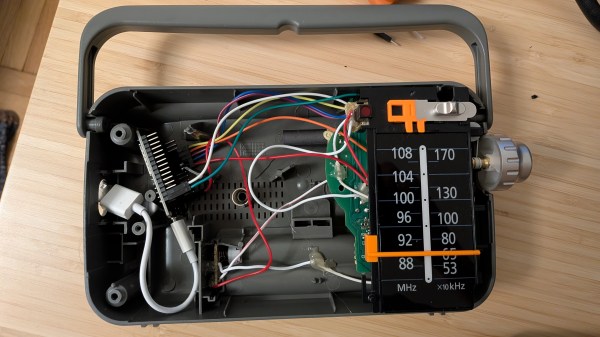
Last year, we brought you a story about the BhangmeterV2, an internet-of-things nuclear war monitor. With a cold-war-era HSN-1000 nuclear event detector at its heart, it had one job: announce to everything else on the network than an EMP was inbound, hopefully with enough time to shut down electronics. We were shocked to find out that the HSN-1000 detector was still available at the time, but that time has now passed. Fortunately [Bigcrimping] has stepped up to replicate the now-unobtainable component at the heart of his build with his BHG-2000 Nuclear Event Detector — but he needs your help to finish the job. Continue reading “Replicating A Nuclear Event Detector For Fun And Probably Not Profit”

Hands On With Creality’s New M1 Filament Maker

Ever since 3D printing has become a popular tool, the question of waste has been looming in the background. The sad reality of rapid prototyping is that you’re going to generate a lot of prints that just aren’t fit for purpose, even if your printer runs them off perfectly every time. Creality has some products on the way aimed at solving that problem, and [Embrace Making] on YouTube has got his hands on a pre-production prototype of the Creality M1 Filament Maker to give the community a first look.

The M1 is actually only half of the system; Creality is also working on an R1 shredder to reduce your prints into re-usable shreds. [Embrace Making] hasn’t gotten his hands on that, but shredding prints isn’t the hard part. We’ve featured plenty of DIY shredders in the past. Extruding filament reliably at home has traditionally proven much more difficult, which is why we mostly outsource it to professionals.

Lacking the matching shredder, and wanting to give the M1 the fairest possible shake, [Embrace] tests the machine out first using Creality-supplied PLA pellets. The filament diameter isn’t as stable as we’ve gotten used to, and the spool rolling setup needs a bit more work.

Again, this is an early prototype. Creality says they’re working on it and claims they’ll get to ±0.05 mm precision in the production models. Doubtless they’ll also fix the errors that led to [Embrace]’s messy spool. That’s probably just software given that the winding mechanism did a pretty good job on the Creality-supplied spool.

Most importantly, the M1-produced filament does print. The prints aren’t perfect due to the variation in diameter, but they turn out surprisingly well for home-made filament. [Embrace] also shows off the ability to mix custom colors and gradients, but, again, using raw PLA rather than shredded material. Hopefully Creality lets him test drive the R1 shredder once its design is further along.

This is hardly the first time we’ve seen a filament extruder. The goal of this product is to pair with a shredder and use it for recycling, but if you’re going to stick with raw plastic pellets, you may as well print them directly.

Continue reading “Hands On With Creality’s New M1 Filament Maker”

Are We Finally At The Point Where Phones Can Replace Computers?

There was an ideal of convergence, a long time ago, when one device would be all you need, digitally speaking. [ETA Prime] on YouTube seems to think we’ve reached that point, and his recent video about the Samsung S26 Ultra makes a good case for it. Part of that is software: Samsung’s DeX is a huge enabler for this use case. Part of that his hardware: the S26 Ultra, as the upcoming latest-and-greatest flagship phone, has absurd stats and a price tag to match.

First, it’s got 12 GB of that unobtanium once called “RAM”. It’s got an 8-core ARM processor in its Snapdragon Elite SOC, with the two performance cores clocked at 4.74 GHz — which isn’t a world record, but it’s pretty snappy. The other six cores aren’t just doddling along at 3.62 GHz. Except for the very youngest of our readers, you probably remember a time when the world’s greatest supercomputers had as much computing power as this phone.

Continue reading “Are We Finally At The Point Where Phones Can Replace Computers?”

Clear Resin Casting Replicates Old Acrylic For Selectric Repair

IBM Selectric typewriters have a lot of unique parts that can be tricky to source, but one we didn’t think of was the clear acrylic(?) dust covers, that are apparently very hard to find in good shape. [Eric Strebel] has a few Selectrics that all have issues with these parts. While you could come close to recreating this piece with acrylic sheeting carefully bent to match the original shape, [Eric] has a different hammer to try in a new video: replicating it with a resin casting.

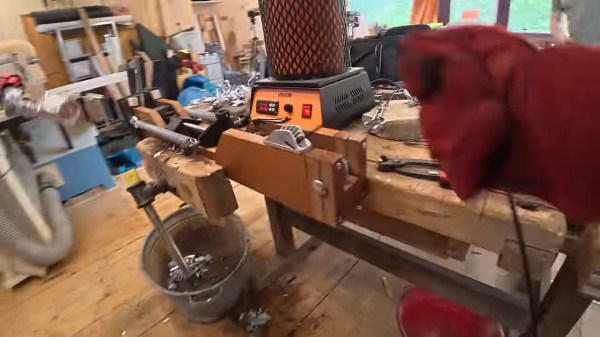
He uses de-gassed tin-cure silicone to create a mold for the original, with a bit of 3D printed PLA and foam board to hold the silicone to create the mold. That’s done in two steps to create a two-part mold, which is separated and cleaned before the resin goes in. The original part is actually a smoky plastic, rather than fully clear, but [Eric] is able to match it perfectly using a colourant in his clear ̶e̶p̶o̶x̶y̶ polyurethane resin. The resin is put into the mold with a simple gravity pour, though he does have a vibrator on it to help it flow. Curing is done under heat and pressure– 60 PSI. The results are amazing; once he adds a touch of paint to match the black finish on one face of the original, it’s very difficult to tell [Eric]’s casting from his master piece, except that the cast replicas are in better shape.

This particular part works very well for casting and not much else. While you could match the large curve by heat-bending a piece of smoky acrylic, there are lips along the edges of the part that would be tricky to reproduce. [Eric] also needed several, for his multiple typewriters, and this method is very efficient at producing multiple units since the mold is reusable.

While you might not have an IBM Selectric that needs a dust cover, this technique is equally applicable to all sorts of clear shapes. If you’re new to resin casting, we have a handy guide to replicating plastic parts to get you started in this kind of work. It’s not just large parts that can be replicated: you can even copy phonograph records, such is the fidelity of resin casting.

Continue reading “Clear Resin Casting Replicates Old Acrylic For Selectric Repair”

The “Tin Blimp” Was A Neither Tin Nor A Blimp: The Detroit ZMC-2 Story

That fireball was LZ37. Nobody wanted to see repeats post-war.
Image: “The great exploit of lieutenant Warnefort 1916 England” by Gordon Crosby, public domain.

After all the crashing and burning of Imperial Germany’s Zeppelins in the later part of WWI – once the Brits managed to build interceptors that could hit their lofty altitude, and figured out the trick of using incendiary rounds to set off the hydrogen lift gas – there was a certain desire in airship circles to avoid fires. In the USA, that mostly took the form of replacing hydrogen with helium. Sure, it didn’t lift quite as well, but it also didn’t explode.

Still, supplies of helium were– and are– very much limited, and at least on a rigid Zeppelin, the hydrogen wasn’t even the most flammable part. As has become widely known, thanks in large part to the Mythbusters episode about the Hindenburg disaster, the doped cotton skin in use in those days was more flammable than some firestarters you can buy these days.

That’s a problem, because, as came up in the comments of our last airship article, rigid airships beat blimps largely on Rule of Cool. Who invented the blimp? Well, arguably it was Henri Griffard with his steam-driven balloon in 1857, but not many people have ever heard his name. Who invented the rigid airship? You know his name: Ferdinand Adolf Heinrich August Graf von Zeppelin. No relation. Probably. Well, admittedly most people don’t know the full name, but Count Zeppelin is still practically a household name over a century after his death. His invention was just that much cooler.

That unavoidable draw of coolness led to the Detroit Airship Company and their amazing tin blimp. The idea was the brainchild of a man named Ralph Upton, and is startling in its simplicity: why not take the all-metal, monocoque design that was just then being so successfully applied to heavier-than-air flight, and use it to build an airship? Continue reading “The “Tin Blimp” Was A Neither Tin Nor A Blimp: The Detroit ZMC-2 Story”

GIF shows the impact window narrowing to exclude the moon

The Moon Is Safe, For Now: No Collision In 2032 After All

When Asteroid 2024 YR4 was first discovered, it created a bit of a kerfuffle when it was reported it had a couple-percent chance of hitting the Earth in 2032. At 60 meters (196 feet) across, this would have been in the “city killer” class that nobody really wants to see make landfall, so NASA and the ESA scrambled all assets to refine its trajectory in time to do something about it. Amongst those assets was the James Webb Space Telescope (JWST), which is now reporting it will miss both us and our moon.

Even with the JWST, asteroid 2024 YR4 only fills a few pixels.

We reported that JWST was being tapped for this task over a year ago, when the main concern was still if YR4 might hit Earth or not. An Earth impact was fairly quickly ruled out as the window narrowed to include only to Earth’s moon, and concern shifted to excitement. A city killer striking Earth is obviously bad news. The same thing happening to the Moon is a chance to do science — and 2032 would have been plenty of time to get assets in place to observe the impact.

Unfortunately for the impact-curious, JWST was able to narrow down the trajectory further — and we’ve now gone from up to a 4% chance of hitting Luna to a sure miss of 20,000 km or more.

As this game of cosmic billiards we call a solar system continues, it’s only a matter of time before Earth or her moon is struck by another object. Unless we can deflect it, that is — NASA and partnering agencies have been testing how to do that.