Pulse Jet Ski Chases The Winter Blues Away

A long winter has a way of making a lot of us northerners a little bit squirrly. In [Build N Pulsejets]’s case, squirly enough to mount a home-made propane-powered pulse-jet to a kids’ kick scooter and take to the frozen lake for a rip.

Okay, well, it started as a kid’s scooter, but after trying it on the ice sans pulsejet, [Build N] decided that his cabin fever wasn’t quite bad enough to risk using it in stock configuration. Before mounting the 180 lb thrust (800 N) pulse jet he’d built in a previous video, a few modifications would be needed. Namely, a trio of scrap metal skis and a goodly amount of metalwork to mount them, and the pulse jet. Even on ice, with relatively little friction, the mass of maker and a full propane tank meant the acceleration wasn’t great, but he did get it over 44 mph (77 km/h) on the snowmobile drag strip. (Yeah, snowmobile drag racing’s a thing in the frozen north. Those of you sipping mai tais in the tropics are probably pretty jealous right now, huh?)

These pages have been no stranger to pulse jets, given that they’re probably the easiest engine to build at home. We’ve seen them mounted on everything from go karts, to Swedish snomobiles, and even tea kettles.  Actually, we’ve seen two of those. No points for guessing what nation the tea kettle builds hail from.

Continue reading “Pulse Jet Ski Chases The Winter Blues Away”

The Quarterhorse 2.1, looking fast even on the ground.

Quarterhorse Vs Blackbird: Hermeus’ Flight Puts Them One Step Closer To Record

You’ve got to be ambitious to target a legend. If there’s one thing the folks at Hermeus Aerospace are, though, it’s ambitious: not only do they plan on their Quarterhorse unmanned aerial vehicle (UAV) to outfly the SR-71 blackbird, they’re hoping to do it in record time. They took one big step closer to that goal in March 2026, when Quarterhorse 2.1 took off for the first time from Spaceport America.

The F-16-sized prototype is actually the second first flight Hermeus can brag of in the past year– version one first flew in May 2025. They’re iterating fast. Version 2.1 is hoped to prove a key part of the engine design for v2.2, which is the plane Humerus hopes to use to break the SR-71’s air-breathing speed record of Mach 3.3 from 1976. They’re hoping the next prototype can actually hit mach 5, which would be amazing if they pulled it off. Of course when exactly v2.2 will fly will depend largely on how this current model does in its test envelope.

This Quarterhorse hasn’t yet broken the sound barrier, but it certainly will. With the same F100 engine as the F-15 and F-16 fighters, it’s got the thrust, and one look tells you it has the aerodynamics. Of course an F100 can’t fly at Mach 5 — not on its own — but the F100 isn’t purely stock. It’s actually a component in Hermeus’ Chimera engine, which combines the F100 with a pre-chiller to actively cool the incoming supersonic air so the engine doesn’t melt at high speeds, and a ramjet stage that bypasses the engine entirely. That would make the Chimera a turboramjet engine; starting with an old and well-known turbine stage seems like a good move and is arguably a hack.

It would work like this: the engine takes off on turbine, the chiller kicks in when the aircraft goes supersonic, and the turbine is bypassed completely at high mach. This is how they hope to break the SR-71’s record: as well-designed as the J-58 engine was in that plane, it only pushed bleed air into the afterburner, rather than bypassing its turbine stage entirely, so was limited by the need to not melt said turbines. In some ways, the Chimera reminds us of a cheaper, simpler SABER engine. Of course as ambitious as breaking a 50 year old speed record might be, Hermeus’ goals are downright humble compared to the single-stage-to-orbit dreams the SABRE was meant to allow.

It remains to be seen just how fast Quarterhorse 2.1 will be able to go. Notably, at least as it was first unveiled, the aircraft doesn’t have any kind of shock cone on the inlet. It’s unlikely that the pre-chiller makes that unnecessary; it is more likely that either 2.1 is going to be restricted to low mach numbers where such things aren’t necessary, or it will be fitted later. Either way, we look forward to following the test program, at least as much as it is made public. Check out footage from the test flight in the video embedded below.

Continue reading “Quarterhorse Vs Blackbird: Hermeus’ Flight Puts Them One Step Closer To Record”

The printer-based "pen" has a pistol form factor.

DIY 3D Pen Is Born To Weld

Depending who you ask, 3D pens are silly toys or handy tools. Those who use them as tools find them handy to fill gaps in printed assemblies or to use them as a PLA or PETG-based hot glue gun for their prints. [half-baked-research] on YouTube is in the second category, but knows that welding is better than gluing — so he built himself a 3D pen designed for plastic welding.

You can weld with a regular 3D pen, and [half-baked] demonstrates that in the video. But thanks to the low-conductivity tips on commercial pens, it’s a slow, fiddly business. By using a normal 3D printer hot-end, with its conductive brass nozzle, [half-baked] is able to get a lot more heat where it’s needed. That means the plastic on either side of the weld melts for a good bond with the stuff coming out the nozzle. He’s also able to push plastic much faster with the modified extruder he’s squeezed into the hot-glue-gun looking contraption. Those two things together conspire to make the whole process go much faster than with a commercial 3D pen. He calls his build a 3D pen, but given the form factor it might be more accurate to call it a ‘plastic extrusion gun’.

Starting at around 13:38 in the video, he performs some strength tests, something we wish more YouTubers would do. He’s able to demonstrate a stronger bond with his welding pen than the normal 3D pen, and a much, much stronger join than the usual superglue. A traditional plastic weld with hot air is even stronger, but [half-baked] points out elsewhere in the video that on thin-walled prints (as opposed to the solid test articles) hot air welding can be a very dicey business. Pen-welding offers much greater control, so is an interesting technique to keep in mind.

Alas, [half-baked-research] apparently still considers this idea too half-baked to release the design. If you don’t have time to wait or reinvent this particular wheel, we featured a much simpler implementation of a similar idea years ago, using PLA in a hot glue gun. If that won’t work for you — maybe you aren’t a fan of PLA — perhaps you might try friction welding with filament.

Continue reading “DIY 3D Pen Is Born To Weld”

Capacitor Memory Makes Homebrew Relay Computer Historically Plausible

It’s one thing to create your own relay-based computer; that’s already impressive enough, but what really makes [DiPDoT]’s design special– at least after this latest video— is swapping the SRAM he had been using for historically-plausible capacitor-based memory.

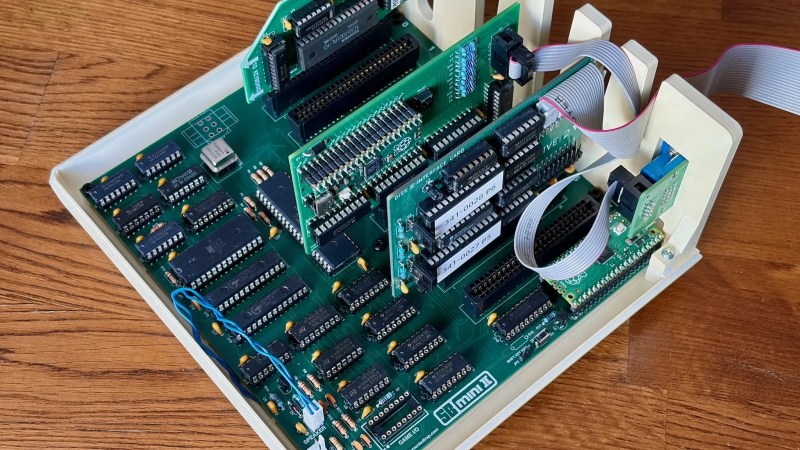
A relay-based computer is really a 1940s type of design. There are various memory types that would have been available in those days, but suitable CRTs for Williams Tues are hard to come by these days, mercury delay lines have the obvious toxicity issue, and core rope memory requires granny-level threading skills. That leaves mechanical or electromechanical memory like [Konrad Zuse] used in the 30s, or capacitors. he chose to make his memory with capacitors.

It’s pretty obvious when you think about it that you can use a capacitor as memory: charged/discharged lets each capacitor store one bit. Charge is 1, discharged is 0. Of course to read the capacitor it must be discharged (if charged) but most early memory has that same read-means-erase pattern. More annoying is that you can’t overwrite a 1 with a 0– a separate ‘clear’ circuit is needed to empty the capacitor. Since his relay computer was using SRAM, it wasn’t set up to do this clear operation.

He demonstrates an auto-clearing memory circuit on breadboard, using 3 relays and a capacitor, so the existing relay computer architecture doesn’t need to change. Addressing is a bit of a cheat, in terms of 1940s tech, as he’s using modern diodes– though of course, tube diodes or point-contact diodes could conceivably pressed into service if one was playing purist. He’s also using LEDs to avoid the voltage draw and power requirements of incandescent indicator lamps. Call it a hack.

He demonstrates his circuit on breadboard– first with a 4-bit word, and then scaled up to 16-bit, before going all way to a massive 8-bytes hooked into the backplane of his Altair-esque relay computer. If you watch nothing else, jump fifteen minutes in to have the rare pleasure of watching a program being input via front panel with a complete explanation. If you have a few extra seconds, stay for the satisfyingly clicky run of the loop. The bonus 8-byte program [DiPDoT] runs at the end of the video is pure AMSR, too.

Yeah, it’s not going to solve the rampocalypse, any more than the initial build of this computer helped with GPU prices. That’s not the point. The point is clack clack clack clack clack, and if that doesn’t appeal, we don’t know what to tell you.

Continue reading “Capacitor Memory Makes Homebrew Relay Computer Historically Plausible”

The LEGO-lookalike displaying [Paul]'s dashboard

LEGO Space Computer Made Full Size, 47 Years On

There’s just something delightful about scaled items. Big things shrunk down, like LEGO’s teeny tiny terminal brick? Delightful. Taking that terminal brick and scaling it back to a full-sized computer? Even better. That’s what designer [Paul Staal] has done with his M2x2 project.

In spite of the name, it actually has a Mac Mini M4 as its powerful beating heart. An M2 might have been more on-brand, but it’s probably a case of wanting the most horsepower possible in what [Paul] apparently uses as his main workstation these days. The build itself is simple, but has some great design details. As you probably expected, the case is 3D printed. You may not have expected that he can use the left stud as a volume control, thanks to an IKEA Symfonisk remote hidden beneath. The right stud comes off to allow access to a wireless charger.

The minifigs aren’t required to charge those airpods, but they’re never out of place.

The 7″ screen can display anything, but [Paul] mostly uses it either for a custom home assistant dashboard, or to display an equalizer, both loosely styled after ‘screen’ on the original brick. We have to admit, as cool as it looked with the minifigs back in the day, that sharp angle to the screen isn’t exactly ergonomic for humans.

Perhaps the best detail was putting LEGO-compatible studs on top of the 10:1 scaled up studs, so the brick that inspired the project can sit securely atop its scion. [Paul] has provided a detailed build guide and the STLs necessary to print off a brick, should anyone want to put one of these nostalgic machines on their own desk.

We’ve covered the LEGO computer brick before, but going the other way–putting a microcontroller and display in the brick it to run DOOM. We’ve also seen it scaled up before, but that project was a bit more modest in size and computing power.

Gwiz car and vapes

Vape-powered Car Isn’t Just Blowing Smoke

Disposable vapes aren’t quite the problem/resource stream they once were, with many jurisdictions moving to ban the absurdly wasteful little devices, but there are still a lot of slightly-smelly lithium batteries in the wild. You might be forgiven for thinking that most of them seem to be in [Chris Doel]’s UK workshop, given that he’s now cruising around what has to be the world’s only vape-powered car.

Technically, anyway; some motorheads might object to calling donor vehicle [Chris] starts with a car, but the venerable G-Wiz has four wheels, four seats, lights and a windscreen, so what more do you want? Horsepower in excess of 17 ponies (12.6 kW)? Top speeds in excess of 50 Mph (80 km/h)? Something other than the dead weight of 20-year-old lead-acid batteries? Well, [Chris] at least fixes that last part.

The conversion is amazingly simple: he just straps his 500 disposable vape battery pack into the back seat– the same one that was powering his shop–into the GWiz, and it’s off to the races. Not quickly, mind you, but with 500 lightly-used lithium cells in the back seat, how fast would you want to go? Hopefully the power bank goes back on the wall after the test drive, or he finds a better mounting solution. To [Chris]’s credit, he did renovate his pack with extra support and insulation, and put all the cells in an insulated aluminum box. Still, the low speed has to count as a safety feature at this point.

Charging isn’t fast either, as [Chris] has made the probably-controversial decision to use USB-C. We usually approve of USB-Cing all the things, but a car might be taking things too far, even one with such a comparatively tiny battery. Perhaps his earlier (equally nicotine-soaked) e-bike project would have been a better fit for USB charging.

Thanks to [Vaughna] for the tip! Continue reading “Vape-powered Car Isn’t Just Blowing Smoke”

Front and back of the prototype phone

Neither Android Nor IOS: DIY Smartphone Runs On ESP32!

You may or may not be reading this on a smartphone, but odds are that even if you aren’t, you own one. Well, possess one, anyway — it’s debatable if the locked-down, one-way relationships we have with our addiction slabs counts as ownership. [LuckyBor], aka [Breezy], on the other hand — fully owns his 4G smartphone, because he made it himself.

OK, sure, it’s only rocking a 4G modem, not 5G. But with an ESP32-S3 for a brain, that’s probably going to provide plenty of bandwidth. It does what you expect from a phone: thanks to its A7682E simcom modem, it can call and text. The OV2640 Arducam module allows it to take pictures, and yes, it surfs the web. It even has features certain flagship phones lack, like a 3.5 mm audio jack, and with its 3.5″ touchscreen, the ability to fit in your pocket. Well, once it gets a case, anyway.

Continue reading “Neither Android Nor IOS: DIY Smartphone Runs On ESP32!”