The word “Schlieren” is German, and translates roughly to “streaks”. What is streaky photography, and why might you want to use it in a project? And where did this funny term come from?
Think of the heat shimmer you can see on a hot day. From the ideal gas law, we know that hot air is less dense than cold air. Because of that density difference, it has a slightly lower refractive index. A light ray passing through a density gradient faces a gradient of refractive index, so is bent, hence the shimmer. Continue reading “Flow Visualization With Schlieren Photography”→
The iMac G3 is an absolute icon of industrial design, as (or perhaps more) era-defining than the Mac Classic before it. In the modern day, if your old iMac even boots, well, you can’t do much with it. [Rick Norcross] got a hold of a dead (hopefully irreparable) specimen, and stuffed a modern PC inside of it.
From the outside, it’s suprizingly hard to tell. Of course the CRT had to go, replaced with a 15″ ELO panel that fits well after being de-bezeled. (If its resolution is only 1024 x 768, well, it’s also only 15″, and that pixel density matches the case.) An M-ATX motherboard squeezes right in, above a modular PSU. Cooling comes from a 140 mm case fan placed under the original handle. Of course you can’t have an old Mac without a startup chime, and [Rick] obliges by including an Adafruit FX board wired to the internal speakers, set to chime on power-up while the PC components are booting.
These sorts of mods have proven controversial in the past– certainly there’s good reason to want to preserve aging hardware–but perhaps with this generation of iMac it won’t raise the same ire as when someone guts a Mac Classic. We’ve seen the same treatment given to a G4 iMac, but somehow the lamp doesn’t quite have the same place in our hearts as the redoubtable jellybean.
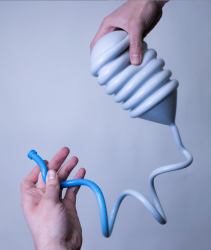
They might call it Levity, but there’s nothing funny about Rapid Liquid Print’s new silicone 3D printer. It has to be seen to be believed, and luckily [3D Printing Nerd] gives us lots of beauty shots in this short video, embedded below.
Smooth, and fast. This bladder took 51 minutes according to the RLP website.
Printing a liquid, even a somewhat-viscous one like platinum-cure silicone, presents certain obvious challenges. The Levity solves them with buoyancy: the prints are deposited not onto a bed, but into a gel, meaning they are fully supported as the silicone cures. The fact that the liquid doesn’t cure instantly has a side benefit: the layers bleed into one another, which means this technique should (in theory) be stronger in all directions than FDM printing. We have no data to back that up, but what you can see for yourself that the layer-blending creates a very smooth appearance in the finished prints.
If you watch the video, it really looks like magic, the way prints appear in the gel. The gel is apparently a commercially-available hydrogel, which is good since the build volume looks to need ̶a̶b̶o̶u̶t̶ ̶5̶0̶0̶ ̶L̶ at least 125 L of the stuff. The two-part silicone is also industry-standard and off-the-shelf, though no doubt the exact ratios and are tweaked for purpose. There’s no magic, just a really neat technology.
If you want one, you can sign up for the waiting list at Rapid Liquid Print’s website, but be prepared to wait; units ship next year, and there’s already a list.
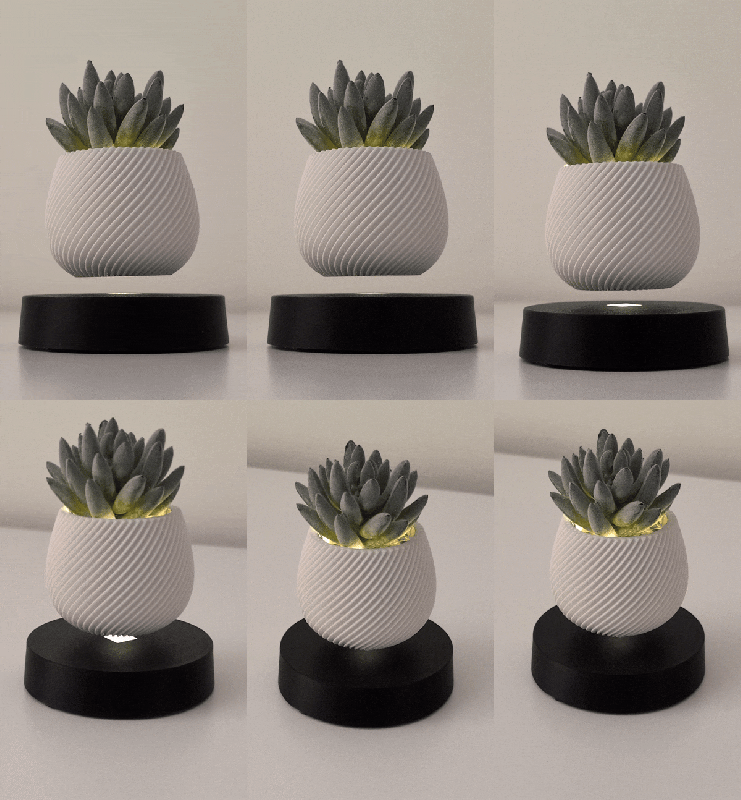
Magnets aren’t magic, but sometimes you can do things with them to fool the uninitiated — like levitating. [Jonathan Lock] does that with his new maglev desk toy, that looks like at least a level 2 enchantment.
This levitator is USB-powered, and typically draws 1 W to 3 W to levitate masses between 10 g and 500 g. The base can provide 3 V to 5 V inductive power to the levitator to the tune of 10 mA to 50 mA, which is enough for some interesting possibilities, starting with the lights and motors [Jonathan] has tried.
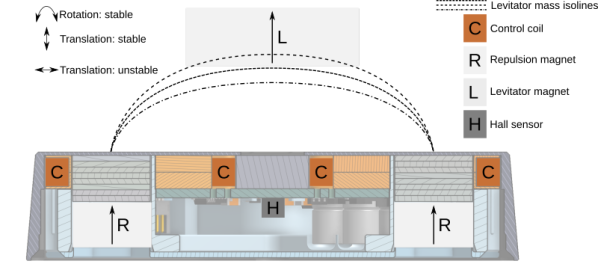
In construction it is much like the commercial units you’ve seen: four permanent magnets that repel another magnet in the levitator. Since such an arrangement is about as stable as balancing a basketball on a piece of spaghetti, the permanent magnets are wrapped in control coils that pull the levitator back to the center on a 1 kHz loop. This is accomplished by way of a hall sensor and an STM32 microcontroller running a PID loop. The custom PCB also has an onboard ESP32, but it’s used as a very overpowered USB/UART converter to talk to the STM32 for tuning in the current firmware.
If you think one of these would be nice to have on your desk, check it out on [Jonathan]’s GitLab. It’s all there, from a detailed build guide (with easy-to-follow animated GIF instructions) to CAD files and firmware. Kudos to [Jonathan] for the quality write-up; sometimes documenting is the hardest part of a project, and it’s worth acknowledging that as well as the technical aspects.
An ongoing refrain with modern movies is “Why is all of this CG?”– sometimes, it seems like practical effects are simultaneously a dying art, while at the same time modern technology lets them rise to new hights. [Davis Dewitt] proves that second statement with his RC movie star “robot” for an upcoming feature film.
The video takes us through the design process, including what it’s like to work with studio concept artists. As for the robot, it’s controlled by an Arduino Nano, lots of servos, and a COTS airplane R/C controller, all powered by li-po batteries. This is inside an artfully weathered and painted 3D printed body. Apparently weathering is important to make the character look like a well-loved ‘good guy’. (Shiny is evil, who knew?) Hats off to [Davis] for replicating that weathering for an identical ‘stunt double’.
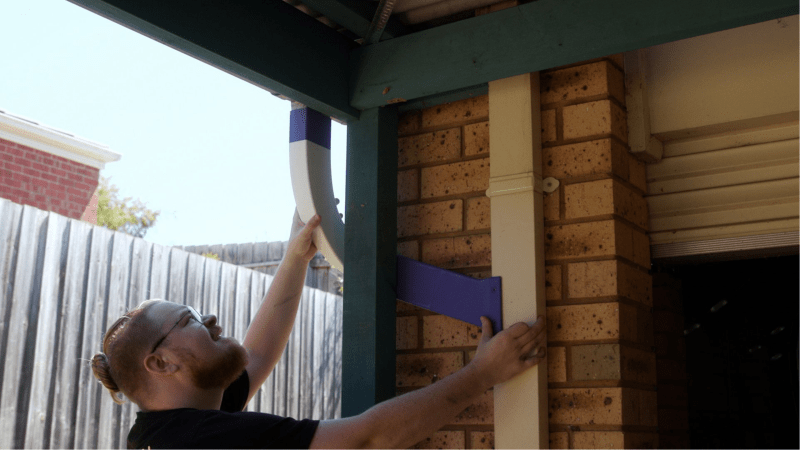
Sometimes, a hack solves a big problem. Sometimes, it’s just to deal with something that kind of bugs you. This hack from [Dillan Stock] is in the latter category, replacing an ugly, redundant downspout with an elegant 3D printed pipe.
As [Dillan] so introspectively notes, this was not something that absolutely required a 3D print, but “when all you have a hammer, everything is a nail, and 3D printing is [his] hammer.” We can respect that, especially when he hammers out such a lovely print.
By modeling this section of his house in Fusion 360, he could produce an elegantly swooping loft to combine the outflow into one downspout. Of course the assembly was too big to print at once, but any plumber will tell you that ABS welds are waterproof. Paint and primer gets it to match the house and hopefully hold up to the punishing Australian sun.
The video, embedded below, is a good watch and a reminder than not every project has to be some grand accomplishment. Sometimes, it can be as simple as keeping you from getting annoyed when you step into your backyard.
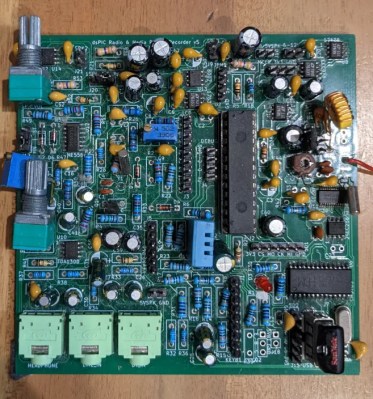
In these days of everything-streaming, it’s great to see an old school radio build. It’s even better when it’s not old-school at all, but packed full of modern ICs and driven by a micro-controller like the dsPIC in [Minh Danh]’s dsMP3 build. Best of all is when we get enough details that the author needs two blog posts — one for hardware, and one for firmware — like [Minh Danh] has done.
This build does it all: radio, MP3 playback, and records incoming signals. The radio portion of the build is driven by an Si4735, which allows for receiving both in FM and AM — with all the AM bands, SW, MW and LW available. The FM section does support RDS, though because [Minh Danh] ran out of pins on the dsPIC, isn’t the perfect implementation.
Just look at that thru-hole goodness.
The audio section is a good intro to audio engineering if you’ve never done a project like this: he’s using a TDA1308 for headphones, which feeds into a NS8002 to drive some hefty stereo speakers– and he tells you why he selected those chips, as well as providing broken-out schematics for each. Really, we can’t say enough good things about this project’s documentation.
That’s before we get to the firmware, where he tells us how he manages to get the dsPIC to read out MP3s from a USB drive, and write WAVs to it. One very interesting detail is how he used the dsPIC’s ample analog inputs to handle the front panel buttons on this radio: a resistor ladder. It’s a great solution in a project that’s full of them.
Of course we’ve seen radio receivers before, and plenty of MP3 players, too — but this might be the first time we’ve seen an electronic Swiss army knife with all these features, and we’re very glad [Minh Danh] shared it with us.




 This levitator is USB-powered, and typically draws 1 W to 3 W to levitate masses between 10 g and 500 g. The base can provide 3 V to 5 V inductive power to the levitator to the tune of 10 mA to 50 mA, which is enough for some interesting possibilities, starting with the lights and motors [Jonathan] has tried.