The $16 PCB Robot

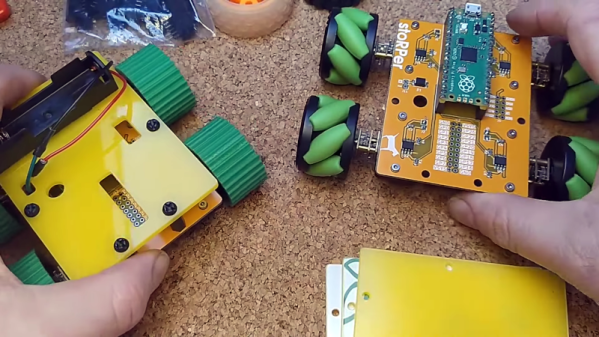
It is a fun project to build a simple robot but, often, the hardest part these days is creating the mechanical base. [Concrete Dog] has a new open source design for stoRPer that uses a PC board as the base. The board has a Raspberry Pi Pico and motor drivers. The modular design allows you to add to it easily and use custom wheels. The video below shows some treaded wheels and some mechanum wheels with gears.

There are mounting holes for sensors and also a way to put another deck above to hold other circuits, power, or whatever you like. There’s lots you could do with this as a starting point.

Continue reading “The $16 PCB Robot”

The 1970s Computer: A Slice Of Computing

What do the HP-1000 and the DEC VAX 11/730 have in common with the video games Tempest and Battlezone? More than you might think. All of those machines, along with many others from that time period, used AM2900-family bit slice CPUs.

The bit slice CPU was a very successful product that could only have existed in the 1970s. Today, if you need a computer system, there are many CPUs and even entire systems on a chip to choose from. You can also get many small board-level systems that would probably do anything you want. In the 1960s, you had no choices at all. You built circuit boards with gates on the using transistors, tubes, relays, or — maybe — small-scale IC gates. Then you wired the boards up.

It didn’t take a genius to realize that it would be great to offer people a CPU chip like you can get today. The problem is the semiconductor technology of the day wouldn’t allow it — at least, not with any significant amount of resources. For example, the Motorola MC14500B from 1977 was a one-bit microprocessor, and while that had its uses, it wasn’t for everyone or everything.

The Answer

The answer was to produce as much of a CPU as possible in a chip and make provisions to use multiple chips together to build the CPU. That’s exactly what AMD did with the AM2900 family. If you think about it, what is a CPU? Sure, there are variations, but at the core, there’s a place to store instructions, a place to store data, some way to pick instructions, and a way to operate on data (like an ALU — arithmetic logic unit). Instructions move data from one place to another and set the state of things like I/O devices, ALU operations, and the like.

Continue reading “The 1970s Computer: A Slice Of Computing”

What’s A Transfluxor?

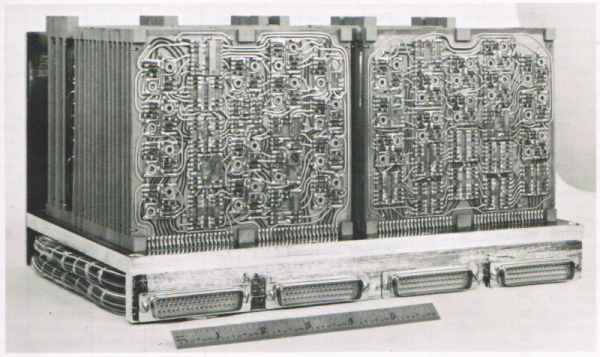
In the 1967 movie The Graduate, a wise older man gives some advice to the title character: plastics. Indeed, plastics would become big business. In 1962, though, a computer-savvy character might have offered a different word: transfluxor. What’s a transfluxor? Well, according to computer history sleuth [Ken Shirriff], it was the heart of a 20-pound transistor computer from Arma. Of course, plastics turned out to be a better bet, but in 1962, the transfluxor seemed to be the wave of the future.

In 1962, most computers were room-sized, but the Arma was “micro” taking up just 0.4 cubic feet — less than an Apple II. It would eventually spawn computers used in ships at sea and airplanes ranging from the Concorde to Air Force One.

Continue reading “What’s A Transfluxor?”

Blast From The Past: Schematic Templates

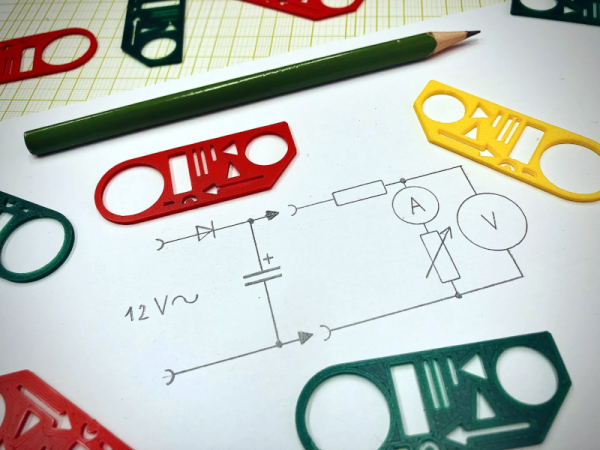
If you want to draw schematics today, you probably sit down at your computer. Why not? There are a ton of programs made to do the work easily, and the results look great. Back in the day, you might sit at a drafting table with a full set of T-squares, triangles, and maybe a Leroy. But what about when inspiration struck at the coffee shop (no, not a Starbucks in those days)? Well, you probably had a schematic drawing template. We were surprised you can still buy these at high prices. Or you can 3D print your own, thanks to [Jan Stech].

Templates of all kinds used to be very common. There were several for schematics, logic symbols, furniture, and even geometric shapes and curves. They were almost always green and transparent. A quick search on Amazon for “drafting template” shows you can still get the generic templates, but schematic ones are still expensive.

Continue reading “Blast From The Past: Schematic Templates”

Joost Bürgi And Logarithms

Logarithms are a common idea today, even though we don’t use them as often as we used to. After all, one of the major uses of logarithms is to simplify computations, and computers do that just fine (although they might use logs internally). But 400 years ago, doing math was painful. Enter Joost Bürgi. According to [Welch Labs], his book of mathematical tables should have changed math forever. But it didn’t.

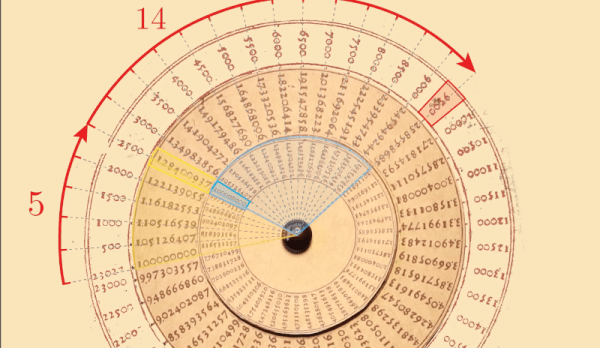
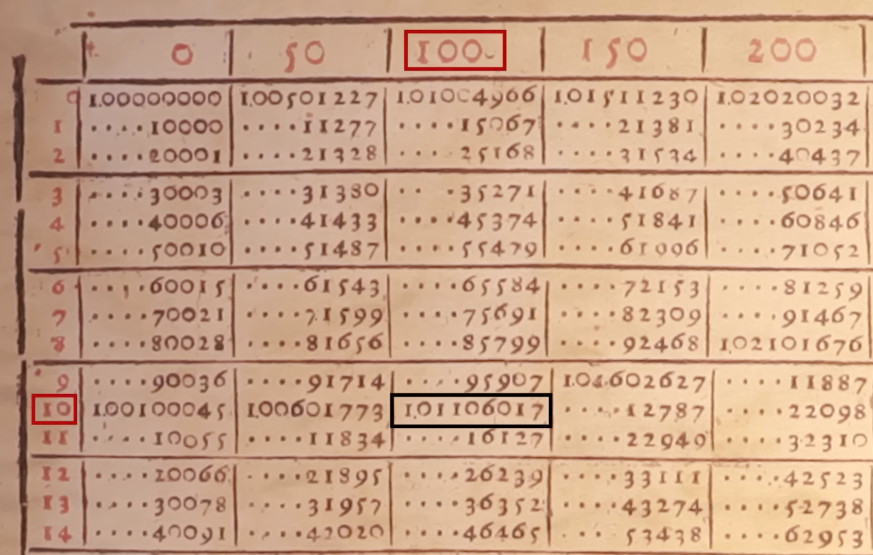
If you know how a slide rule works, you’ll find you already know much of what the video shows. The clockmaker was one of the people who worked out how logs could simplify many difficult equations. He created a table of 23,030 “red and black” numbers to nine digits. Essentially, this was a table of logarithms to a very unusual base: 1.0001.
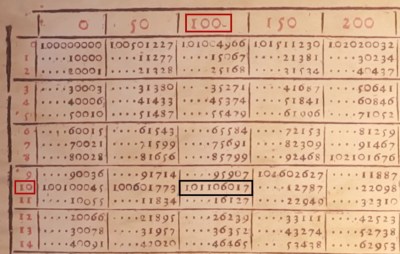
Why such a strange base? Because it allowed interpolation to a higher accuracy than using a larger base. Red numbers are, of course, the logarithms, and the black numbers are antilogs. The real tables are a bit hard to read because he omitted digits that didn’t change and scaled parts of it by ten (which was changed in the video below to simplify things). It doesn’t help, either, that decimal points hadn’t been invented yet.

What was really impressive, though, was the disk-like construct on the cover of the book. Although it wasn’t mentioned in the text, it is clear this was meant to allow you to build a circular slide rule, which [Welch Labs] does and demonstrates in the video.

Unfortunately, the book was not widely known and Napier gets the credit for inventing and popularizing logarithms. Napier published in 1614 while Joost published in 1620. However, both men likely had their tables in some form much earlier. However, Kepler knew of the Bürgi tables as early as 1610 and was dismayed that they were not published.

While we enjoy all kinds of retrocomputers, the slide rule may be the original. Want to make your own circular version? You don’t need to find a copy of this book.

Continue reading “Joost Bürgi And Logarithms”

Integration Taught Correctly

[Math the World] claims that your calculus teacher taught you integration wrong. That’s assuming, of course, you learned integration at all, and if you haven’t forgotten it. The premise is that most people think of performing an integral as finding the area under a curve or as the “antiderivative.” However, fewer people think of integration as adding up many small parts. The video asserts that studies show that students who don’t understand the third definition have difficulty applying integration to real-world problems.

We aren’t sure that’s true. People who write software have probably looked at numerical integration like Simpson’s rule or the midpoint rule. That makes it pretty obvious that integration is summing up small bits of something. However, you usually learn that very early, so you’re forgiven if you didn’t get the significance of it at the time.

Continue reading “Integration Taught Correctly”

Radioactive 3D Printed Flower Glows And Glows

Glow-in-the-dark projects aren’t that uncommon. You can even get glow-in-the-dark PLA filament. However, those common glowing items require a charge from light, and the glow fades very quickly. [Ogrinz Labs] wasn’t satisfied with that. His “Night Blossom” 3D-printed flower glows using radioactive tritium and will continue to glow for decades.

Tritium vials are available and often show up in watches for nighttime visibility. The glow doesn’t actually come directly from the radioactive tritium (an isotope of hydrogen). Instead, the radioactive particles excite phosphor, which glows in the visible spectrum.

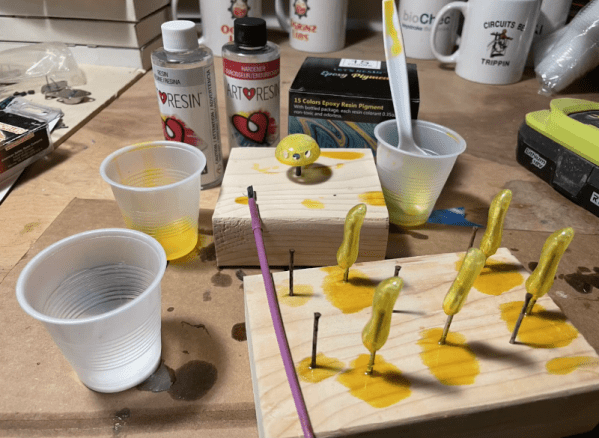
Once you have the vials, it is easy to understand how to finish off the project. The flower contains some long tubes inside each petal. There are also a few tiny vials in the center. The whole assembly goes together with glue.

Continue reading “Radioactive 3D Printed Flower Glows And Glows”