That’s Not A Junker… That’s My Generator

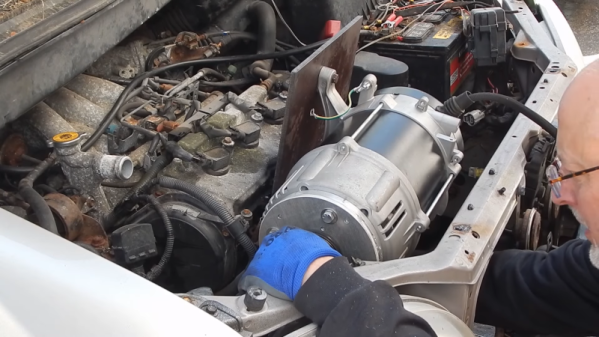
If you live somewhere prone to power outages, you might have thought about buying a generator. The problem is that small generators are cheap but — well — small. Big generators are expensive. [Jake von Slatt] had an idea. He has a “yard car” which we thought might be a junk car but, instead, it is an old car he uses to drive around his yard doing tasks. It has a winch and a welder. Now it has a big generator, too. You can follow the project in the three videos found below.

The project started with a scrap generator with a blown motor. Of course, the car has a motor so — in theory — pretty simple. Remove the generator from the motor and graft it to the car’s motor. But the details are what will kill you.

Continue reading “That’s Not A Junker… That’s My Generator”

Ham Radio Mini Beam

Years ago, ham radio operators more often than not had land, and usually there weren’t any restrictions on what kind of antenna they could erect on that land. These days you are more likely to live with less or no land, and even if you do own property, you might have restrictions that prevent you from putting up any kind of visible antenna.

But even if that’s not the case, you might not have room for an old-fashioned “tri-bander” or “cubical quad” that the hams of old preferred. [Waters & Stanton] has a 65-year-old design for a miniature beam that he explains, and it produces a good beam antenna in a reduced amount of space. You can watch a video about the antenna below.

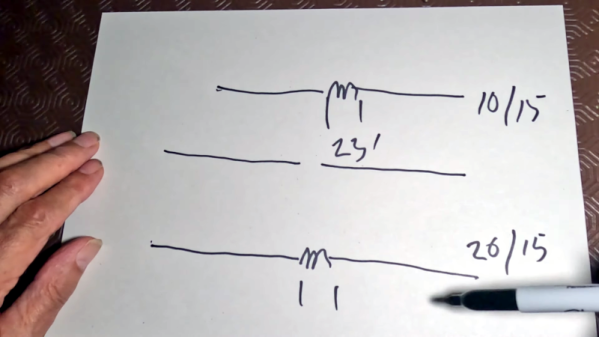
The design uses a doublet — a dipole fed with a balanced line and tuned at the feed point. A 22-foot doublet can cover 20 meters down to 10 meters without traps. Adding a director and reflector element provides directionality and gain. A unique arrangement allowed a 12-foot boom to support multiple elements on some bands by introducing a central coil on some elements. For example, the director is tuned to 15 meters using a center coil. But the coil is shorted with a 10 meter quarter stub that acts as a short on that band. You can see a complete explanation in the video.

We were hoping to see a build and some on-the-air testing, but, apparently, that is left as an exercise for the viewer. We imagine that 65 years ago, you’d use a grid dip oscillator to tune the stubs. Today, an antenna analyzer would do the job easily.

Continue reading “Ham Radio Mini Beam”

Aluminum Battery Is Sustainable

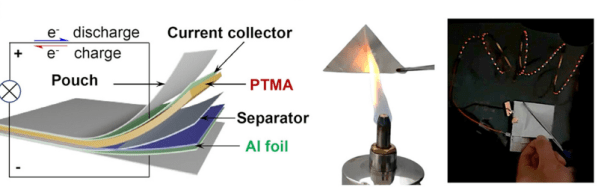
If you think of metals in a battery, you probably think of lithium, mercury, lead, nickel, and cadmium. But researchers in Australia and China want you to think about aluminum. Unlike most battery metals, aluminum is abundant and not difficult to dispose of later.

Their battery design uses water-based electrolytes and is air-stable. It is also flame retardant. The battery can provide 1.25V at a capacity of 110 mAh/g over 800 charge cycles. The idea of using aluminum in a battery isn’t new. Aluminum is potentially more efficient since each aluminum ion is equivalent to three lithium ions. The batteries, in theory, have higher energy density compared to lithium-ion, but suffer from short shelf life and, so far, practical devices aren’t that close to the theoretical limits of the technology.

Continue reading “Aluminum Battery Is Sustainable”

Cold Metal Fusion For 3D Printing

When you see the term cold fusion, you probably think about energy generation, but the Cold Metal Fusion Alliance is an industry group all about 3D printing metal using Selective Laser Sintering (SLS) printers. The technology promoted by Headmade Materials typically involves using a mix of metal and plastic powder. The resulting part is tougher than you might expect, allowing you to perform mechanical operations on it before it is oven-sintered to remove the plastic.

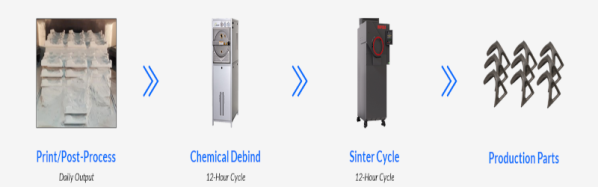
The key appears to be the patented powder, where each metal particle has a thin polymer coating. The low temperature of the laser in the SLS machine melts the polymer, binding the metal particles together. After printing, a chemical debinding system prepares the part — which takes twelve hours. Then, you need another twelve hours in the oven to get the actual metal part.

You might wonder why we are interested in this. After all, SLS printers are unusual — but not unheard of — in home labs. But we were looking at the latest offerings from Nexa3D and realized that the lasers in their low-end machines are not far from the lasers we have in our shops today. The QLS230, for example, operates at 30 watts. There’s plenty of people reading this that have cutters in that range or beyond out in the garage or basement.

We aren’t sure what a hobby setup would look like for the debinding and the oven steps, but it can’t be that hard. Maybe it is time to look at homebrew SLS printers again. Of course, the powder isn’t cheap and is probably hard to replace. We saw a 20 kg tub of it for the low price of €5,000. On the other hand, that’s a lot of powder, and it looks like whatever doesn’t go into your part can be reused so the price isn’t as bad as it sounds. We’d love to see someone get some of this and try it with a hacked printer.

We have seen homebrew SLS printers. There’s also OpenSLS that, coincidentally, uses a laser cutter. It wouldn’t be cheap or easy, but being able to turn out metal parts in your garage would be quite the payoff. Be sure to keep us posted on your progress.

Button, Button, Who’s Got The (Pico) Button?

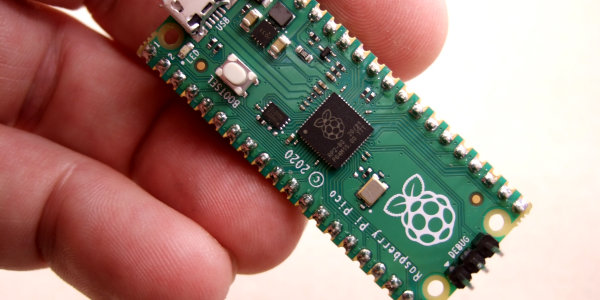
There is an episode of Ren and Stimpy with a big red “history eraser’ button that must not be pressed. Of course, who can resist the temptation of pressing the unpressable button? The same goes for development boards. If there is a button on there, you want to read it in your code, right? The Raspberry Pi Pico is a bit strange in that regard. The standard one lacks a reset button, but there is a big tantalizing button to reset in bootloader mode. You only use it when you power up, so why not read it in your code? Why not, indeed?

Turns out, that button isn’t what you think it is. It isn’t connected to a normal CPU pin at all. Instead, it connects to the flash memory chip. So does that mean you can’t read it at all? Not exactly. There’s good news, and then there’s bad news.

The Good News

The official Raspberry Pi examples show how to read the button (you have read all the examples, right?). You can convert the flash’s chip-select into an input temporarily and try to figure out if the pin is low, meaning that the button is pushed. Sounds easy, right?

Continue reading “Button, Button, Who’s Got The (Pico) Button?”

Driving A Motor With An Audio Amp Chip

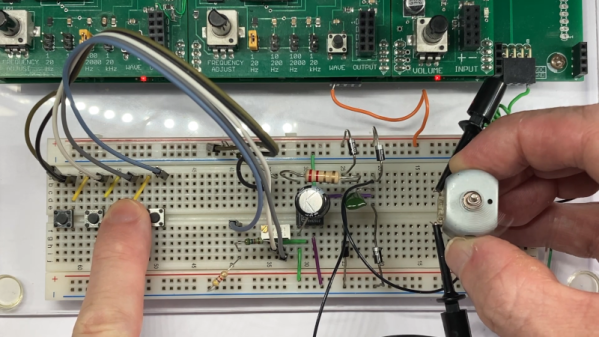
[InazumaDenki] wanted to answer the question: can you drive a motor with an audio amplifier chip? The answer, of course, is yes. The TDA7052 has a single input, and a bridge output meant to drive a speaker differentially. It should work if the motor doesn’t present more of a load than a speaker.

The plan was to use a resistive divider to provide several discrete voltages to the input. At precisely the half-way mark, there should be no voltage across the load. Altering the input to go higher than halfway should make the motor turn one way, and making it go lower should turn the motor the other way. As you can see in the video below, it does work, although it may not be ideal for this application.

Continue reading “Driving A Motor With An Audio Amp Chip”

3D Printing At 100C

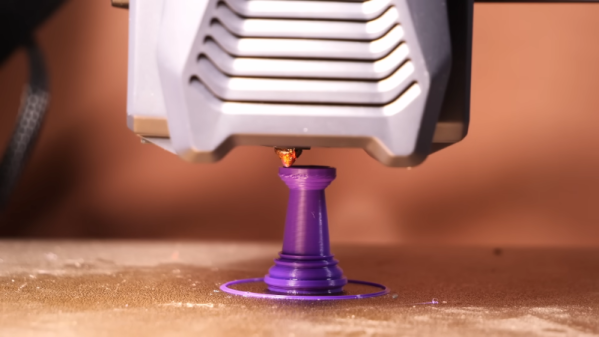
Normally, 3D printing with filament takes temperatures of around 200 °C. However, there are some crafting plastics that melt in hot water at 60 °C. You can get spools of similar plastic that prints at very low temperatures, and some 3D printing pens use it. [Lost in Tech] picked up a spool of the stuff meant for medical printing and found that printing with it was a challenge. You can watch a video of the results below.

The first problem is that most printers don’t want to extrude at low temperatures. You can override this or, if you want to print with this plastic — PCL — you can rebuild the printer firmware. He never got bridges to work very well, but some prints came out reasonably well.

Of course, you might wonder why you would care about this kind of plastic. For one thing, it’s apparently safe to work with. If you were printing with students, too, you might be interested in a lower printer temperature. However, it didn’t look like the results were that good. However, it makes you wonder what kinds of filament you could use with a little work that might have some benefit.

The last time we heard about this stuff, someone was printing bones with it. We are always on the lookout for oddball filament to play with.

Continue reading “3D Printing At 100C”