Roll Your Own Simple Tube Tester

You can easily get carried away when trying to test things. For example, if you want to know if your car is working, you could measure the timing of the ignition and put the car on a dynamometer. Or you could just start it and figure that if it runs and moves when you put it in drive, it is probably fine.

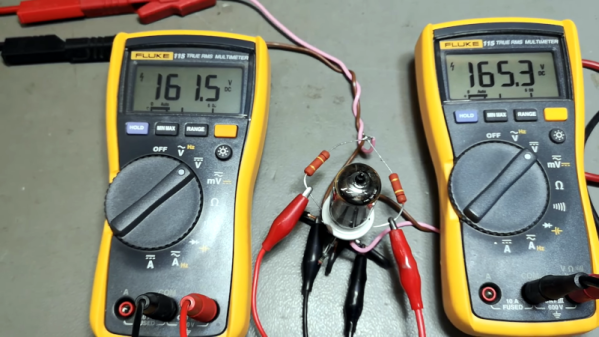
When [Thomas Scherrer] wanted to test some tubes, he made the same kind of assumption. While tubes can develop wacky failure modes, the normal difference between a working tube and a failing tube is usually not very subtle. He made a simple test rig to test tubes at DC and one operating point. Not comprehensive, but good enough most of the time. Have a look at what he did in the video below.

The tester is just a few resistors, a tube socket, and some bench power supplies. Of course, you may have to adapt it to whatever tube you are testing. If we had a lot of tubes to do, we might make the rig a bit more permanent, but for an afternoon of testing, what he has would be fine.

In addition to the power supplies, you’ll need at least one, preferably two, volt meters. He was able to validate his results with a proper tube tester. The results matched up well. While this won’t solve all your tube testing problems, it will give you a quick start.

You can build your own modern tube tester, of course. Or pick up a vintage one. Our favorite one uses punched cards.

Continue reading “Roll Your Own Simple Tube Tester”

Watch Those 1% Resistors

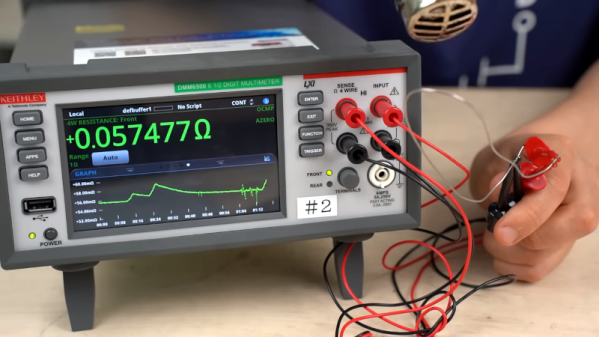
Decades ago, electronic components were not as easy to acquire as they are today. Sure, you could get some things at Radio Shack. But you might not have many choices, and the price would be on the high side. TV repair components were another option, but, again, big bucks. Some places sold surplus parts, which could be cheap. These often came from manufacturing runs where a company bought 10,000 components and made 8,000 products. But today, you can order parts inexpensively and get them on your doorstep in a day or, sometimes, even less. Are these inexpensive parts really any good? [Denki Otaku] likes to find out. In a recent video, he checks out some Amazon-supplied 1% resistors to find out how good they are. You can watch his results below.

Continue reading “Watch Those 1% Resistors”

Russian Weather Satellite Reuses Name, Yields Images

Which Russian weather satellite has the name Meteor 2? According to [saveitforparts], pretty much all of them. He showed how to grab images from an earlier satellite with the same name a while back. That satellite, though, met with some kind of disaster, so he’s posted a new video about reading data from the new Meteor 2 and you can watch it below.

The interesting part, we thought, was that the software he’s using, Raspberry-NOAA v2, doesn’t know about this incarnation of the bird which has only been up for a few weeks. That means he had to find a satellite with similar orbital parameters. Eventually, the program will have the setup for this satellite.

Continue reading “Russian Weather Satellite Reuses Name, Yields Images”

Retrotechtacular: The Nuclear Cruise Ship Of The Future Earns Glowing Reviews

The average modern cruise ship takes about 250 tons or 80,000 gallons of fuel daily. But can you imagine a cruise ship capable of circling the globe fourteen times before it needed to top off? That was the claim for the NS Savannah, a nuclear-powered cruise ship born out of President Eisenhower’s “Atoms for Peace” initiative.

The ship was a joint project of several government agencies, including the US Maritime Administration. With a maiden cruise in 1962, the vessel cost a little more than $18 million to build, but the 74-megawatt nuclear reactor added nearly $30 million to the price tag. The ship could carry 60 passengers, 124 crew, and over 14,000 tons of cargo around 300,000 nautical miles using one set of 32 fuel elements. What was it like onboard? The video below gives a glimpse of nuclear cruising in the 1960s.

Continue reading “Retrotechtacular: The Nuclear Cruise Ship Of The Future Earns Glowing Reviews”

Hackaday Podcast 226: Ice, Snow, And Cooling Paint In July

This week, Editor-in-Chief Elliot Williams and Al Williams shoot the breeze about all things Hackaday. We start off with some fond remembrances of Don Lancaster, a legendary hardware hacker who passed away last month. There’s also news about the Hackaday Prize (the tool competition) and a rant about fast computers and slow software, a topic that drew many comments this week.

In the What’s That Sound event, Al proves he’s more of a Star Trek fan than a videogamer. But there were plenty of correct answers, but only one winner: [Wybrandus]. There’s always next week, so keep playing!

Elliot may be dreaming of cooler weather since he talks about ice sculptures, snow measurements, and a paint that can make things cooler. We don’t know what Al is dreaming about, but he is worried about his fuses, and the ins and out of open source licensing.

Along the way, you’ll hear about personal vehicles, sky cameras, and zapping weeds with extreme solar power. As usual, there is an eclectic mix of other posts. What has the Hackaday crew been up to? Field trips! Hear about Dan Maloney’s visit to the SNOTEL network to measure snowfall and a report from Al and Bil Herd’s trip to the Vintage Computer Festival Southwest.

What to read along? The links below will get you started. Don’t forget to tell us what you think in the comments!

Or, download a copy for posterity to file away in your archive.

Continue reading “Hackaday Podcast 226: Ice, Snow, And Cooling Paint In July”

Getting A Rise With Laser Cutting

Your first 3D print probably seemed pretty amazing. But if you revisit it after a few years, you’ll likely notice it wasn’t nearly as good as you thought. We improve our printers and our processes and the new better results become normal. If you have a laser cutter, you may go through the same iteration. At first, you are happy just to get scorch marks on the workpiece. But when you move to cutting, you want cleaner cuts. You put tape over the work, add air assist, and invest in a honeycomb bed. Each step gets you better results, but you can always improve.

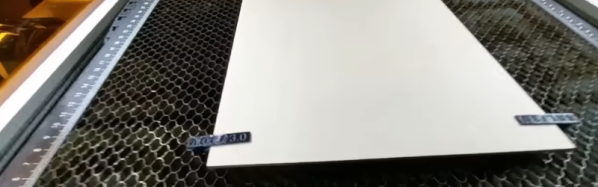
[The Louisiana Hobby Guy] (also known as [Rich]) knows a lot about the practical side of lasers. He suggests using standoff pins to not just secure the part to the honeycomb bed but lift it up a little, allowing air to flow under the part and lets the laser easily cut all the way through. You can see them in action in the video below.

This is a cheap upgrade to prevent flashback when cutting. [Rich] explains how to size them properly and even how to make your own if you don’t want to buy them off the shelf. You can laser cut hold-down pins from plans [Rich] provides, although he prefers to 3D print them, and you can do that, too. Most beds look similar, but if yours is an oddball, you might have to modify them slightly. He has regular dog clamps and the antiflashback standoffs, so you can make some of each. You can also buy them online. Most do not have the antiflashback feature, but at least one vendor that [Rich] points out does have them

If you don’t like the ones [Rich] shows, you can find 3D models for similar pins in the usual places. You can also design them yourself if you want them exactly how you want.

A good thing to add to your laser cutting workflow. [Rich’s] channel is full of great stuff. If you want to know more about air assist, we’ve added it to our cutters. If you are serious about precision cuts, know your kerf, too.

Continue reading “Getting A Rise With Laser Cutting”

Improved Hydrogen Fuel Cells Are Groovy

According to [Charles Q. Choi], a new study indicates that grooves in the hydrogen fuel cells used to power vehicles can improve their performance by up to 50%. Fuel cells are like batteries because they use chemical reactions to create electricity. Where they are different is that a battery reacts a certain amount of material, and then it is done unless you recharge it somehow. A fuel cell will use as much fuel as you give it. That allows it to continue creating electricity until the fuel runs out.

Common hydrogen fuel cells use a proton exchange membrane — a polymer membrane that conducts protons to separate the fuel and the oxidizer. You can think of it as an electrolyte. Common fuel cells use an electrode design that hasn’t changed in decades. The new research has catalyst ridges separated by empty grooves. This enhances oxygen flow and proton transport.

Conventional electrodes use an ion-conducting polymer and a platinum catalyst. Adding more polymer improves proton transport but inhibits oxygen flow. The grooved design allows for dense polymer on the ridges but allows oxygen to flow in the grooves. In technical terms, the proton transport resistance goes down, and there is little change in the oxygen transport resistance.

The grooves are between one and two nanometers wide, so don’t pull out your CNC mill. The researchers admit they had the idea for this some time ago, but it has taken several years to figure out how to fabricate the special electrodes.