Retrotechtacular: Voice Controlled Typewriter Science Project In 1958

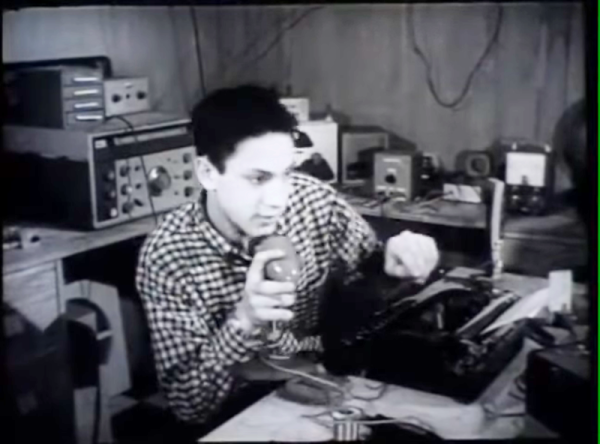
Hackaday readers might know [Victor Scheinman] as the pioneer who built some of the first practical robot arms. But what was a kid like that doing in high school? Thanks to a film about the 1958 New York City Science Fair, we know he was building a voice-activated typewriter. Don’t believe it? Watch it yourself below, thanks to [David Hoffman].

Ok, we know. Voice typing is no big deal today, and, frankly, [Victor’s] attempt isn’t going to amaze anyone today. But think about it. It was 1958! All those boat anchor ham radios behind him aren’t antiques. That’s what radios looked like in 1958. Plus, the kid is 16 years old. We’d say he did pretty darn good!

Continue reading “Retrotechtacular: Voice Controlled Typewriter Science Project In 1958”

Finding Paths With Water Is A-Mazing

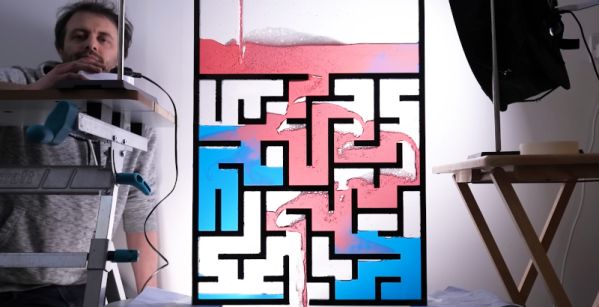
We aren’t sure if it qualifies as fluidic logic, but [Steve Mould] was inspired by a simulation of water flowing through a maze and decided to build some actual mazes and watch water flowing through them. It turns out there are several physical effects in play, and you can see [Steve] discuss them in the video below.

The maze, of course, has to be oriented so that water flows into the top and flows out of the bottom. Without much thought, you’d think that the water just goes to the bottom and then fills up. Eventually, the part that is open at the bottom will have water coming out, right? Turns out it isn’t that simple.

A combination of air pressure and surface tension conspire to make the water do better than expected. Not that it perfectly solves it, but it doesn’t just fill up the entire maze, either. Even more interesting is that once the water has found the bottom, changing the water color will clearly show the path through the maze since nearly all of the new colored water will follow the flow path.

Practical? We can’t think of why. But it is a great think piece on how water flows and what sort of forces can affect it.

[Steve] is no stranger to making water work out algorithms, something called fluidic logic.

Continue reading “Finding Paths With Water Is A-Mazing”

Retrotechtacular: Solder Like Its 1944!

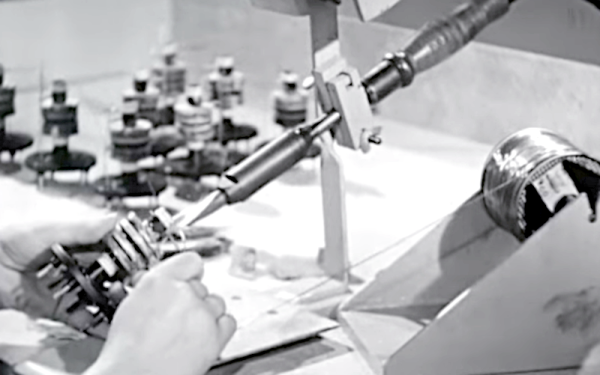
When we first saw this 1944 US Office of Education film about hand soldering, we figured it might still have some good information. Well, perhaps it does, but the 1944 soldering was with a giant iron, and the work looked more like metal bricks than anything we’ve soldered lately. Of course, the physics is all the same, but some of the terminology, like “sweating in” isn’t anything we’ve heard before, although we have heard of sweat soldering.

They do show some electronic soldering on components, including some interesting-looking coils. But the irons look more like a bad science fiction movie’s idea of a lightsaber. The solder is equally huge, of course.

Continue reading “Retrotechtacular: Solder Like Its 1944!”

Upgrade Your Voodoo With More Memory

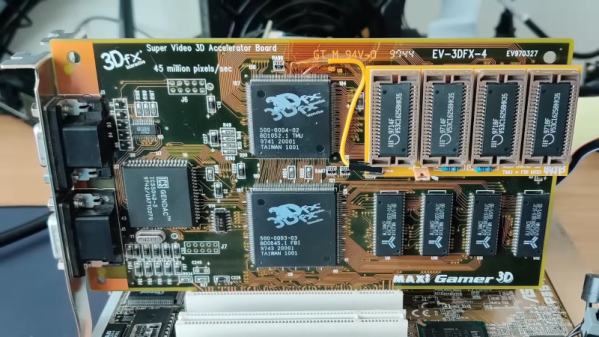
In 1996, the 3Dfx VooDoo VGA chipset changed computer graphics forever. Because of the high cost of memory, most of the boards had only 4 MB of memory — which seemed a lot back then. However, the chipset could actually handle up to 8 MB. [Bits and Bolts] couldn’t stand that his board only had 4 MB, so he did what any good hacker would do: he figured out how to add the missing memory!

The mod has been done before using the “piggyback” technique, where you solder the new RAM chips on the old chips and bend out a few pins out to directly wire them to chip selects elsewhere on the board. [Bits and Bolts] didn’t want to try that, so instead, he developed a PCB that slips over the chip using a socket.

Continue reading “Upgrade Your Voodoo With More Memory”

CP/M 6502-Style

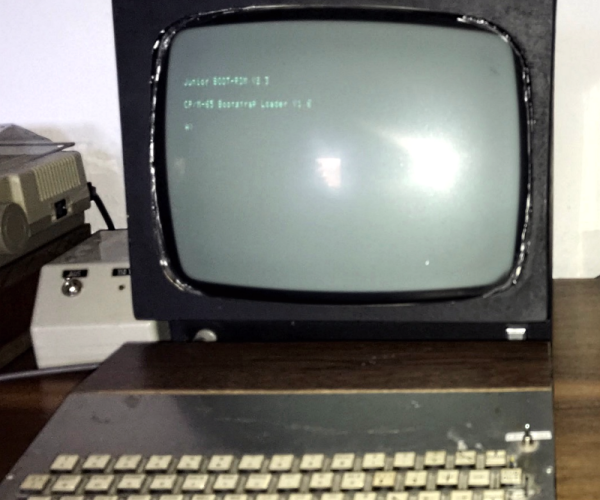
There are projects you create to share with the world, but there are also those you do just because you want something for yourself. Lucky for us, [Dietrich-L]’s 30-year-long project to create CPM-65, a CP/M-like OS for the 6502, has become both.

[Dietrich-L] does admit that the documentation is “sparse” and “for my personal needs.” Still, the OS has most of what you’d expect and runs well on the target system, a heavily-modified Elektor Junior with 57 kB of RAM. The disk structure is compatible with CP/M, although the Transient Program Area (TPA) apparently starts at $200, which is a bit different from a typical CP/M. Apparently, the system uses some low memory which necessitated the relocation. Just in case you were hoping, CPM-65 doesn’t emulate an 8080 system, so you can’t run normal CP/M programs. You just get a similar operating environment and tools.

The 31 commands listed include an assembler, BASIC, Forth, an editor, and some disk tools, along with a debugger. Xmodem is available, too. Everything is written in assembly for the CPM-65 assembler, so bootstrapping could be an issue if you need to make any changes.

Speaking of changes, there is some documentation in the docs sub-directory, including the layout of [Dietrich-L]’s system, which would be handy if you were trying to run this on your own hardware. You’ll also find basic commands for the editor, details of the assembler, and some other documents.

[Dietrich-L] notes that he was unaware when he started the project that there were other similar projects. DOS/65 (which has a port for the Commodore 64), OUP/M (which hasn’t been updated since 1983), and CPM65 (apparently no relation, but very impressive), which appeared in 2022.

If you need a 6502 computer, grab a breadboard, although adding the disk drive is an exercise left to the reader. Or, grab an FPGA but expect more work.

Thanks [Stephen Walters] for the tip!

Machine Learning Helps Electron Microscopy

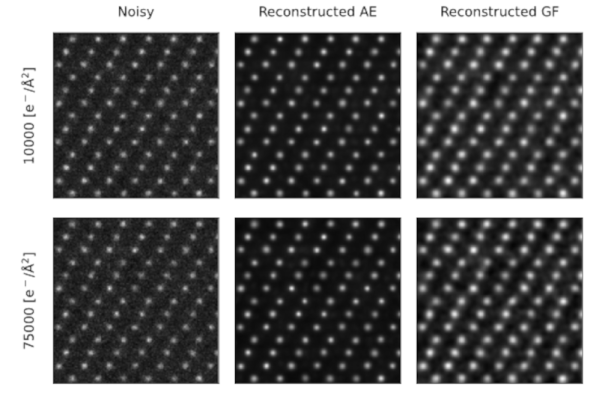
Machine learning is supposed to help us do everything these days, so why not electron microscopy? A team from Ireland has done just that and published their results using machine learning to enhance STEM — scanning transmission electron microscopy. The result is important because it targets a very particular use case — low dose STEM.

The problem is that to get high resolutions, you typically need to use high electron doses. However, bombarding a delicate, often biological, subject with high-energy electrons may change what you are looking at and damage the sample. But using reduced electron dosages results in a poor image due to Poisson noise. The new technique learns how to compensate for the noise and produce a better-quality image even at low dosages.

Continue reading “Machine Learning Helps Electron Microscopy”

Linux Fu: Gum Up Your Script

We often write quick bash scripts and judging by the comments, half of us use bash or a similar shell to pop out quick, useful scripts, and half of us think that’s an abomination, and you should only use bash for your command line and resort to something more like a traditional language to do anything else. If you’re in the former camp, you’re probably cursing your allegiance when you need to make your bash scripts more interactive.

Gum can help. It’s a utility that can handle your script input and output with a little flair while requiring almost no effort on your part.

The command looks simple, but it has twelve subcommands, each with myriad options. But you can break down the functions into a few simple categories. The input commands let you prompt for a line of input or a bunch of lines of input. You can also create a pick list or a yes/no type of prompt. There’s also a file picker and a filter, sort of like fzf.

Continue reading “Linux Fu: Gum Up Your Script”