Truly Giant Telescope Could Image Exoplanets

Have you ever wished we could peek at all these exoplanets that have been recently discovered? We aren’t likely to visit anytime soon, but it would be possible to build a truly giant telescope that could take a look at something like that. At least according to [SciShow Space] in a recent video you can see below.

The idea put forth in a recent scientific paper is to deliberately create the conditions that naturally form gravitational lenses. If you recall, scientists have used these naturally-occurring lenses to image the oldest star ever observed. These natural super-telescopes have paid off many times, but you can’t pick what you want to look at. It is all a function of the distance to the star creating the lens and the direction a line between us points.

But what if you could create your own gravity lens? Granted, we probably aren’t going to do that in our garages. However, a recent paper talks about launching an optical detector that you could maneuver so that it was on a line that would pass through the object you want to see and our own sun. We clearly have the technology to do this. After all, we have several nice space telescopes, and several probes operating far away from the sun.

That is one of the biggest catches, though. This new telescope will need to be some 550 AU from the sun to get good results. For the record, the Earth is 1 AU (about 8 light minutes) out. Pluto — maybe not a planet anymore, but still a signpost on the way out of the solar system — is a scant 39 AU out. Voyager I, which has been racing away from the sun since 1977 is only about 156 AU out.

Because the craft would be so far out, it would be practically a one-shot mission. You also have to have something reliable enough to go the 17 years it would take with today’s technology to get in place. You also need a way to get the data back over that distance. All doable, but non-trivial.

The paper simulates what the Earth would look like using this technique from a nearby star. The images are shockingly good, especially after a bit of post-processing. Meanwhile, we may have to settle for more modest images. You might not see detail, but it is possible to find exoplanets with reasonably modest equipment.

Continue reading “Truly Giant Telescope Could Image Exoplanets”

Expedient Jig Lets You Crank Out Chain Link Fence

After the zombie apocalypse or whatever is coming, folks like us will be in high demand as the people who know how to fix things, generate electricity, and scavenge parts. But keeping out marauding zombies and neighbors requires fencing. Can you make your own chain link fence? If you watch [Diamleon]’s recent video, you might be able to. Admittedly, the bulk of the video is about fabricating the jig and you should expect to do some welding and cutting.

However, you might be able to make a similar jig with a little less work. The jig is essential a spool on a shaft with a crosswise cut to guide the wire. The whole thing is powered by an electric drill turning a sprocket much like a bicycle.

One pass through the machine makes a nice twisty wire. Once you’ve run off a few lengths of twisty wire it is relatively easy to interlace them into fencing panels. It is one of those things that is hard to visualize until you see it. We were impressed with the drill drive and immediately thought about modifying the design to wind large coils. There are probably many other uses for such a thing. So even if you don’t want to build a fence, you might want to check it out.

As for us, we’ll probably just make our fence out of wood. Or do something electric. Oddly enough, we saw a hand-crank version of this same type of machine last year.

Continue reading “Expedient Jig Lets You Crank Out Chain Link Fence”

Smart Contact Lenses Put You Up Close To The Screen

Google Glass didn’t take off as expected, but — be honest — do you really want to walk around with that hardware on your head? The BBC recently covered Mojo, a company developing smart contact lenses that not only correct vision but can show a display. You can see a video from CNET on the technology below.

The lenses have microLED displays, smart sensors, and solid-state batteries similar to those found in pacemakers. The company claims to have a “feature-complete prototype” and are going to start testing, according to the BBC article. We imagine you can’t get much of a battery crammed into a contact lens, but presumably, that’s one of the things that makes it so difficult to develop this sort of tech.

The article mentions other smart contacts under development, too, including a University of Surrey lens that can monitor eye health using various sensors integrated into the lens. You have to wonder how this would be in real life. Presumably, the display turns off and you see nothing, but it is annoying enough having your phone beep constantly without getting messages across your field of vision all the time.

It seems like this is a technology that will come, of course. If not this time, then sometime in the future. While we usually think the hacker community should lead the way, we aren’t sure we want to hack on something that touches people’s eyeballs. Not everyone can say that, though. For us, we’ll stick with headsets.

Continue reading “Smart Contact Lenses Put You Up Close To The Screen”

VR Spectrum Analyzer

At one point or another, we’ve probably all wished we had a VR headset that would allow us to fly around our designs. While not quite the same, thing, [manahiyo831] has something that might even be better: a VR spectrum analyzer. You can get an idea of what it looks like in the video below, although that is actually from an earlier version.

The video shows a remote PC using an RTL dongle to pick up signals. The newer version runs on the Quest 2 headset, so you can simply attach the dongle to the headset. Sure, you’d look like a space cadet with this on, but — honestly — if you are willing to be seen in the headset, it isn’t that much more hardware.

What we’d really like to see, though, is a directional antenna so you could see the signals in the direction you were looking. Now that would be something. As it is, this is undeniably cool, but we aren’t sure what its real utility is.

What other VR test gear would you like to see? A Tron-like logic analyzer? A function generator that lets you draw waveforms in the air? A headset oscilloscope? Or maybe just a giant workbench in VR?

A spectrum analyzer is a natural project for an SDR. Or things that have SDRs in them.

Continue reading “VR Spectrum Analyzer”

Building Your Own 8088 XT Motherboard

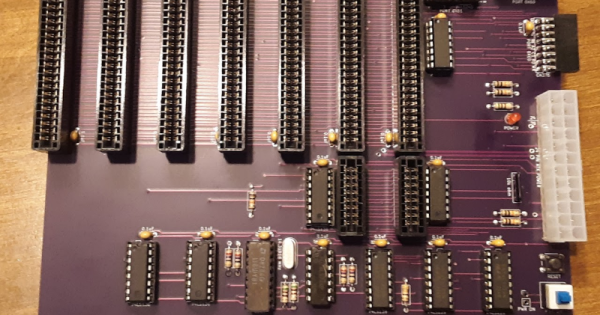
There was a time when an XT-class motherboard — like the old IBM PC with an 8088 CPU — was a high-tech accomplishment. Now, something like that is easily within reach of the average hobby lab. [Homebrew8088] did it, and it looks surprisingly simple, especially compared to what passes for a motherboard these days.

The board will take an 8088 or one of the NEC chips and by default sports 512 K of RAM, a few ISA slots, a PC speaker, a USB hard drive, and a PS/2 keyboard connector. The board will fit in an ATX case. Not bad. You can see a video of the board below.

In fact, the channel has a lot of related videos and the main site has many interesting topics, like driving an 8088 or 8086 from a Raspberry Pi. The GitHub site has design files for KiCad along with a lot of other information. Some of this will be interesting even if you are just trying to repair an old motherboard or would like to design a new ISA card.

If you want to know why the PC used an 8088 instead of an 8086, we just covered that. What are you going to do with an old XT computer? How about IRC?

Continue reading “Building Your Own 8088 XT Motherboard”

Sound Generation Board Makes The Tunes

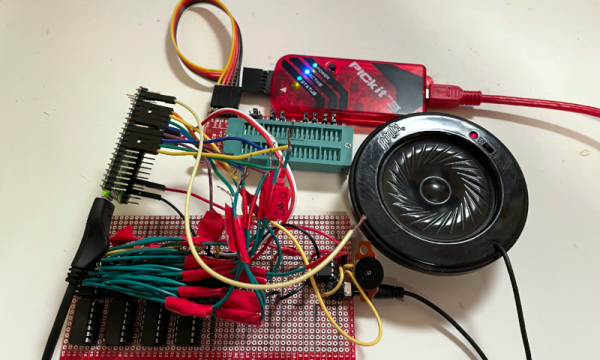
[Mcjack123] has been getting into chiptunes lately and realized that his original interest started in 2018 when he used an Arduino to turn a TI-84 calculator into a sound machine. His latest iteration is a custom-designed soundboard and he takes us through the design and construction of it in a recent post.

The work models classic sound generators like the 2A03 or the Commodore 64 SID. You have a bunch of simple waveform generators along with filters and modulators to make various effects. These boards eventually gave way to FM synthesis devices like the Yamaha OPL2 and OPL3 chips. All of these cards accepted commands and generated audio on their own. More modern boards are more likely to simply convert digital data from the computer into audio.

Continue reading “Sound Generation Board Makes The Tunes”

Scott’s CPU From The Bottom Up

It isn’t for everyone, but if you work much with computers at a low level, you’ll probably sooner or later entertain the idea of creating your own CPU. There was a time when that was a giant undertaking, but with today’s tools and FPGAs it is… well, not easy, but certainly easier. If you have the urge to try your own, you might have a look at [Simply Explained’s] video series called “Building Scott’s CPU.

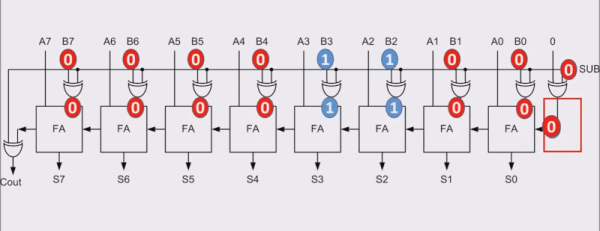
The 11 videos cover everything from basic transistor logic to sequential circuits and moves on to things like ALUs, clock units, and how jump instructions work.

Continue reading “Scott’s CPU From The Bottom Up”