Running ARM Chips On Algae Power

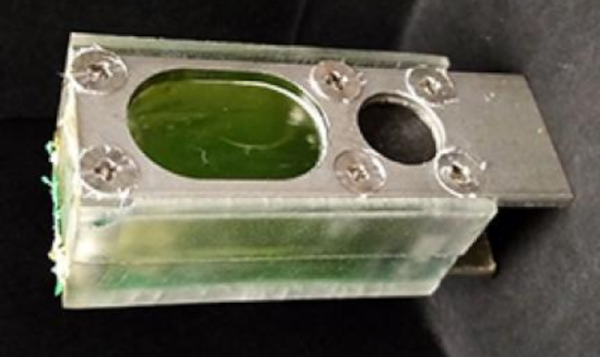
What’s the size of an AA battery and can run an ARM Cortex M0+ for six months? Well… probably an AA battery, but obviously, that wouldn’t be worth mentioning. But researchers at Cambridge have built a cell of blue-green algae that can do the job.

As you might expect, the algae need light, since they generate energy through photosynthesis. However, unlike conventional solar cells, the algae continue to produce energy in the dark at least for a while. Presumably, the algae store energy during the day and release it at night to survive naturally-occurring periods of darkness.

Generating power from photosynthesis isn’t a new idea since photosynthesis releases electrons. A typical cell has gold electrodes and a proton exchange membrane of some kind. You can see a video from Cambridge below about generating electricity from photosynthesis. Keep in mind, of course, that the Cortex M0+ is capable of very low power operation. Don’t look for that algae-powered spot welder anytime soon.

People tend to get fixated on electricity as energy, but there are other ways to harness photosynthesis. For example, we’ve seen algae fueling a chicken hole in the past. Not to mention we’ve seen algae used to power a robot in a novel and non-electrical way.

Continue reading “Running ARM Chips On Algae Power”

What’s In A Wattmeter?

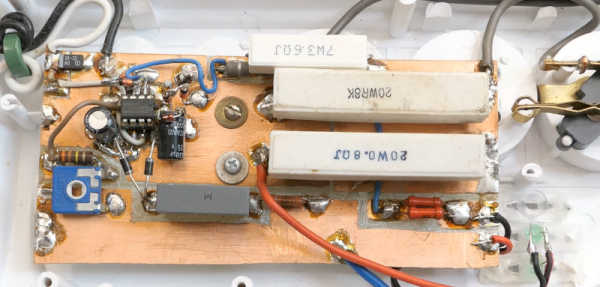
The idea behind watts seems deceptively simple. By definition, a watt is the amount of work done when one ampere of current flows between a potential of one volt. If you think about it, a watt is basically how much work is done by a 1V source across a 1Ω resistor. That’s easy to say, but how do you measure it in the real world? [DiodeGoneWild] has the answer in a recent video where he tears a few wattmeters open.

There are plenty of practical concerns.  With AC, for example, the phase of the components matters. The first 11 minutes of the video are somewhat of a theory review, but then the cat intervenes and we get to see some actual hardware.

Continue reading “What’s In A Wattmeter?”

Retrotechtacular: The IBM System/360 Remembered

Before IBM was synonymous with personal computers, they were synonymous with large computers. If you didn’t live it, it was hard to realize just how ubiquitous IBM computers were in most industries. And the flagship of the mainframe world was the IBM System/360. For a whole generation that grew up in the late 1960s and early 1970s, a 360 was probably what you thought of when someone said computer. [Computer History Archive Project] has a loving recollection of the machine with a lot of beautiful footage from places like NASA and IBM itself. You can see the video below.

Not only was the 360 physically imposing, but it had lots of lights, switches, and dials that appealed to the nerdiest of us. The machines were usually loud, too, with a Selectric terminal, card punches and readers, noisy 9-track tape drives, and a line printer or two.

Continue reading “Retrotechtacular: The IBM System/360 Remembered”

Absolute Encoder Teardown

According to [Lee Teschler], the classic representation of encoders showing code rings is out of date. His post says that most industrial absolute encoders use a special magnetic sensor known as a Wiegand wire to control costs. To demonstrate he does a teardown of an encoder made by Nidec Avtron Automation, and if you’ve ever wondered what’s inside something like this, you enjoy the post.

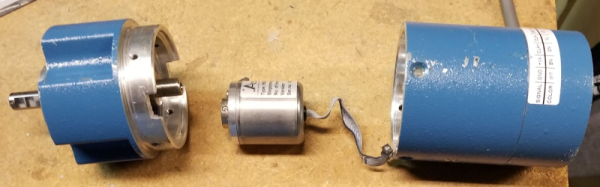
This is a large industrial unit and when you open it up, you’ll get a surprise. Most of the inside is empty! There is a very small encoder inside. The main body protects the inside and holds the large bearings. The real encoder looks more like a toy car motor than anything else.

The inner can is nearly empty, too. But it does have the part we are interested in. There’s a Melexis Hall effect sensor The Weigand wire is a special magnetic wire with an outer sheath that is resistant to having its magnetic field reversed and an inner core that isn’t. Until an applied magnetic field reaches a certain strength, the wire will stay magnetized in one direction. When the field crosses the threshold, the entire wire changes magnetic polarity rapidly. The effect is independent of the rate of change of the applied magnetic field.

In other words, like old core memory, the wire has strong magnetic hysteresis. Between pulses from the Weigand wire and information from the Hall effect sensor, you can accurately determine the position of the shaft.

It is always amazing to us how many modern pieces of gear are now mostly empty with the size of the device being driven by physical constraints and not the electronics within.

3D Printing A Carburetor Is Easier Than You Probably Think

We’ve all been there. You see a cool gadget on the Internet to 3D print and you can’t wait to fire up the old printer. Then you realize it will take 8 different prints over a span of 60 hours, chemical post-processing, drilling, exotic hardware, and paint to get the final result. [Peter Holderith’s] carburetor design, however, looks super easy.

If you have experience with real-world carbs, you might wonder how that would work, but as [Peter] points out, carburetors are very simple at the core — nothing more than a venturi. All the extra pieces you think of are for special cases and not necessary for basic operation. We doubt, though, that you could really use the thing in its current form in your car. There are no mounts and since he printed it in PLA, it seems like a hot engine would be a bad idea. However, it does work well with water and an electric blower.

[Peter] mentions that with some more work and the right material, he has no doubt he could create a working practical carb. We think he’s right. But even in this form, it is a great educational project for a budding car enthusiast — like the old transparent V8 engine models, maybe.

Speaking of transparent, we’ve seen — or maybe not seen is a better phrase — a see-through carburetor that is also a good demonstrator. If you could perfect a 3D printed carb, it would make conversion projects a lot easier.

Summer’s Coming – Let Mowerino Cut Your Grass

In the Northern hemisphere, summer is about to hit us full bore. While we love the season, we do dislike lawn maintenance. Apparently, so does [salmec] who developed the Mowerino around an Arduino Mega 2560 board.

As you might expect, the robot uses sharp blades so, you probably want to be careful. There are sensors that allow the machine to self-navigate or you can control it via Bluetooth. This is one of those things that seems easy until you try to actually do it. Nylon trimmer string is probably safer, but it breaks and it is hard to keep it cutting. Blades are more robust but also riskier to things like rocks, fingers, and pets.

Moving around in the yard is also an issue. The Mowerino has some ordinary-looking caster wheels in the front. That might be a place for improvement since most yards are not friendly to that kind of wheel. The other thing we worried about is what happens to the grass clippings. Around here, a week of rain means your mower will choke on grass clippings. On the other hand, the Mowerino has a smaller blade so maybe that helps mitigate clipping clogging.

Overall, though, it looks like it might be a good place to start if you dream of robot groundskeepers patrolling your estate. Most of the mowers we see like this have big wheels. But, of course, not all of them.

Continue reading “Summer’s Coming – Let Mowerino Cut Your Grass”

Linux Fu: The Infinite Serial Port

Ok, the title is a bit misleading. Like most things in life, it really isn’t infinite. But I’m going to show you how you can use a very interesting Linux feature to turn one serial port from a microcontroller into a bunch of virtual ports. In theory, you could create over 200 ports, but the reality is you will probably want to stick with fewer.

The feature in question is what’s known as pseudoterminal or sometimes a pty or pts. These special files were made to feed data to programs that expect to accept data from a terminal. The files provide two faces. To the client, it looks like any other terminal device. To the creator, though, it is just another file. What you write to that file goes to the fake terminal and you can read anything that is sent from the program connected to the terminal. You use these all the time, probably, without realizing it since running a shell under X Windows, for example, doesn’t attach to a real terminal, after all.

You could, of course, do the same trick with a composite USB device, assuming you have one. Also assuming you can find a working driver and get it working. However, many microcontrollers have a serial port — even one with a USB converter built-in — but fewer have full-blown USB hardware. Even the ones that do are often at odds with strange drivers on the PC side. Serial ports work and work well even on the simplest microcontrollers.

The Plan

The plan is simple enough. A Linux program listens to a real serial port and watches for special character sequences in the data stream. Those sequences will allow you to switch data so that the data stream will go to a particular terminal. Data coming back from the terminals will go to the real serial port after sending a sequence that identifies its source.

Continue reading “Linux Fu: The Infinite Serial Port”