That’s No Moon… It’s An Algae Robot

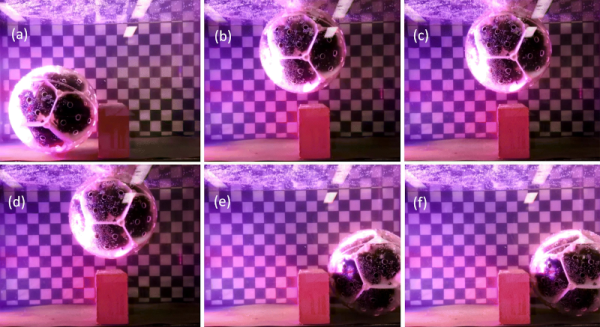
When you think of a robot, you probably don’t think of a ball of underwater algae. But a team of university researchers used a 3D-printed exoskeleton and a ball of marimo algae to produce a moving underwater sensor platform. It is really at a proof-of-concept stage, but it seems as though it would be possible to make practical use of the technology.

Marimo are relatively rare balls of algae that occur in some parts of the world. A robot powered by algae runs on sunlight and could be electromagnetically quiet.

Continue reading “That’s No Moon… It’s An Algae Robot”

Better Farming Through Electricity

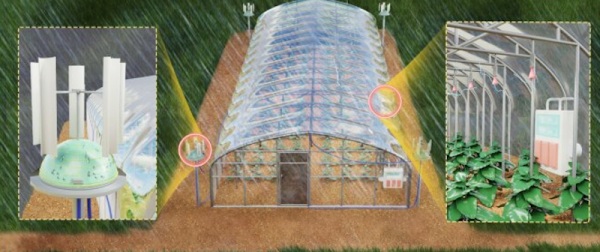
Chinese researchers are reporting that applying an electric field to pea plants increased yields. This process — known as electroculture — has been tested multiple times, but in each case there are irregularities in the scientific process, so there is still an opportunity for controlled research to produce meaningful data.

This recent research used two plots of peas planted from the same pods. The plants were tended identically except one plot was stimulated by an electric field. The yield on the stimulated plot was about 20% more than the control plot.

The actual paper is paywalled in the journal Nature Food, but the idea seems simple enough. If you search for the topic, you’ll find there have been other studies with similar findings. There are also anecdotal reports of electrical plant stimulation going back to 1746.

Continue reading “Better Farming Through Electricity”

Linux Fu: Bash Strings

If you are a traditional programmer, using bash for scripting may seem limiting sometimes, but for certain tasks, bash can be very productive. It turns out, some of the limits of bash are really limits of older shells and people code to that to be compatible. Still other perceived issues are because some of the advanced functions in bash are arcane or confusing.

Strings are a good example. You don’t think of bash as a string manipulation language, but it has many powerful ways to handle strings. In fact, it may have too many ways, since the functionality winds up in more than one place. Of course, you can also call out to programs, and sometimes it is just easier to make a call to an awk or Python script to do the heavy lifting.

But let’s stick with bash-isms for handling strings. Obviously, you can put a string in an environment variable and pull it back out. I am going to assume you know how string interpolation and quoting works. In other words, this should make sense:

echo "Your path is $PATH and the current directory is ${PWD}"

The Long and the Short

Suppose you want to know the length of a string. That’s a pretty basic string operation. In bash, you can write ${#var} to find the length of $var:


#/bin/bash
echo -n "Project Name? "
read PNAME
if (( ${#PNAME} > 16 ))
then
   echo Error: Project name longer than 16 characters
else
   echo ${PNAME} it is!
fi

Continue reading “Linux Fu: Bash Strings”

Strange Computer Languages: A Hacker’s Field Guide

Why do we build radios or clocks when you can buy them? Why do we make LEDs blink for no apparent purpose? Why do we try to squeeze one extra frame out of our video cards? We don’t know why, but we do. That might be the same attitude most people would have when learning about esolangs — esoteric programming languages — we don’t know why people create them or use them, but they do.

We aren’t talking about mainstream languages that annoy people like Lisp, Forth, or VBA. We aren’t talking about older languages that seem cryptic today like APL or Prolog. We are talking about languages that are made to be… well… strange.

INTERCAL

We have to start at the beginning. INTERCAL. This was started as a joke in 1972 and the acronym is purportedly for Compiler Language With No Pronounceable Acronym. There was no actual implementation, though, until around 1990. Now there are two: C-INTERCAL and CLC-INTERCAL.

Since INTERCAL is a parody, it makes some very odd choices. For example, bitwise operators like AND operate with two arguments, but one of the arguments is reversed. That is, the top bit of one operand matches the bottom bit of the second operand. In a nod to social convention, there is a modifier known as PLEASE that you should sometimes use when, for example, reading data as in “PLEASE READ IN.” If you don’t use it often enough, the compile will fail warning you that the program is insufficiently polite. However, if you use it too often, you’ll also get an error that your program is excessively polite.

Originally, the implementation used EBCDIC, so it uses some characters that don’t appear on conventional 7-bit ASCII systems. This forced some character substitutions and now, with Unicode, some versions will allow the old-style characters if you prefer them. The INTERCAL manual renames nearly all the special characters for further confusion. A single quote is a “spark” and the equal sign is a “half-mesh”. Only the ampersand remains unscathed.

Want to know more? Be careful what you wish for.

Continue reading “Strange Computer Languages: A Hacker’s Field Guide”

Better Car Hinges By 3D Printing

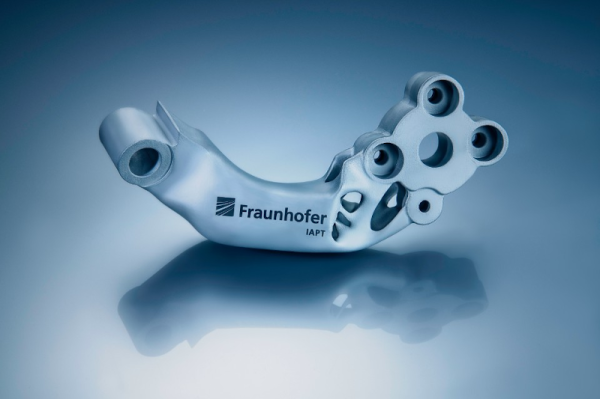
We often use 3D printing to replicate items we might otherwise make with traditional machining methods. Fraunhofer’s new door hinge for a sports car takes a different tack: it tries to be better than the equivalent machined part. The company claims that the new part is half the cost and weighs 35% less than the normal hinge.

Using tools in their 3D Spark software, the team analyzed different factors that led to manufacturing cost. Some of these were specific to the part while others were specific to the process. For example, orienting the part to minimize support and maximize the quantity that fit on the build surface.

Continue reading “Better Car Hinges By 3D Printing”

Printing In Silicone

When you think of making something out of silicone, you usually think of using a mold and injecting it with the material. Can you 3D print it? [Kimberly Beckett] answers that very question in a recent post. The short answer is yes, but you need specialized printing equipment.

Most consumer or hobby printers use either filament deposition or photoresin. Neither of these processes are good for printing silicone. For one thing, silicone doesn’t melt and reform like a thermoplastic. After all, that is why we like making hotend socks and oven utensils with the material. If you do melt silicone, you get a gooey mess, not a nice fluid you can push through an extruder nozzle. As for resin printing, silicone is resistant to UV so the chances of coming up with UV curable silicone are pretty small.

Continue reading “Printing In Silicone”

Underwater Drone Films, Is In Film

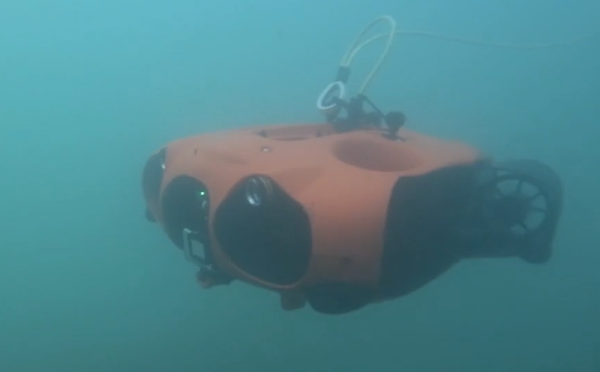
Having a drone that can follow you running or biking with a camera isn’t big news these days. But French firm Notilo Plus has an underwater drone that can follow and video an underwater diver. The Seasam has been around since 2019, but recently made an appearance in a French film, The Deep House about a couple exploring an underwater haunted house, as reported by New Atlas. You can see a video about the drone — and a trailer for the movie — in the videos below.

To follow a diver, the robot uses an acoustic signal from the user’s control unit to find the approximate location of the user. This works even in dark conditions. Once close enough, computer vision zeros in on the diver while a sonar system allows safe navigation.

Continue reading “Underwater Drone Films, Is In Film”