Experiments With A Nernst Lamp

Every biography of Edison talks about how the secret to the incandescent lamp was to remove the air from the bulb. That’s true when you use conventional filaments, but a man named Nernst found that using a filament that was already oxidized would allow you to create a lamp that would operate fine in the normal atmosphere. [Jaynes Network] takes a look at these oddities which date back to the 1800s in a recent video that you can see below.

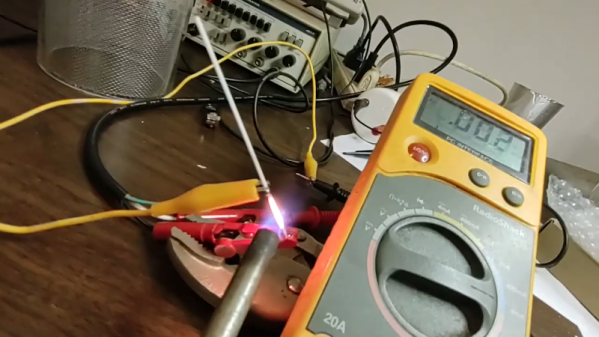
The lamps use a ceramic filament, but the downside is that the filament needs to be hot to allow the lamp to work. The experiment takes a zirconium oxide rod and attempts to light it up. The heat source is a propane torch.

Continue reading “Experiments With A Nernst Lamp”

New Holographic Display Hacks The Light Field

[Petapixel] has an interesting post about a startup company’s new holographic display that claims to be “indistinguishable from reality.” The company behind it, Light Field Labs, claims their system requires no glasses and handles different angles.

You can see a bit in the [C|Net] video below, but — of course — being on YouTube, you can’t get a sense for how good the 3D effect is.

Continue reading “New Holographic Display Hacks The Light Field”

Frame Antenna Works The Low Bands

The lower the frequency of radio transmission, the more antenna that will be needed in general. [OM0ET] wanted to work the 80M to 20M ham bands and decided to turn to a frame antenna. You can see the project in the video below.

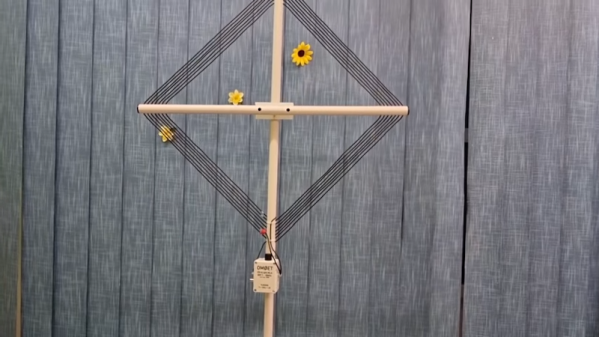
The antenna looks a lot like a magnetic loop antenna. The one in the video has seven loops forming a 520mm square. The loop is, of course, an inductor and by removing some insulation, the operator can clip a lead at different points to control the inductance. A variable capacitor resonates the antenna, so there is definitely tuning required.

Continue reading “Frame Antenna Works The Low Bands”

Tech In Plain Sight: Primitive Engineering Materials

It isn’t an uncommon science fiction trope for our hero to be in a situation where there is no technology. Maybe she’s back in the past or on a faraway planet. The Professor from Gilligan’s Island comes to mind, too. I’d bet the average Hacakday reader could do pretty well in that kind of situation, but there’s one thing that’s often overlooked: materials. Sure, you can build a radio. But can you make wire? Or metal plates for a capacitor? Or a speaker? We tend to overlook how many abstractions we use when we build. Even turning trees into lumber isn’t a totally obvious process.

People are by their very nature always looking for ways to use the things around them. Even 300,000 years ago, people would find rocks and use them as tools. It wasn’t long before they found that some rocks could shape other rocks to form useful shapes like axes. But the age of engineered materials is much younger. Whether clay, metal, glass, or more obviously plastics, these materials are significantly more useful than rocks tied to sticks, but making them in the first place is an engineering story all on its own.

Continue reading “Tech In Plain Sight: Primitive Engineering Materials”

Linux For The Paranoid Does The Work For You

We all know that our activity on the Internet is not that hard to track. It just annoys some people more than others. If you are really hardcore, you’ll learn all the ins and outs of networking to help cover your tracks, but what if you don’t want to invest that kind of time? Maybe, as [TechRepublic] suggests, try Kodachi Linux.

You could, of course, start with your own live image. Then when you boot, you could take the following steps:

  • Randomize your MAC Address
  • Establish a TOR connection through a VPN
  • Route all internet traffic through TOR and use DNS encryption
  • Set up a scheduled task to scramble your MAC address periodically

But that’s what Kodachi does without any real effort on your part.

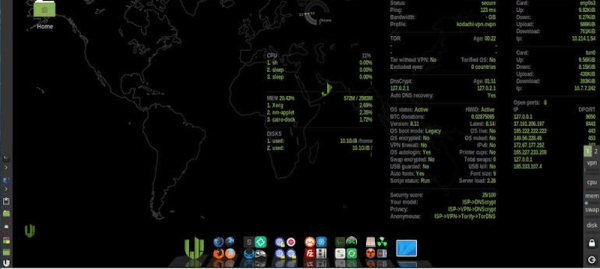
The distribution is based on Ubuntu, so all the familiar tools are there. There are also a few security and privacy tools included like KeePass, Tox, OnionShare, i2p, and more. The desktop shows a summary of secure network information

Do you need Kodachi? Probably not, if you are a Linux guru. Plus, most people aren’t doing anything that’s that interesting. But if you want to protect your privacy or you are up to something, give Kodachi a try. Then again, if you are that paranoid, maybe that’s just what THEY want you to do. Make your own decisions. You can also check out the video review from [eBuzz Central] below.

Looking for more conventional Linux? Why not Rocky Linux? If you just want a VPN, you can always just use ssh.

Continue reading “Linux For The Paranoid Does The Work For You”

Shake With Your New Robot Hand

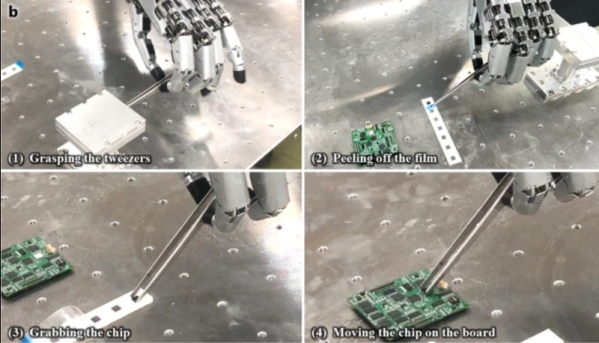
Korean researchers have created a very realistic and capable robot hand that looks very promising. It is strong (34N of grip strength) and reasonably lightweight (1.1 kg), too. There are several videos of the hand in action, of which you can see two of them below including one where the hand uses scissors to cut some paper. You can also read the full paper for details.

Continue reading “Shake With Your New Robot Hand”

Laser Sees Through Keyhole

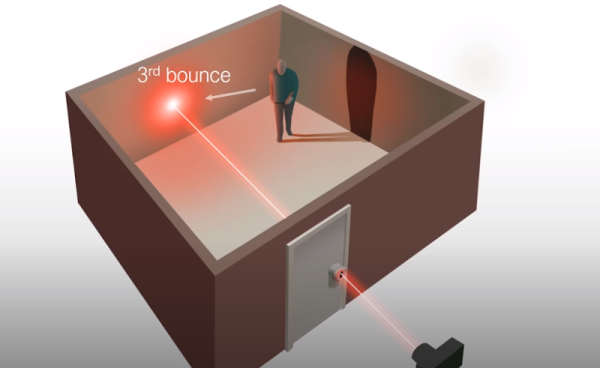
Those guys at Stanford must be watching a lot of James Bond movies. Their latest invention is a laser that can image an entire room through a keyhole. We imagine that will show up in a number of spy movies real soon now. You can see the code or watch the video below.

The technique is called NLOS or non-line-of-sight imaging. Previous approaches require scanning a large area to find indirect light from hidden objects. This new approach uses a laser to find objects that are moving. The indirect data changes based on the movement and an algorithm can reverse the measurements to determine the characteristics of the object.

Continue reading “Laser Sees Through Keyhole”