Rare Radio Receiver Teardown

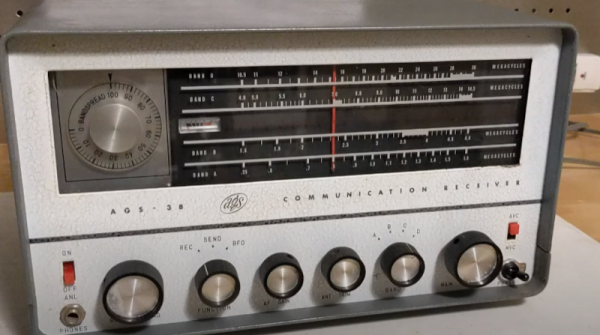
We’ll admit we haven’t heard of the AGS-38, it reminds us of the shortwave receivers of our youth, and it looks like many that were made “white label” by more established (and often Japanese) companies. [Jeff] found a nice example of this Canadian radio and takes it apart for our viewing pleasure. He also found it was very similar to a Layfayette receiver, also made in Japan, confirming our suspicions.

The radio looks very similar to an Eico of the same era — around the 1960s. With seven tubes, radios like this would soon be replaced by transistorized versions.

Continue reading “Rare Radio Receiver Teardown”

3D Printed Material Might Replace Kevlar

Prior to 1970, bulletproof vests were pretty iffy, with a history extending as far as the 1500s when there were attempts to make metal armor that was bulletproof. By the 20th century there was ballistic nylon, but it took kevlar to produce garments with real protection against projectile impact. Now a 3D printed nanomaterial might replace kevlar.

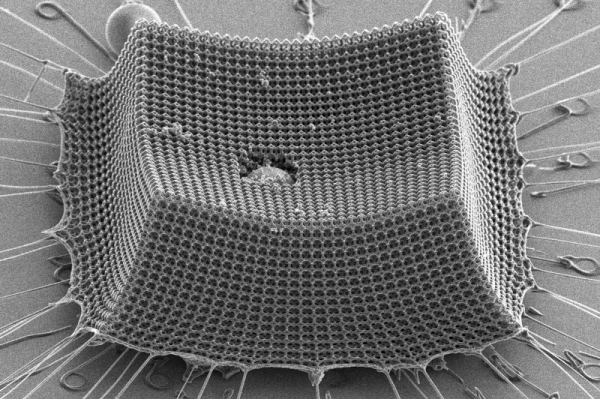
A group of scientists have published a paper that interconnected tetrakaidecahedrons made up of carbon struts that are arranged via two-photon lithography.

We know that tetrakaidecahedrons sound like a modern invention, but, in fact, they were proposed by Lord Kelvin in the 19th century as a shape that would allow things to be packed together with minimum surface area. Sometimes known as a Kelvin cell, the shape is used to model foam, among other things.

The 3D printing, in this case, is a form of lithography using precise lasers, so you probably won’t be making any of this on your Ender 3. However, the shape might have some other uses when applied to conventional 3D printing methods.

We’ve actually had an interest in the history of kevlar. Then again, kevlar isn’t the only game in town.

Pinewood Derby Scale Measures CG

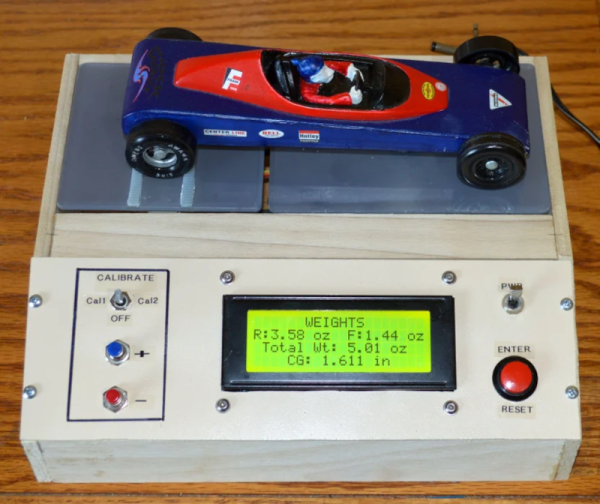
If you suffer from nostalgia, you might remember carving a block of wood into a car, adding some wheels, and racing it against other contestants in a pinewood derby. Today’s derby is decidedly high tech though, and we were impressed with this car scale that also figures out the car’s center of gravity.

Based on an Arduino, of course, along with a pair of HX711 load cells. Why a pair? That’s how the device measures the center of gravity is by weighing the front and rear of the car separately.

Continue reading “Pinewood Derby Scale Measures CG”

Fail Of The Week: The Metal Hot End Upgrade

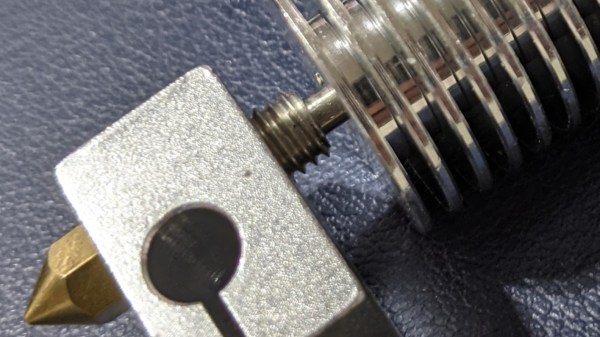
My son, Patrick, has observed on more than one occasion that I do not like 3D printing. That may sound odd, because I built a printer back in 2012 and since then I’ve built a lot of printers and I currently have at least three in my lab. But Patrick correctly realized that I don’t actually enjoy printing things that I need. What I do enjoy is building, fixing and even more importantly improving the printers themselves. If you are reading Hackaday, you probably know how that is. This is the story of an upgrade gone bad, although the ending is happy enough. If you’ve ever thought about moving from a traditional hot end to an all-metal hot end, you might want to hear me out and maybe I can save you some trouble.

A few years ago, I picked up an Anet A8 for a really low price. As printers go, it is adequate. Not bad, but not amazing. But it is a fun printer because you really need to do some work on it to brace the acrylic frame and fix other shortcomings. I merrily improved the printer quite a bit over a relatively short period of time and I also bought a bunch of aluminum extrusion to rebuild the frame to the AM8 plans you can find on Thingiverse.

Continue reading “Fail Of The Week: The Metal Hot End Upgrade”

3D Printer Add On Makes Sharp(ie) Colors

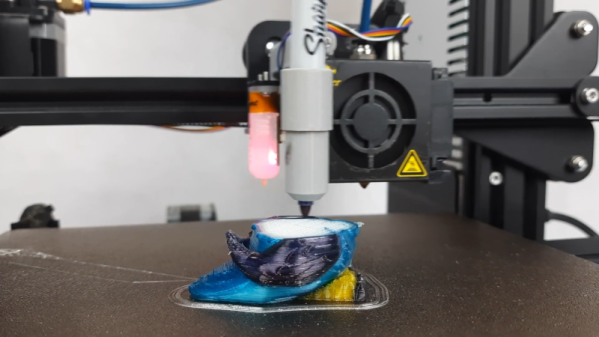
We’ve all seen 3D printed jigs that use a permanent marker to color filament as it goes into the hot end. [Sakati84] has a completely different idea. A holder on the print head can pick up one of several pens and use it to color the layer the hot end just laid down. In the video below, it looks like it works well and, although we imagine it will be a bear to calibrate on height, it seems like something you could replicate with nearly any conventional printer.

Logically, you print a layer with no pen in the holder and when you do pick up a pen, it will need to be somewhat lower than the print nozzle or else you’ll drag around in the fresh plastic.

Continue reading “3D Printer Add On Makes Sharp(ie) Colors”

Orbiter Is Now Open Source

We always have it on our list to learn more about Orbiter. If you haven’t seen it, it is a hyperrealistic space simulator. Granted, you can put it in an easy mode, but its real strength is you can very accurately model spacecraft like the Space Shuttle and have very realistic controls. In order to spur development, the program is now open source.

We think this is interesting for two reasons. First, if you ever wanted to contribute into a project of this scope, here’s your chance. You might not want to write a full-blow space simulator but you might have something to add. However, open source also means you can see how the program works and either reuse it in your own open source projects or just simply learn from the techniques.

Continue reading “Orbiter Is Now Open Source”

Linux Fu: Superpowers For Mere Mortals

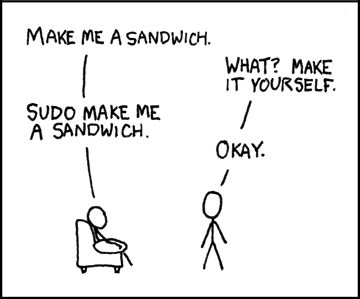
You can hardly mention the sudo command without recalling the hilarious XKCD strip about making sandwiches. It does seem like sudo is the magic power to make a Linux system do what you want. The only problem is that those superpowers are not something to be taken lightly.

CC-BY-NC-2.5 by [XKCD]
If you are surfing the web, for example, you really don’t want to be root, because if someone naughty takes over your computer they could do a lot more harm with your root password. But still, there are times when you want to run certain commands that are normally root-only and don’t want to bother with a password. Luckily, sudo can handle that use case very easily.

Why?

As a simple example, suppose you like to shut your computer down at the end of the day. You run the shutdown command from the terminal but it doesn’t work because you aren’t root. You then have to do it again with sudo and if you haven’t logged in lately, provide your password. Ugh.

Continue reading “Linux Fu: Superpowers For Mere Mortals”