Hydraulics Made Simple

Corralling electrons is great and what most of us are pretty good at, but the best projects have some kind of interface to the real world. Often, that involves some sort of fluid such as water or air moving through pipes. If you don’t grasp hydraulics intuitively, [Practical Engineering] has a video you’ll enjoy. It explains how flow and pressure work in pipes.

Granted, not every project deals with piping, but plumbing, sprinkler systems, cooling systems, and even robotics often have elements of hydraulics. In addition, as the video points out, fluid flow in a pipe is very similar to electrical current flowing through wires.

Continue reading “Hydraulics Made Simple”

3D Printer As Robot: The Functograph

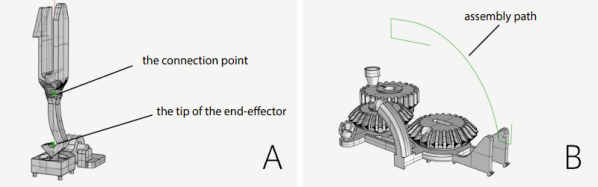
A 3D printer is really a specialized form of robot. Sure, it isn’t exactly Data from Star Trek, but it isn’t too far from many industrial robots. Researchers from Meiji University made the same observation and decided to create a 3D printer that could swap a hot end for other types of robotic manipulators. They call their creation the Functgraph. (Video, embedded below.)

Some of the tasks the Functgraph can do including joining printed parts into an assembly, breaking support material, and more. The surprise twist is that — unlike traditional tool change schemes — the printer prints its own end effectors together with the print job and picks them up off the build plate.

Continue reading “3D Printer As Robot: The Functograph”

Satellite Ground Station Upcycles Trash

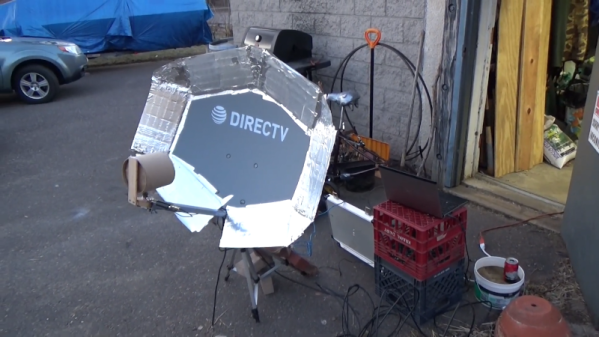
While the term “upcycle” is relatively recent, we feel like [saveitforparts] has been doing it for a long time. He’d previously built gear to pick up low-Earth orbit satellites, but now wants to pick up geosynchronous birds which requires a better antenna. While his setup won’t win a beauty contest, it does seem to work, and saved some trash from a landfill, too. (Video, embedded below.)

Small dishes are cheap on the surplus market. A can makes a nice feedhorn using a classic cantenna design, although that required aluminum tape since the only can in the trash was a cardboard oatmeal carton. The tape came in handy when the dish turned out to be about 25% too small, as well.

Continue reading “Satellite Ground Station Upcycles Trash”

One Bit CPU Runs At A Blistering 60Hz

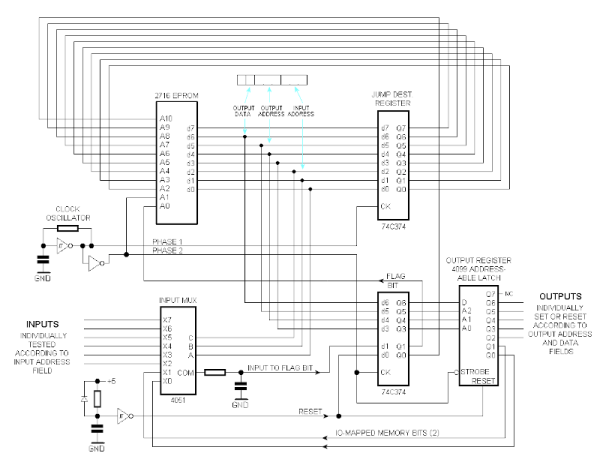
If you really think hard about it, a CPU is just a very general-purpose state machine. Well, most CPUs are, anyway. The MC14500 is a one-bit computer that has only 16 instructions and was meant to serve in simple tasks where a big CPU wouldn’t work for space, power, or budget reasons. However, [Laughton] took the idea one step further and created a single-bit computer with no real instructions to control a printing press. The finished machine uses a clever format in an EEPROM to drive an endless program.

Honestly, we’d say this is more of a state machine, but we like the idea of it being a minimal CPU which is also true. The design uses the EEPROM in an odd way. Each CPU address really addresses a block of four bytes. The byte that gets processed depends on the current phase and the status of the one-bit flag register.

Continue reading “One Bit CPU Runs At A Blistering 60Hz”

Moving Things With Electricity

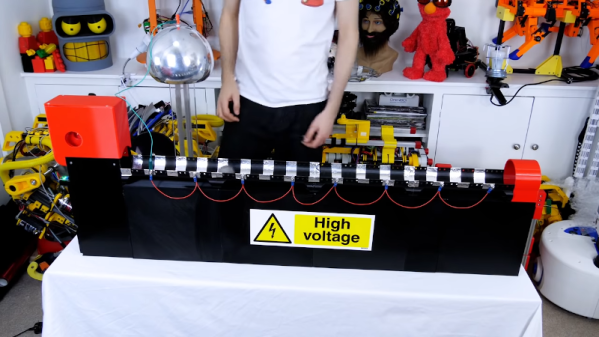
We use electricity to move things with the help of motors and magnets all the time. But if you have enough voltage, you can move things with voltage alone. As [James] found out, though, it works best if your objects — ping pong balls, in his case — are conductive.

He wanted to add a Van de Graaff generator to add to his “great ball machine” which already has some cool ways to move ping pong balls. However, to get the electrostatic motion, [James] had to resort to spraying the balls with RF shielding spray.

Continue reading “Moving Things With Electricity”

Code Talkers: Programming With Voice

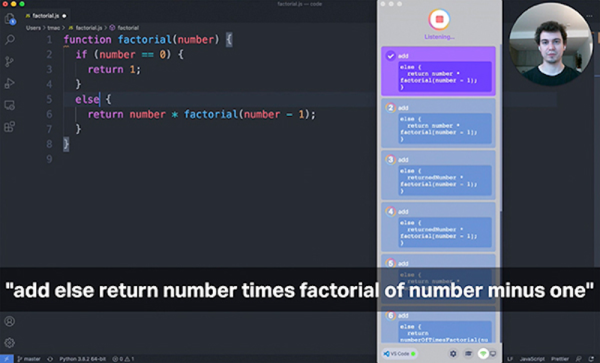
IEEE Spectrum had an interesting post covering several companies trying to sell voice programming interfaces. Not programming APIs for speech recognition, but the replacement of the traditional text editor to produce programs.

The companies, Serenade and Talon, have very different styles. Serenade has fairly normal-sounding language, whereas Talon has you use very specific phrases and can even use eye tracking to figure out what you are looking at when you issue a command. There’s also mention of two open-source products (Aenae and Caster) that require you to use a third-party speech engine.

For an example of Talon’s input, imagine you want this line of code in your program:

name=extract_word(m)

You’d say this out loud: “Phrase name op equals snake extract word paren mad.” Not exactly how Star Trek envisioned voice programming.

For accessibility, this might be workable. It is hard for us to imagine a room full of developers all talking to make their computers enter C or Python code. Until we can say, “Computer, build a graphic using the data in file hackaday-27,” we think this is not going to go mainstream.

The actual speech recognition part is pretty much a commodity now. Making a reasonable set of guesses about what people will say and what they mean by it is something else. It seems like this works best when you have a very specific and limited vocabulary, like operating a 3D printer.

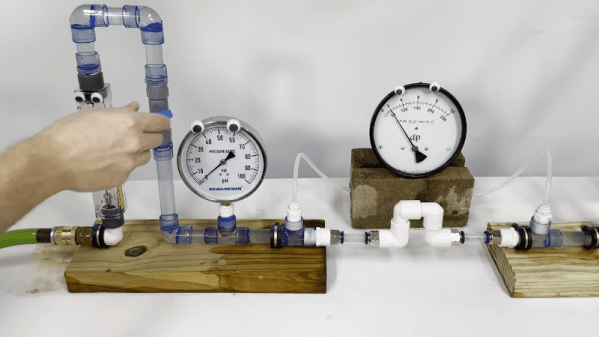
Image Sensors Demystified By [IMSAI Guy]

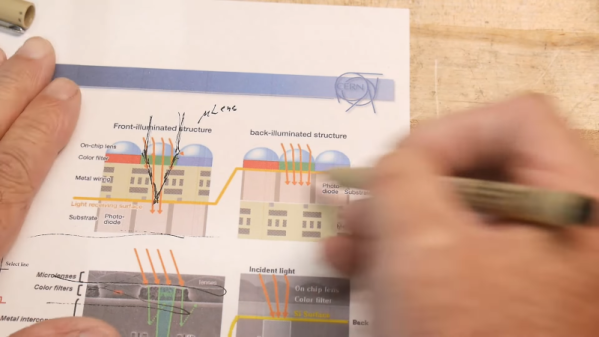
The February 1975 issue of Popular Electronics had what was — at the time — an amazing project. The Cyclops, a digital camera with a 32 by 32 pixel resolution with 4 bits per pixel. It was hard to imagine then that we would now all carry around high-resolution color cameras that were also phones, network terminals, and so many other things. But how much do you know about how those cameras really work? If you want to know more, check out [IMSAI Guy’s] recent video on how image sensors work.

The video doesn’t cover any practical projects or circuits, but it has a good explanation of what goes on in modern digital cameras. If you don’t know what digital cameras have in common with an octopus, you might want to watch.

If you want to see what the state of the art in 1975 was, have a look at this post. The image sensor in that camera didn’t have much in common with the ones we use today, but you have to admit it is clever. Of course, 1975 was also the year Kodak developed a digital camera and failed to understand what to do with it. Like the Cyclops, it had little in common with our modern smartphone cameras, but you have to start somewhere.