The B-2 Bomber: Those Who Forget History Are Doomed To Reverse Engineer It

The Drive had an interesting post recently, about someone noticed a procurement from the U. S. Air Force to reverse engineer the B-2 bomber’s Load Heat Exchanger (whatever that is). You’d think if the Air Force wanted to reverse engineer something, they’d be looking at another country’s aircraft. What can this mean?

Presumably, the original plans for the system have been lost, or maybe the company who made them is long gone and the tooling to create new ones along with it. Then again, maybe the assembly needs parts that you can no longer get. The Drive has another interesting speculation: perhaps the plans were so secret that were accidentally destroyed.

You don’t hear much about the B-2. There are only 20 left of the 21 built, at least that we know about. Original plans in the 1980s called for 132, but the end of the Cold War spelled the end for the stealth bomber. They get an overhaul every nine years. The Drive also speculates that this may be part of the Air Force’s desire to digitize spare parts and use 3D printing, but — honestly — it doesn’t sound that way to us. Especially since the fleet will retire no later than 2032, so whatever is replaced is only needed for a decade.

If you think you want to have a go, here’s the help wanted ad from the Air Force. If you read the text, it’s pretty clear they have some defective units that need replacement and it sounds like no one knows how to do it with existing materials. Not many of us get to design things that are still working nearly three decades later. Keeping a supply of parts and even know-how for something built in the 1990s isn’t trivial. Something to think about if you design something with a long service life.

The B-2 is a stealth bomber and while one did crash, it wasn’t shot down. The F-117A — the stealth fighter — was shot down against all odds, though. While the B-2 appears to be quite a plane, we prefer our bombers a little bit older. Still, you might enjoy the video below about the B-2’s chief engineer, although he doesn’t mention the Load Heat Exchanger.

Continue reading “The B-2 Bomber: Those Who Forget History Are Doomed To Reverse Engineer It”
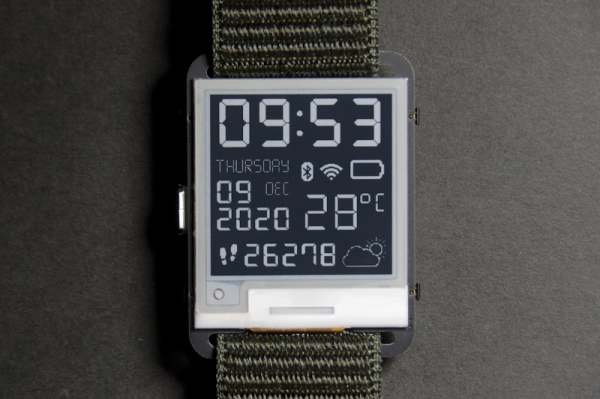
The IEEE Builds A Smart Watch

It used to be that building your own watch was either a big project or it meant that you didn’t really care about how something looked on your wrist. But now with modern parts and construction techniques, a good-looking smart watch isn’t out of reach of the home shop. But if you don’t want to totally do it yourself, you can turn to a kit and that’s what [Stephen Cass] did. Writing in IEEE Spectrum, he took a kit called a Watchy and put it through its paces for you.

Watchy is an open source product that uses an ESP32, an E-ink display, and costs about $50. The display is 1.5 inches — good enough for a watch — and it has a real time clock, a vibration motor, an accelerometer, and four buttons. The whole thing runs on a 200 mAh lithium polymer battery. The charger is microUSB and you can also upload software to it using the usual Arduino tools.

However, [Stephen] found that none of the examples he tried would work at first. He found problems with the Mac software, but he also had problems under Windows. The answer? Switching to a Raspberry Pi seemed to work and once the watch was wiped clean, the Mac tools would work, too. It sounds like this isn’t a common problem, but he has to erase the watch with the Pi before each programming cycle.

Unlike a normal Arduino program, all the work in a typical Watchy program happens in setup() so the watch can mostly sleep and it updates the 200×200 typically just once a minute. As an example, [Stephan] wrote a watch face that uses an old Irish alphabet to tell time. He plans to add code to grab online data, too, and the phone has support for connecting wirelessly and parsing JSON to make tasks like that easier.

We always thought the EZ430-Chronos was a good-looking watch, but its screen is dated now. You can also pick up a lot of cheap import watches that can be hacked.

Fueling With Ammonia

There’s a major push now to find energy sources with smaller carbon footprints. The maritime shipping industry, according to IEEE Spectrum, is going towards ammonia. Burning ammonia produces no CO2 and it isn’t hard to make. It doesn’t require special storage techniques as hydrogen does and it has ten times the energy density of a modern lithium-ion battery.

You can burn ammonia for internal combustion or use it in a fuel cell. However, there are two problems. First, no ships are currently using the fuel and second most ammonia today is made using a very carbon-intensive process. However it is possible to create “green” ammonia, and projects in Finland, Germany, and Norway are on schedule to start using ammonia-powered ships over the next couple of years.

Continue reading “Fueling With Ammonia”

BGA Soldering And Inspection

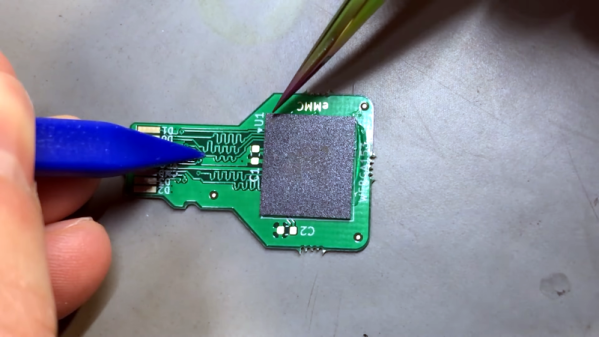
If you want to build cool things these days, you’ve probably had to master surface mount electronics. However, for many people, ball grid array (BGA) is still intimidating. Have a look at [VoltLog’s] video about his techniques for soldering BGA and inspecting that you managed to do it right.

He’s got quite a few tips about things like surface finish and flux selection. It looks easy when he does it. Of course, having a good PCB with good registration markings will help too.

Continue reading “BGA Soldering And Inspection”

Fail Of The Week: How Not To Build A Filament Extruder

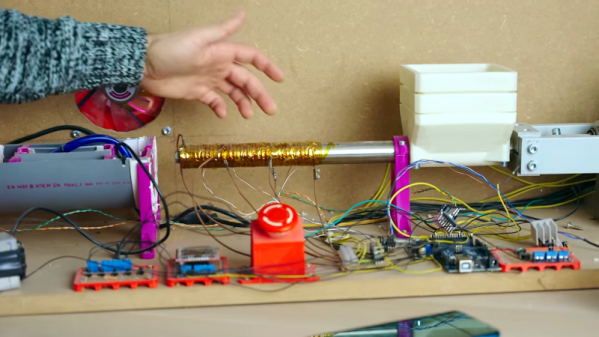
It would be great if you could create your own filament. On the face of it, it seems easy to do, but as [Thomas Sanladerer] found out when he was a student, there are a lot of details that can bedevil your design. His extruder sort of works, but he wouldn’t suggest duplicating his effort. In fact, he hopes you can learn what not to do if you try to do it yourself.

In all fairness, [Thomas] was a low-budget student and was trying to economize. For example, he tried using a drill to drive the auger. Why not? It looks like a drill bit. But he found out that wasn’t satisfactory and moved to a pair of wiper motors with their built-in gear train.

Continue reading “Fail Of The Week: How Not To Build A Filament Extruder”

OnShape To Robot Models Made Easier

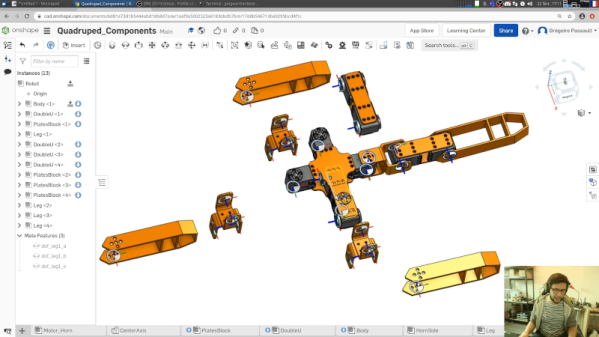
We live in a time where our phones have computing power that would have been the envy of NASA a few decades ago. So, in theory, we should be able to simulate just about anything. Thanks to [rhoban], robots you design in OnShape — a popular CAD tool — are now easier to simulate using several common simulation tools.

Electronic circuits are pretty easy to simulate, because we typically draw schematics and circuit simulators can capture those schematics readily. But simulating physics for robotic designs is a bit trickier. Gazebo and Pybullet both can use SDF files or URDF. However, building those files is often a separate process from actual physical design even though you probably did the design using a CAD tool. Even if you don’t use OnShape, you can probably import your preferred format and then bridge to the simulation file format without having to manually recreate your design. You can see the author walk through the process in the video below.

Continue reading “OnShape To Robot Models Made Easier”

The Famous Basic Computer Games Book Gets A 2021 Update

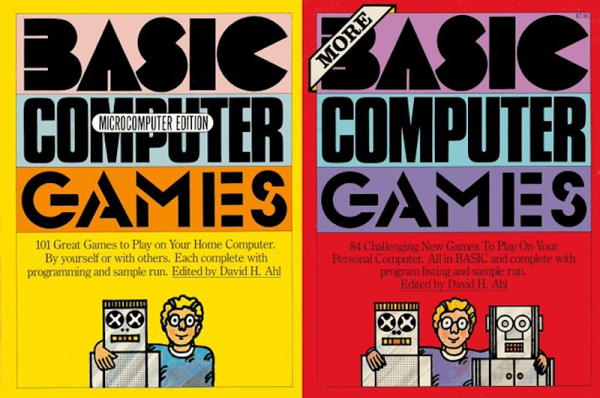
If you are a certain age, your first programming language was almost certainly BASIC. You probably at least saw the famous book by Ahl, titled BASIC Computer Games or 101 BASIC Computer Games. The book, published in 1973 by [David Ahl] was a staple in its day and the first computer book to sell over one million copies. Of course, if you want to run Super Star Trek or Hamurabi, you better fire up an old retrocomputer or a simulator because BASIC in 1973 doesn’t look like what we have today. Or, you can head to GitHub where [coding-horror] is inviting people to help update the programs using modern languages.

One of our favorites, Bagels, is there with directories for C#, Java, Javascript, Python, Ruby, and VB.net. It doesn’t appear that all of the games are in all the languages, though. There’s also a .Net solution file that apparently has a few entries in it. We were also happy to see Super Star Trek represented, along with a link to an article about a C++ language port. The original games were tweaked to run on VintageBasic.

Continue reading “The Famous Basic Computer Games Book Gets A 2021 Update”