Make Some Noise Or Simulate It, At Least

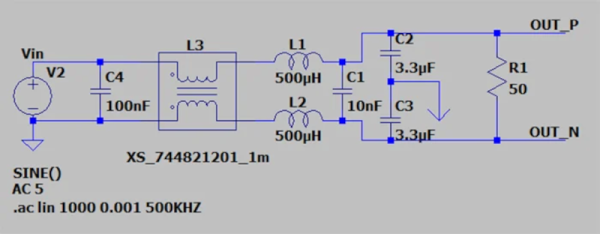
Noise is a fact of life, especially in electronic circuits. But on our paper schematics and just as often our simulations, there is no noise. If you are blinking an LED on a breadboard, you probably don’t care. But if you are working on something meatier, handling electrical noise gracefully is important and simulation can help you. [Ignacio de Mendizábal] has a great piece on simulating EMC filters using LTSpice that can get you started.

There are many ways of classifying noise and [Ignacio] starts with common-mode versus differential noise, where common-mode is noise with current flowing in the same direction without regard to the circuit’s normal operation, and differential noise having currents that flow in the opposite direction of normal current flow.

Continue reading “Make Some Noise Or Simulate It, At Least” →

TTL Simulator In JavaScript

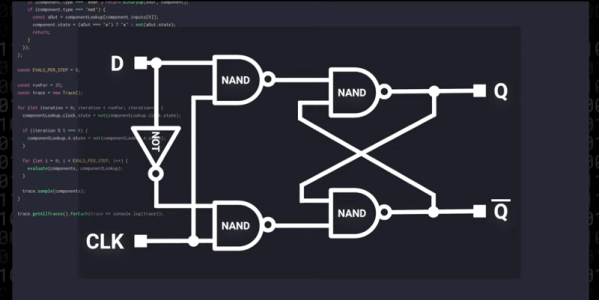
How do you celebrate your YouTube channel passing the 7400 subscriber mark? If you are [Low Level JavaScript], the answer is obvious: You create a 7400 TTL logic simulator in JavaScript. The gate simulations progress from simple gates up to flipflops and registers. You could probably build a 7400-based computer virtually with this code.

In addition to just being fun and interesting, there were a lot of links of interest in the video (see below) and its comments. For one, someone watching the channel took the code and made a Verilog-like IDE that is impressive.

Continue reading “TTL Simulator In JavaScript” →

OpenOffice Or LibreOffice? A Star Is Torn

When it comes to open source office suites, most people choose OpenOffice or LibreOffice, and they both look suspiciously similar. That isn’t surprising since they both started with exactly the same code base. However, the LibreOffice team recently penned an open letter to the Apache project — the current keepers of OpenOffice — asking them to redirect new users to the LibreOffice project. Their logic is that OpenOffice has huge name recognition, but hasn’t had a new major release in several years. LibreOffice, on the other hand, is a very active project. We could argue that case either way, but we won’t. But it did get us thinking about how things got here.

It all started when German Marco Börries wrote StarWriter in 1985 for the Zilog Z80. By 1986, he created a company, Star Division, porting the word processor to platforms like CP/M and MSDOS. Eventually, the company added other office suite programs and with support for DOS, OS/2, and Windows, the suite became known as StarOffice.

The program was far less expensive than most competitors, costing about $70, yet in 1999 that price point prompted Sun Microsystems to buy StarOffice. We don’t mean they bought a copy or a license, they bought the entire thing for just under $74 million. The story was that it was still cheaper than buying a license for each Sun employee, particularly since most had both a Windows machine and a Unix machine which still required some capability.

Sun in Charge

Sun provided StarOffice 5.2 in 2000 as a free download for personal use, which gave the software a lot of attention. It eventually released much of the code under an open source license producing OpenOffice. Sun contributed to the project and would periodically snapshot the code to market future versions of StarOffice.

This was the state of affairs for a while. StarOffice 6.0 corresponded to OpenOffice 1.0. In 2003, release 1.1 turned into StarOffice 7. A couple of years later, StarOffice 8/OpenOffice 2.0 appeared and by 2008, we had StarOffice 9 with OpenOffice 3.0 just before Oracle entered the picture.

Continue reading “OpenOffice Or LibreOffice? A Star Is Torn” →

Kelvin Probes Review Shows How 4-Wire Resistance Measurement Works

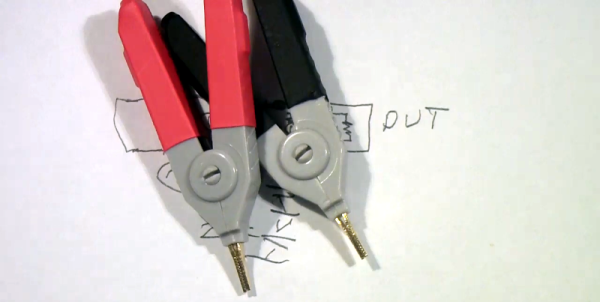
You might think the probes in the picture are just funny looking alligator clips. But if you watch [tomtektest’s] recent video, you’ll learn they are really Kelvin probes. Kelvin probes are a special type of probe for making accurate resistance measurements using four wires and, in fact, the probe’s jaws are electrically isolated from each other.

We liked [Tom’s] advice from his old instructor: you aren’t really ever measuring a resistance. You are measuring a voltage and a current. With a four-wire measurement, one pair of wires carries current to the device under test and the other pair of wires measure the voltage drop.

Continue reading “Kelvin Probes Review Shows How 4-Wire Resistance Measurement Works” →

Altair Front Panel Tutorials

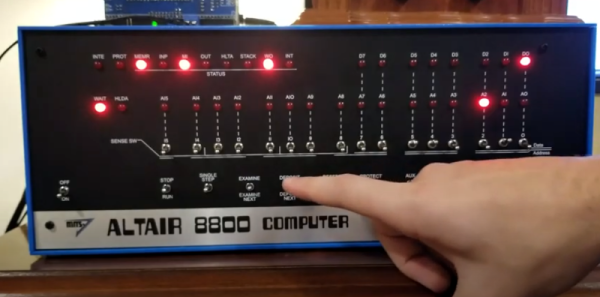
If you aren’t old enough to remember when computers had front panels, as [Patrick Jackson] found out after he built a replica Altair 8800, their operation can be a bit inscrutable. After figuring it out he made a pair of videos showing the basics, and then progressing to a program to add two numbers.

Even when the Altair was new, the days of front panels were numbered. Cheap terminals were on their way and MITS soon released a “turnkey” system that didn’t have a front panel. But anyone who had used a minicomputer from the late 1960s or early 1970s really thought you needed a front panel.

Continue reading “Altair Front Panel Tutorials” →

Easy-SDR Gets Updates

Back in 2018, we covered [Igor’s] Easy-SDR project that aimed to provide open hardware extensions for the chap RTL-SDR receivers. If you haven’t been there for a while, it’s worth a look as there have been many recent updates. According to the author’s Reddit post:

  1. Most of the devices are now prepared for installation in a metal case measuring 80 x 50 x 20 millimeters.
  2. There’s a completely redesigned LNA design. Now, Bias Tee powered amplifiers are housed in a 50 x 25 x 25mm metal case and have N-type connectors.
  3. There’s an added amplifier based on the PGA-103 microcircuit.
  4. Added is the ability to install filters in final amplifiers (a separate printed circuit board, depending on the filter used).
  5. A new device – SPDT antenna switch for receiving antennas.
  6. The upconverter has been redesigned. Added intermediate buffer stage between the crystal generator and mixer.
  7. RF lines in all devices were recalculated to correspond to the characteristic wave impedance of 50 Ohm.
  8. Reduced size of PI attenuator PCB.

Continue reading “Easy-SDR Gets Updates” →

DIY Regular Expressions

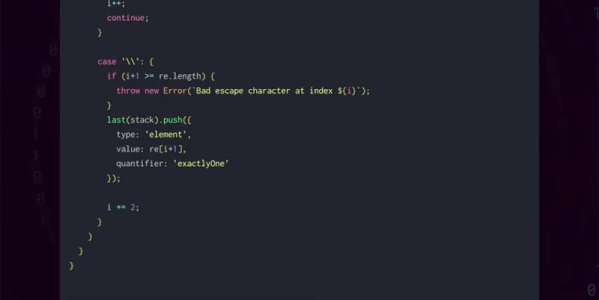
In the Star Wars universe, not everyone uses a lightsaber, and those who do wield them had to build them themselves. There’s something to be said about that strategy. Building a car or a radio is a great way to learn how those things work. That’s what [Low Level JavaScript] points out about regular expressions. Sure, a lot of people think they are scary. So why not write your own regular expression parser and engine? Get that under your belt and you’ll probably never fear another regular expression.

Of course, most of us probably won’t do it ourselves, but you can still watch the process in the video below. The code is surprisingly short, but don’t expect all the bells and whistles you might find in Python or even Perl.

Continue reading “DIY Regular Expressions” →