Intel Says Nanowire And NanoRibbon In Volume In Five Years

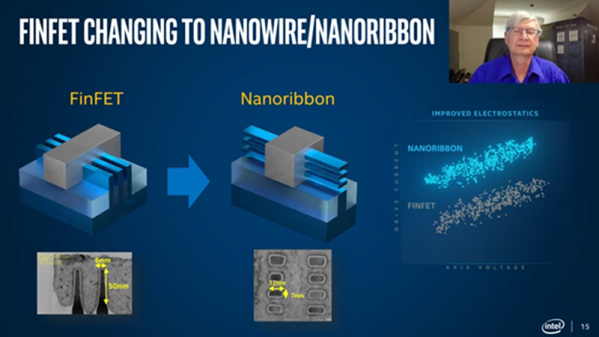
Intel’s CTO says the company will eventually abandon CMOS technology that has been a staple of IC fabrication for decades. The replacement? Nanowire and nanoribbon structures. In traditional IC fabrication, FETs form by doping a portion of the silicon die and then depositing a gate structure on top of an insulating layer parallel to the surface of the die. FinFET structures started appearing about a decade ago, in which the transistor channel rises above the die surface and the gate wraps around these raised “fins.” These transistors are faster and have a higher current capacity than comparable CMOS devices.

However, the pressure of producing more and more sophisticated ICs will drive the move away from even the FinFET. By creating the channel in multiple flat sheets or multiple wires the gate can surround the channel on all sides leading to even better performance. It also allows finer tuning of the transistor characteristics.

Continue reading “Intel Says Nanowire And NanoRibbon In Volume In Five Years”

Tracked Robot Makes Sand Drawings

[Ivan] seems to enjoy making 3D printed vehicles with tracks. His latest one uses 50 servo motors to draw patterns in the sand at the beach. You can see it work in the video below. Well, more accurately you can see it not work and then work as the first iteration didn’t go exactly as planned.

An Arduino Mega 2560 provides the brains and the whole unit weighs in at almost 31 pounds, including the batteries. We didn’t see Ivan’s design files, although it wouldn’t be hard to do your own take on the robot.

Continue reading “Tracked Robot Makes Sand Drawings”

Raspberry Pi Takes Control Of Ham Radio

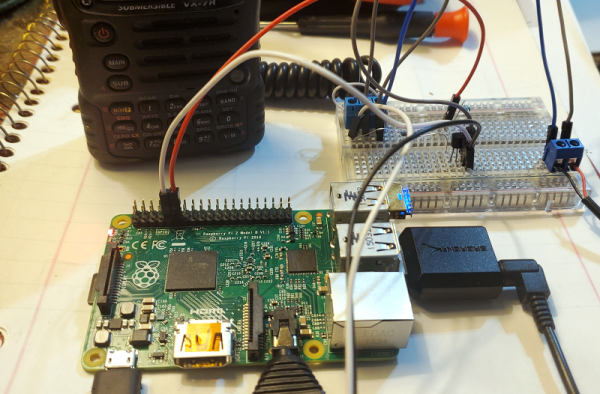
Today’s ham radio gear often has a facility for remote control, but they most often talk to a computer, not the operator. Hambone, on the other hand, acts like a ham radio robot, decoding TouchTone digits and taking action — for example, keying the radio and reading off the weather — in response to the commands received.

The code is in Python and uses numpy’s fast Fourier transform to identify digits. We’d be interested to test the performance of that compared to doing a Goertzel to specifically probe for the 8 digit tones: there are four row tones and four column tones. On the other hand, the FFT is handy and clearly works fast enough for this application.

Continue reading “Raspberry Pi Takes Control Of Ham Radio”

Eico Signal Generator Gets A Repair

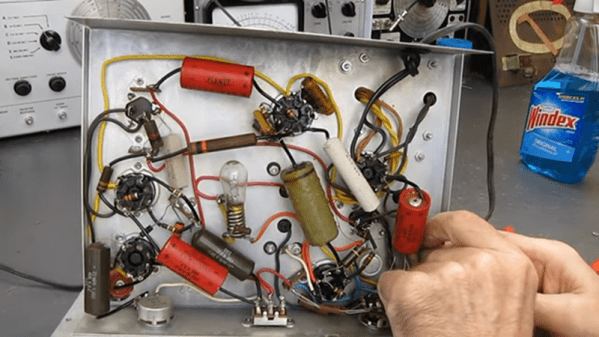
The Eico model 377 was a pretty common audio signal generator. [The Radio Mechanic] picked one up from 1956 that was in reasonably good shape, and shares a teardown and repair of the unit that you can see in the video below. The device could produce sine and square waves using a few tubes.

The unit was a bit different inside than expected because there were several versions made that shared the same model number. The bottom of the case had some goo in it, which is never a good sign. Unsurprisingly, the culprit was an old capacitor.

Continue reading “Eico Signal Generator Gets A Repair”

OTA ESP32 GUI Makes Updates Simple

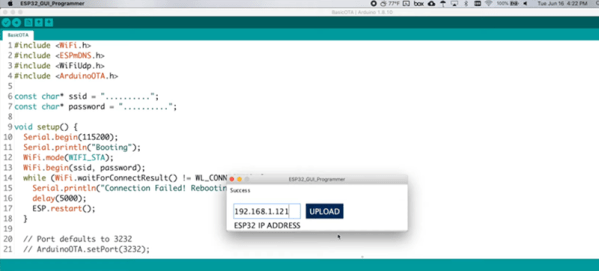
One of the disadvantages of having cheap WiFi-capable boards like those based on the ESP32 is that you have to update them. If you have even a few in every room of your house, it can be a pain to pull them out and connect them to a cable for programming. Over the air programming is a great answer, and [Kevin] shows how you can control the update via a simple GUI. You can see a video demonstration of how it works below.

[Kevin] uses a ready-made OTA library to do the work, but creates a GUI configuration and downloader tool. There is a manual step to force the board into the OTA mode, which might be a mild inconvenience, but it improves security since you need physical access to the device to do an update.

Continue reading “OTA ESP32 GUI Makes Updates Simple”

Educational Radio, Educates

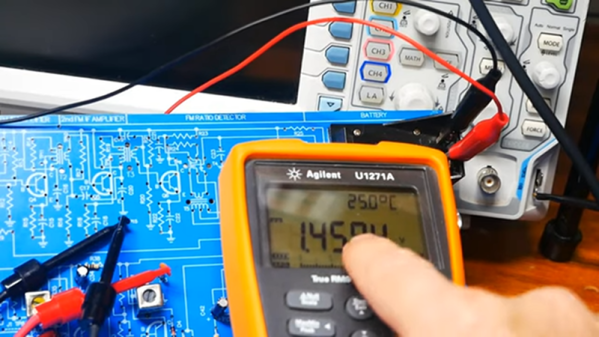
Analyzing and troubleshooting a modern AM/FM radio, digital radio, or TV can be a pretty daunting task. However, a common AM radio is easy to understand, experiment with, and repair. Learning about that will help you understand more complex circuits later. That’s the idea behind the Elenco AM radio which is built on a wide-open PCB with markings for all the important sections. [The Offset Volt] uses one of these to explain how a receiver works, especially how a diode detects the signal and how the automatic gain control works.

Between a series of diagrams and live scope demonstrations, you can see the effects of capacitance in the receiver along with other circuit effects.

Continue reading “Educational Radio, Educates”

Decapsulating A Dual Triode

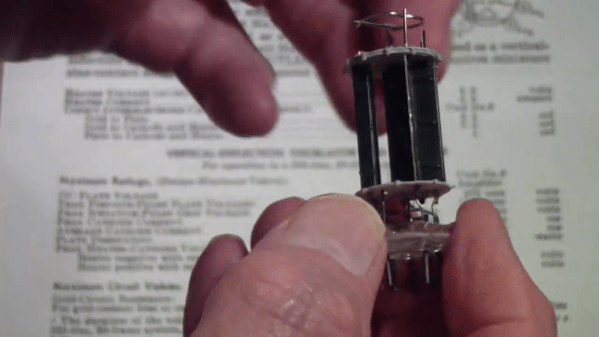
We see quite a bit of work where people decapsulate ICs or other solid state devices to expose their inner workings. But how about hollow state? [Tomtektest] had a dual triode that has lost its vacuum integrity — gone to air, as he calls it — and decided to open it up to better expose its inner workings. (Video, embedded below.)

Of course, you can always see the innards through the glass, but it is interesting to have the envelope out of the way. Apparently, how you remove the glass is a bit tricky if you don’t want to damage the working bits as you remove it.

Continue reading “Decapsulating A Dual Triode”