Hide Silent, Hide Deep: Submarine Tracking Technologies Of The Cold War

All through the cold war, there was a high-stakes game of cat and mouse in play. Nuclear powers like the United States and the Soviet Union would hide submarines armed with nuclear missiles underwater. The other side would try to know where they were so they could be targeted in the event of war. The common wisdom was that the United States had many high tech gadgets to help track enemy submarines, but that the Soviet Union was way behind in this area. This was proven false when a Soviet Victor-class boat followed a US missile submarine for six days. Now, a recently declassified CIA report shows how the Soviets didn’t use sonar at all but developed their own technology.

There is something fascinating about submarines. Like an old sailing ship, submarines are often out of touch with their command bases and the captain is the final authority. Like a space ship, the submarine has to survive in an inimical environment. I guess in all three cases, the crew doesn’t just use technology, they depend on it.

Although the submarine has some non-military uses, there are probably more military subs than any other type. After all, a sub is as close to a cloaking device as any real-life military vehicle has ever had. Before modern technology offered ways to find submarines using sonar or magnetic anomalies, a completely submerged submarine was effectively invisible.

There was a lot of speculation that the Soviet Union lacked sufficient technology to use sonar  the way the US did. However, in some cases, they had simply developed different types of detection — many of which the West had discarded as impractical.

Continue reading “Hide Silent, Hide Deep: Submarine Tracking Technologies Of The Cold War”
Commercial Circuit Simulator Goes Free

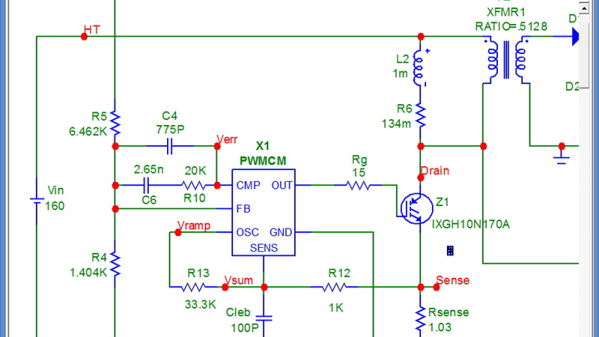
If you are looking for simulation software, you are probably thinking LTSpice or one of the open-source simulators like Ngspice (which drives Oregano and QUCs-S), or GNUCap. However, there is a new free option after the closing of Spectrum Software last year: Micro-Cap 12. You may be thinking: why use another closed-source simulator? Well, all the simulators have particular strengths, but Micro-Cap does have very nice features and used to retail for about $4,500.

The simulator boasts a multipage schematic editor, native robust digital simulation, Monte Carlo analysis, 33,000 parts in its library, worst-case and smoke analysis, Smith charts, and it can even incorporate spreadsheets. There’s a built-in designer for active and passive filters. Have a look at the brochure and you will see this is a pretty serious piece of software. And now it’s at least free as in beer.

Continue reading “Commercial Circuit Simulator Goes Free”

Spintronic RAM Gets A Little Closer To SRAM

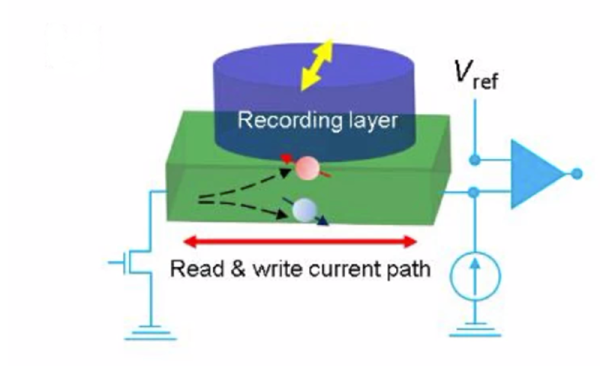
Sometimes it seems as though everything old is new again. The earliest computers used magnetic memory such as magnetic core. As practical as that was compared to making for example each bit of memory be a vacuum tube or relay flip flop, newer technology such as SRAM and DRAM displaced core and similar technologies. However, some of the newest technologies once again use magnetic fields. FRAM or ferroelectric RAM and magnetoresistive or MRAM both use magnetic fields to store data. Now Japanese researchers think they are on track to make MRAM more competitive with traditional RAM chips.

The Tokyo Institute of Technology researchers use new material combinations to make chips that store data based on the spin of electrons — the underlying reason for the way magnets behave. Their recent paper discusses USMR or Unidirectional spin Hall magnetoresistance and using this effect could greatly simplify the construction of MRAM cells.

Continue reading “Spintronic RAM Gets A Little Closer To SRAM”

The Oldest Nuclear Reactor? Nature’s 2 Billion Year Old Experiment

When was the first nuclear reactor created? You probably think it was Enrico Fermi’s CP-1 pile built under the bleachers at the University of Chicago in 1942. However, you’d be off by — oh — about 2 billion years.

The first reactors formed naturally about 2 billion years ago in what is now Gabon in West Africa. This required several things coming together: natural uranium deposits, just the right geology in the area, and a certain time in the life of the uranium. This happened 17 different times, and the average output of these natural reactors is estimated at about 100 kilowatts — a far cry from a modern human-created reactor that can reach hundreds or thousands of megawatts.

The reactors operated for about a million years before they spent their fuel. Nuclear waste? Yep, but it is safely contained underground and has been for 2 billion years.

Continue reading “The Oldest Nuclear Reactor? Nature’s 2 Billion Year Old Experiment”

Full Duplex Radio Claimed Easier With Analog Module

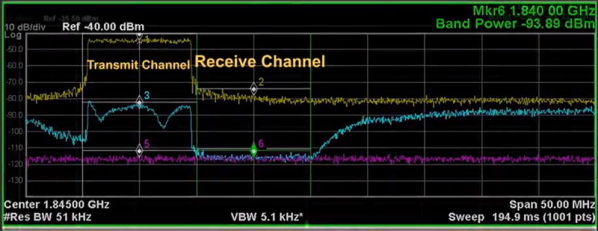
There’s an old saying that we have one mouth and two ears so you can listen twice as much as you talk. However, talking and listening at the same time is fairly difficult and doing it with radio signals is especially hard. A company called Kumu Networks has an analog module that can use self-interference cancellation which allows transmitting and receiving on the same frequency with around 50 dB of the transmitted signal in the transceiver. You can see a video about Kumu’s claims its technology below.

You may think that cell phones and ham radio repeaters transmit and receive at the same time, which of course they do, but usually on different frequencies to avoid direct interference. A diplexer is a device that sorts out the two frequencies while a duplexer sorts them out by the direction of the signal, but they are tricky to use. A duplexer can operate on a single frequency in applications such as radar, and even then it is still very difficult to prevent leakage from the transmitter from overloading and desensitizing the receiver.

Continue reading “Full Duplex Radio Claimed Easier With Analog Module”

Arduino Wristwatch Has LED Hands

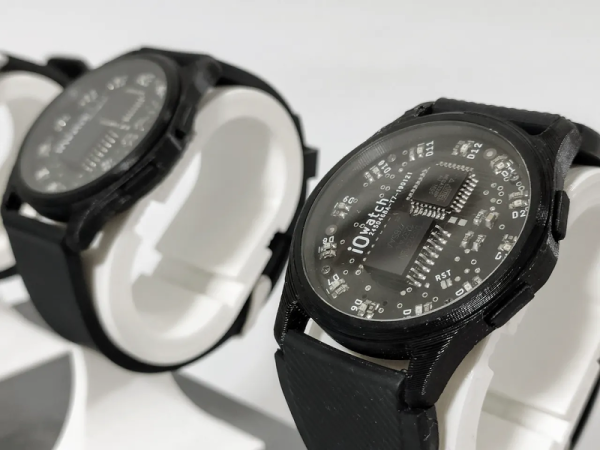
When you read “Arduino wristwatch”, you fall into the trap of envisioning an Arduino UNO clumsily strapped to someone’s wrist. [Marijo Blažević’s] creation is much more polished than that. A round circuit board holds two surface mount ICs and 12 LEDs. The whole thing looks nice fit snugly inside of a watch body. It isn’t a Rolex, but it does have considerable geek cred without being unwearable in polite company.

One IC is an AVR micro, of course. The other is a DS3231 real time clock with built-in crystal. A CR2032 keeps it all running. The main body, the outer ring, the bottom, and the buttons are 3D printed in PLA. The crystal and the band are the only mechanical parts not printed. The bill of materials shows a 36mm crystal and even provides links for all the parts.

You don’t want to run LEDs all the time because it is bad on the battery. When you press the button once, you get one of the LEDs to light to show the hours. Another press reads the minutes in units of 5 minutes. A third press shows you one of five LEDs to show how many minutes to add. For example, if the time is 9:26 you’d get LED 9 (hours), LED 5 for 25 minutes, and the third press would show LED 1 for 1 extra minute. If either of the minute indicators show 12 o’clock, that indicates zero minutes.

The exciting thing, of course, is that you can program it beyond the code on GitHub. Already it can tell time and display the temperature. You don’t have a lot of I/O, but you ought to be able to get some more options and maybe some flashy LED blinking patterns in if you try.

Altair 8800 Again Project

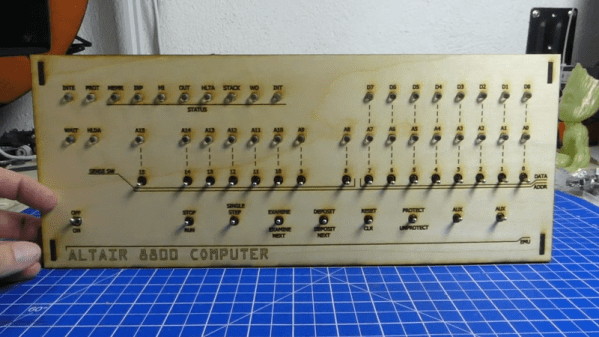
[Dirk] posted a video (you can see below) titled, “Mystery Retro Project Start.” That turned out to be the first of a multipart series on his Altair 8800 Again simulator. The front panel appears to be laser cut and in some future video episodes, we expect to see him simulate the CPU with a Teensy.

There have been plenty of 8800 clones ranging from projects that recreate the original PCBs, to those that just run a Raspberry Pi inside. The middle ground will use an Arduino or some other small CPU to simulate the 8080 CPU.

Continue reading “Altair 8800 Again Project”