Bring The Smithsonian Home With 3D Printing

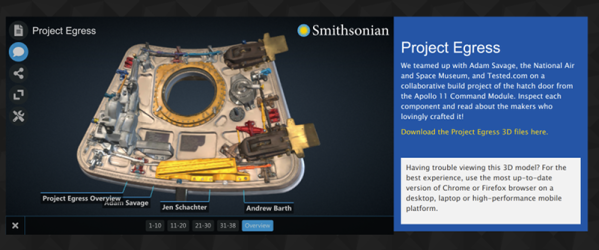
If you’ve ever been to Washington DC, you know the Smithsonian isn’t just a building, instead it’s a collection of 19 museums, 21 libraries, 9 research centers, and a zoo. Even though there are hundreds of affiliated museums, there is a way to bring at least some of the museum to you. The Smithsonian has a 3D digitization portal that currently features 124 models of items from the collection. Almost 100 of them have models you can download and print — or have someone print for you.

Printing yourself is probably the most cost-effective option if you already have a printer. According to the Smithsonian, if you want a 1/20th scale model of a T. Rex cranium, Shapeways will do it for about $21. If you want a 9-inch version of Neil Armstrong’s spacesuit, that would go for $130 or so.

Continue reading “Bring The Smithsonian Home With 3D Printing”
Restoring A 1949 Golden Throat Radio

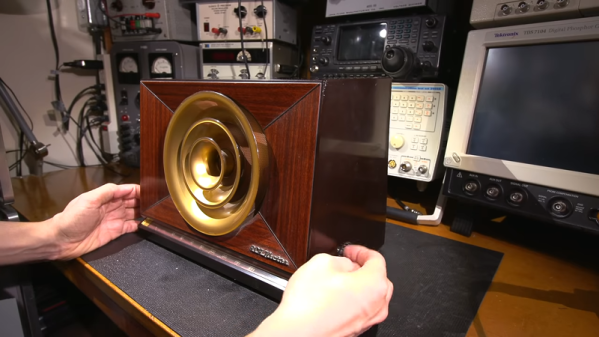
[Mr. Carlson] has a really beautiful old 1949-era radio to restore and you can watch him do it in a comprehensive video, below. We aren’t sure what we were more amused by: the odd speaker that looks like a ceiling air vent or the sticker on the back certifying that the radio produces the tone of the “golden throat” signed by RCA’s chief engineer.

Electrically, the radio didn’t look that remarkable. Of course, the capacitors were presumed bad and replaced. The video made us remember how much we hated restringing dial radios!

Continue reading “Restoring A 1949 Golden Throat Radio”

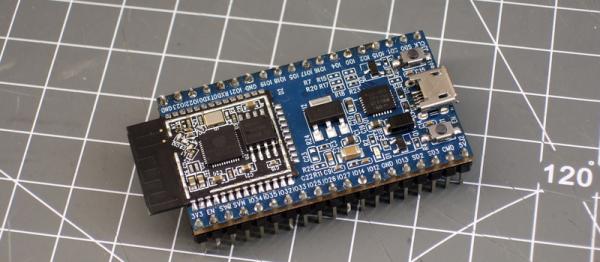
ESP32 Audio Sampling With Interrupts And IRAM

Interrupting while someone is talking is rude for humans, but smart for computers. [Ivan Voras] shows how to use interrupts to service the ESP32 analog to digital converters when sampling sound. Interestingly, he uses the Arduino IDE mixed with native ESP-IDF APIs to get the best performance.

Like most complex interrupt-driven software, [Ivan’s] code uses a two-stage interrupt strategy. When a timer expires, an interrupt occurs. The handler needs to complete quickly so it does nothing but set a flag. Another routine blocks on the flag and then does the actual work required.

Because the interrupt service routine needs to be fast, it has to be in RAM. [Ivan] uses the IRAM_ATTR attribute to make this work and explains what’s going on when you use it.

…the CPU cores can only execute instructions (and access data) from the embedded RAM, not from the flash storage where the program code and data are normally stored. To get around this, a part of the total 520 KiB of RAM is dedicated as IRAM, a 128 KiB cache used to transparently load code from flash storage.The ESP32 uses separate buses for code and data (“Harvard architecture”) so they are very much handled separately, and that extends to memory properties: IRAM is special, and can only be accessed at 32-bit address boundaries.

This is very important because some ESP-IDF calls — including adc1_get_raw — do not use this attribute and will, therefore, crash if they get pushed out to flash memory. At the end, he muses between the benefit of using an OS with the ESP32 or going bare metal.

If you want to know more about the Arduino on ESP32, we covered that. We also dug deeper into the chip a few times.

Visiting The FACOM 128B 1958 Relay Computer

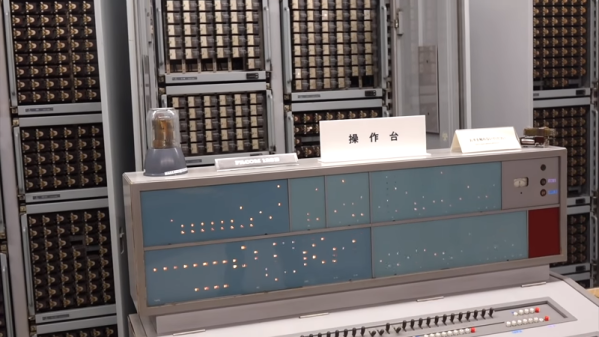
If you study the history of computing you might have heard of the FACOM 128B, a Japanese relay computer from 1958. It holds the distinction of being a contender for the oldest computer that still works in its original form, as it resides in a Fujitsu building in Numazu Japan. [CuriousMarc] visited the old computer and created a video about it as well as painting a picture of other contemporary machines. You can see the video below.

[Marc] explains how a relay machine was already behind the times in 1958, and also shows how the 5,000 relay machine is laid out. The machine on display came from a Tokyo university and did the kind of computations you might use a computer for today to do engineering design.

Continue reading “Visiting The FACOM 128B 1958 Relay Computer”

Behind Amazon’s Doors Is A Library

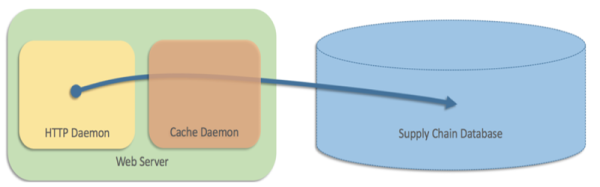
Some people love Amazon, while others think it has become too big and invasive. But you have to admit, they build gigantic and apparently reliable systems. Interestingly, they recently released a library of white papers from their senior staff called the Builder’s Library.

According to their blog post:

The Amazon Builders’ Library is a collection of living articles that take readers under the hood of how Amazon architects, releases, and operates the software underpinning Amazon.com and AWS. The Builders’ Library articles are written by Amazon’s senior technical leaders and engineers, covering topics across architecture, software delivery, and operations. For example, readers can see how Amazon automates software delivery to achieve over 150 million deployments a year or how Amazon’s engineers implement principles such as shuffle sharding to build resilient systems that are highly available and fault tolerant.

The Amazon Builders’ Library will continue to be updated with new content going forward.

Continue reading “Behind Amazon’s Doors Is A Library”

Chandrayaan-2 Found By Citizen Scientist; Reminds Us Of Pluto Discovery

What does Pluto — not the dog, but the non-Planet — have in common with the Vikram lunar lander launched by India? Both were found by making very tiny comparisons to photographs. You’d think landing something on the moon would be old hat by now, but it turns out only three countries have managed to do it. The Chandrayaan-2 mission would have made India the fourth country. But two miles above the surface, the craft left its planned trajectory and went radio silent.

India claimed it knew where the lander crashed but never revealed any pictures or actual coordinates. NASA’s Lunar Reconnaissance Orbiter took pictures several times of the landing area but didn’t see the expected scar like the one left by the doomed Israeli lander when it crashed in April. A lot of people started looking at the NASA pictures and one Indian computer programmer and mechanical engineer, Shanmuga Subramanian, seems to have been successful.

Continue reading “Chandrayaan-2 Found By Citizen Scientist; Reminds Us Of Pluto Discovery”

A Magnetron Tear Down

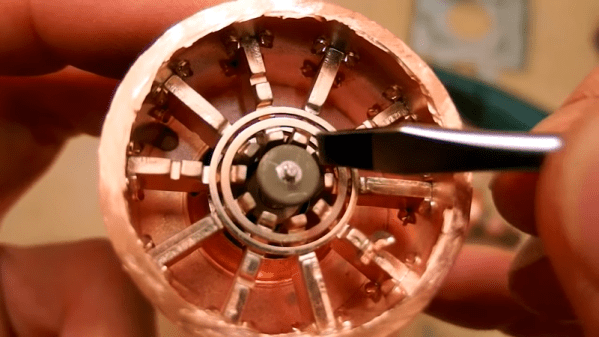
Microwave ovens are everywhere, and at the heart of them is a magnetron — a device that creates microwaves. [DiodeGoneWild] tore one apart to show us what was inside and how it works. If you decide to do this yourself, be careful. The magnetron may have insulators made of beryllium oxide and inhaling dust from the insulator even one time can cause an incurable lung condition.

Luckily, you can’t get a lung problem from watching a video. In addition to just seeing the guts of the magnetron, there are also explanations about how everything works with some quick sketches to illustrate the points.

Continue reading “A Magnetron Tear Down”