Radio Piracy On The High Seas: Commercial Demand For Taboo Music

The true story of pirate radio is a complicated fight over the airwaves. Maybe you have a picture in your mind of some kid in his mom’s basement playing records, but the pirate stations we are thinking about — Radio Caroline and Radio Northsea International — were major business operations. They were perfectly ordinary radio stations except they operated from ships at sea to avoid falling under the jurisdiction of a particular government.

Back then many governments were not particularly fond of rock music. People wanted it though, and because people did, advertisers wanted to capitalize on it. When people want to spend money but can’t, entrepreneurs will find a way to deliver what is desired. That’s exactly what happened.

Of course, if that’s all there was to it, this wouldn’t be interesting. But the story is one of intrigue with armed boardings, distress calls interrupting music programs, and fire bombings. Most radio stations don’t have to deal with those events. Surprisingly, at least one of these iconic stations is still around — in a manner of speaking, anyway.

Continue reading “Radio Piracy On The High Seas: Commercial Demand For Taboo Music”
Power Measurement Oscilloscope Style

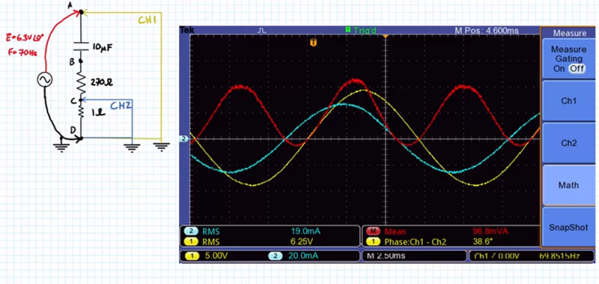
If you want to measure voltage you reach for a voltmeter. Current? An ammeter. Resistance? An ohmmeter. But what about measuring AC power? A watt meter? Usually. But if you know what to do, you could also reach for your oscilloscope. If you don’t know what to do, [Jim Pytel] has the video answers for you. Truth is, an oscilloscope can measure almost anything if you know how. [Jim] shows how to measure the voltage and current in a circuit and then it is simply a matter of doing a little math, something modern scopes can do very easily.

We like that [Jim] shows a circuit and how the math works before he verifies the math with the scope. Of course, theory doesn’t always match practice. The method uses a small current-sensing resistor that throws readings off a bit. The scope and signal generator are not perfect, either. However, the results match up pretty nicely with the computed results.

Continue reading “Power Measurement Oscilloscope Style”

Forget Artificial Intelligence; Think Artificial Life

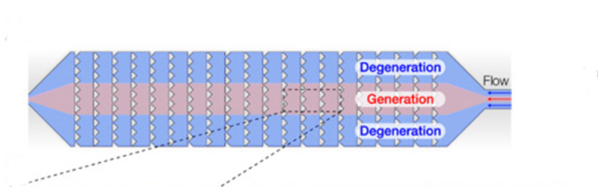
If you are a science fiction fan, you are probably aware of one of the genre’s oddest dichotomies. A lot of science fiction is concerned about if a robot, alien, or whatever is a person. However — sometimes in the same story — finding life is as easy as asking the science officer with a fancy tricorder. If you go to Mars and meet Marvin, it is pretty clear he’s alive, but faced with a bunch of organic molecules, the task is a bit harder. Now it is going to get harder still because Cornell scientists have created a material that has an artificial metabolism and checks quite a few boxes of what we associate with life. You can read the entire paper if you want more detail.

Three of the things people look for to classify something as alive is that it has a metabolism, self-arranges, and reproduces. There are other characteristics, depending on who you ask, but those three are pretty crucial.

Continue reading “Forget Artificial Intelligence; Think Artificial Life”

Televox: The Past’s Robot Of The Future

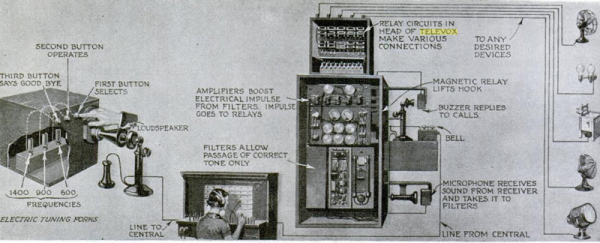
When I read old books, I like to look for predictions of the future. Since we are living in that future, it is fun to see how they did. Case in point: I have a copy of “The New Wonder Book of Knowledge”, an anthology from 1941. This was the kind of book you wanted before there was a Wikipedia to read in your spare time. There are articles about how coal is mined, how phonographs work, and the inner workings of a beehive. Not the kind of book you’d grab to look up something specific, but a great book to read if you just want to learn something interesting. In it there are a few articles about technology that seemed ready to take us to the future. One of those is the Televox — a robot from Westinghouse poised to usher in an age of home and industrial mechanical servants. Robots in 1941? Actually, Televox came into being in 1927.

If you were writing about the future in 2001, you might have pictured city sidewalks congested with commuters riding Segways. After all, in 2001, we were told that something was about to hit the market that would “change everything.” It had a known inventor, Dean Kamen, and a significant venture capitalist behind it. While it has found a few niche markets, it isn’t the billion dollar personal transportation juggernaut that was predicted.

But technology is like that. Sometimes things seem poised for greatness and disappear — bubble memory comes to mind. Sometimes things have a few years of success and get replaced by something better. Fax machines or floppy drives, for example. The Televox was a glimpse of what was to come, but not in any way that people imagined in 1941. Continue reading “Televox: The Past’s Robot Of The Future”

Custom Rotary Switch Takes A Motor

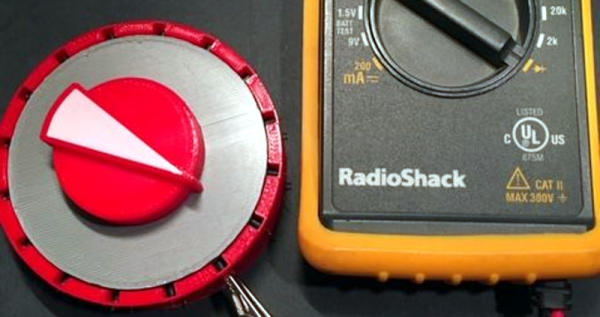
There are certain challenges we all will have to face sooner or later. Changing a flat tire in the rain, trying to put on a shirt that doesn’t quite fit, or producing a 16 position rotary switch for a replica computer front panel. There was a time when something like this would be a major undertaking, but with the help of a 3D printer [Mike Gardi] was able to build good looking switches that were big enough to be motor driven.

Switches of course are old tech, and there are plenty of ways to make contacts. [Mike] settled on using 16 small magnets and reed switches. This works, but you probably wouldn’t want to use it where the switch might get close to an external magnet. It does however make for a neat assembly without a lot of mechanical work. It also resists wear compared to a brush type arrangement.

The switch is a little large, but it could probably be made smaller with proper contacts. However, you still need at least some magnets to provide the detents without making mechanical changes.

We couldn’t help but think of the homemade rotary switches from the do it yourself computer that used sewing thread spools, wires, and paper clips. It would be fun to revisit that computer with an eye to making things using a 3D printer. We liked the knob, but if you only need a reproduction knob, there are other ways to go.

Graphene Is So Yesterday — Meet Borophene

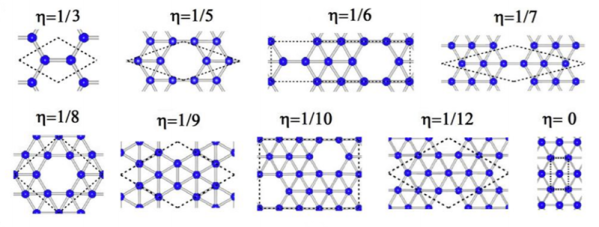
It wasn’t long ago that graphene seemed to take the science and engineering communities by storm. You can make bits of it with a pencil and some sticky tape, yet it had all sorts of wonderful properties. The key, of course, is that it is a single layer of atoms. Now scientists have done the same trick with boron to form borophene, and it looks to be even more exciting than graphene. You can read a pretty dense paper about the material if you want to dig deeper.

The new material is stronger and more flexible than graphene. It appears too that it could boost the performance of lithium-ion batteries. Computer simulations showed that borophene was possible back in 1990, but it wasn’t until 2015 that anyone was able to make any. The material is a good conductor of electricity and heat. It also exhibits superconductivity. Another exciting prospect is that it can be created in different arrangements, each with a unique set of properties. So you may be able to build borophene to be, for example, especially conductive or particularly strong.

Continue reading “Graphene Is So Yesterday — Meet Borophene”

A Laser Cutting 101

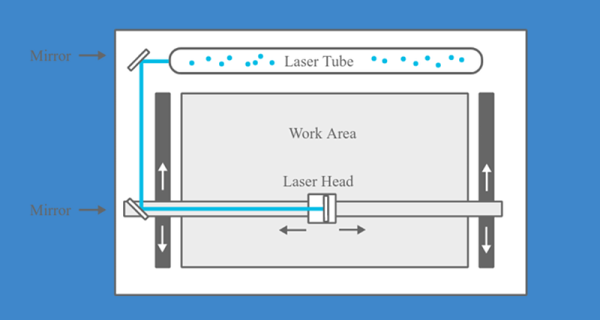
If you’ve worked with a laser cutter before, you might not find much new in [Maker Design Lab’s] recent post about getting started. But if you haven’t, you’ll find a lot of practical advice and clean clear figures. The write up focuses on a tube-style laser cutter that uses a gas-filled tube and mirrors. Some cheap cutters use a diode, and many of the same tips will apply to those cutters.

You can probably guess that a laser cutter can cut like a CNC and also engrave where the cut doesn’t go all the way through. But it can also mark metals and other surfaces by using a marking solution. If you’ve done CNC or 3D printing, the process is similar, but there are a few unique things to know, like the use of the marking solution.

Continue reading “A Laser Cutting 101”