The Strangest Gameboy Emulator We’ve Seen Yet

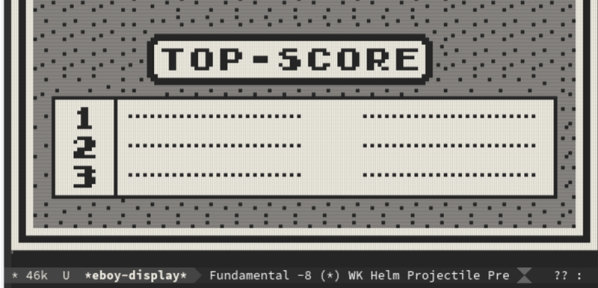
In the secret Hackaday bunker, we have some emacs users, some vi users, and some people who don’t really care. However, even the staunchest of our emacs supporters had to do a double take at [Vreeze’s] project that creates a GameBoy emulator using the venerable text editor. You can see [Alexei Nunez’s] reaction to the emulator in the video below.

The Eboy uses unicode characters to output the graphics. You can use emacs commands to load ROM images and use your keyboard to control the game.

Continue reading “The Strangest Gameboy Emulator We’ve Seen Yet”

Tech Imitates Life: Fireflies Make Better Light Bulbs

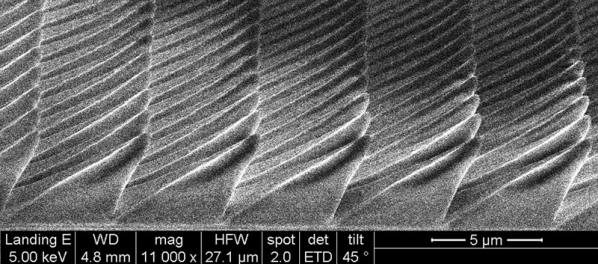
While we often think we are clever designers, living things often meet or beat the best human designs. It is easy to forget that nature even has living lightbulbs, among them the firefly. Researchers from Penn State decided to compare how fireflies create light and found that they deal with a problem similar to LEDs. The insight may lead to an increase in efficiency for LEDs, which is currently about 50%.

The problem is that some light generated never gets out of the LED (or the firefly’s body). Some light inevitably reflects back into the device. One known mitigation for this is creating a tiny texture pattern on the LED surface which allows more light to escape. These are typically a V-shaped structure etched into the surface. This isn’t news to the firefly, however, which has similar structures on their lanterns as do some other light-generating animals (apparently glowing cockroaches are a thing). However, the organic structures differ from LED textures in an important way.

Continue reading “Tech Imitates Life: Fireflies Make Better Light Bulbs”

Better Living Through Science: Why Your Kids Probably Aren’t Getting Measles

Oddly, there’s been a few recent outbreaks of measles. It struck me how when I was a kid, a few hundred kids getting measles wouldn’t have been news at all. However, even a handful makes the news now, since in 2000 the Center for Disease Control declared measles eradicated in the United States.

So how can an eradicated disease come back? How did we eradicate it to start with? The answers tell a pretty interesting tale of science applying to everyday life.

Continue reading “Better Living Through Science: Why Your Kids Probably Aren’t Getting Measles”

Reducing Carbon Emissions With Coal

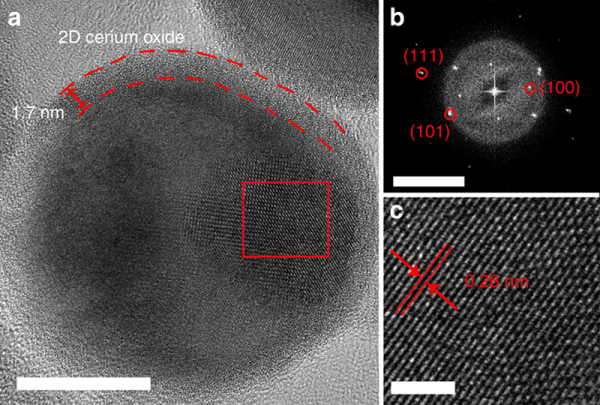
It might seem like a paradox, but coal might hold the answer to solving carbon emission problems. The key isn’t burning it, but creating it using carbon dioxide from the atmosphere.  While this has always been possible in theory, high temperatures make it difficult in practice. However, a recent paper in Nature Communications shows how a special liquid metal electrocatalyst can convert the gas into a solid form of carbon suitable for, among other things, making high-quality capacitor electrodes. The process — you can see more about it in the video below — works at room temperatures.

It isn’t that hard to extract carbon dioxide from the air, the problem is what to do with it. Storing it as a gas or a liquid is inefficient and expensive, while converting it to a solid makes it much easier to store or even reuse for practical applications.

Continue reading “Reducing Carbon Emissions With Coal”

CNC Your Own PCB With This Tutorial

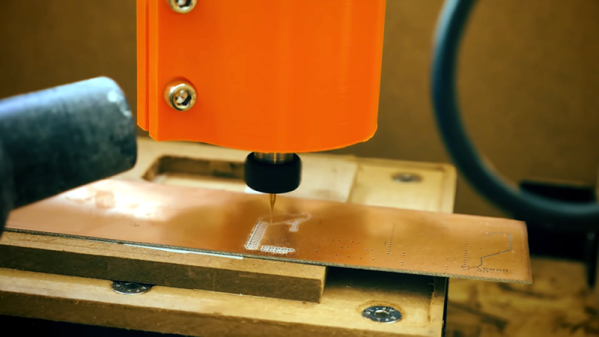
It is getting so easy to order a finished printed circuit board that it is tough to justify building your own. But sometimes you really need a board right now. Or maybe you need a lot of fast iterations so you can’t wait for the postal service. [Thomas Sanladerer] shows how he makes PCBs with a CNC machine and has a lot of good advice in the video below.

He starts with Eagle, although, you could use any creation package. He shows what parameters he changes to make sure the traces don’t get eaten away and how to do the CAM job to get the files required to make the boards. If you don’t use Eagle, you’ll need to infer how to do similar changes and get the same kind of output.

We’ve only heard a few people pronounce Gerber (as in Gerber file) with a soft G sound, but we still knew what he meant. We have the same problem with GIF files. However, once you have Gebers, you can join the video’s workflow about 5 minutes in.

At that point, he uses FlatCAM to convert the Gerbers to a single G-code file that integrates the paths and drill files. There were a few tricks he used to make sure all the tracks are picked up. Other tricks include leveling a spoil board by just milling it down and mounting different size bits. He also has ideas on aligning the Z axis.

Continue reading “CNC Your Own PCB With This Tutorial”

3D Printing Logic Gates

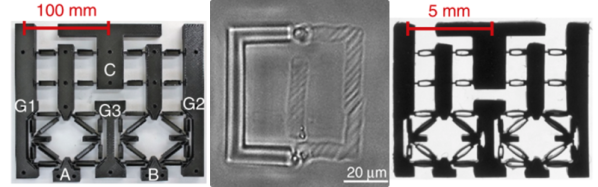
It may seem a paradox, but in the future tiny computers may dump electronics and return to their mechanical roots. At the macroscale, mechanical computers are fussy and slow, but when your area is down to a few molecules, electronics have trouble working but mechanical systems do just fine. In addition, these devices don’t use electricity directly, don’t generate electronic signatures, and may be less sensitive to things like radiation that damage electronics. A recent paper in Nature Communications discusses how to 3D print common logic gates using both macro-scale 3D printing techniques and a much smaller version with microstereolithography. You can see a video of gates in action below.

The gates use a bistable flexible mechanism. The larger gates use ABS plastic and measure about 250mm square. The smaller gate measures less than 25 mm square. They also use a special technique to make gates as small as 100 microns theoretically possible, although some of that is future work for the team.

Continue reading “3D Printing Logic Gates”

Grape Plasma Explained

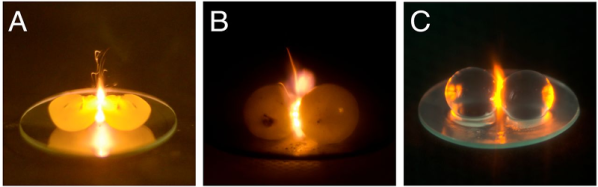
You’ve probably seen the videos of a grape — cut almost totally in half — in a microwave creates a plasma. A recent physics paper studies the phenomenon with a lot of high-tech gear and now the actual mechanism is known. [Veritasium] interviews the scientists and explains the grape plasma phenomenon in plain language. You can see the video below or read the paper directly.

Turns out the grape is about 1/10 of the microwave frequency and the refractive index of the grape at microwave frequencies might be as much as ten. A whole grape can get all the microwaves trapped inside, but two grapes — or two halves — that touch create fields strong enough to ionize the air.

Continue reading “Grape Plasma Explained”