Pushing Tin Remotely: The Start Of Flight Control In The Cloud

In a 1999 movie (Pushing Tin), a flight controller is a passenger on a plane and tells the flight attendant that he needs to speak to the person controlling the plane. The flight attendant tells him the pilot is very busy to which the controller responds, “…you really think the pilot is controlling this plane? That would really scare me.” We wonder what that fictional character would think flying into Loveland Colorado. Their Colorado Remote Tower Project. While there’s still a human flight controller, they aren’t physically located at the airport and rely on remote cameras and radar so the controller can be located elsewhere.

The subject airport is the Northern Colorado Regional Airport and is the state’s busiest airport that has no tower. While the concept — generically known as Remote and Virtual Tower or RVT — dates back to 2002, its adoption is only now starting to pick up steam. An airport in Sweden was the first to go live for normal use in April of 2015, but the Colorado installation is the first approved in the United States. If the official site is a little too dry for you, there’s a CBS report with a video that gives you a quick overview of what’s happening. Or dive in with the demonstration video you can see below.

Continue reading “Pushing Tin Remotely: The Start Of Flight Control In The Cloud”
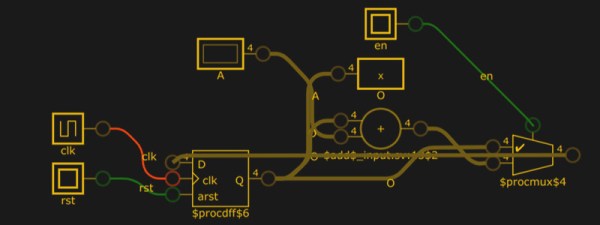
Visualizing Verilog Simulation

You don’t usually think of simulating Verilog code — usually for an FPGA — as a visual process. You write a test script colloquially known as a test bench and run your simulation. You might get some printed information or you might get a graphical result by dumping a waveform, but you don’t usually see the circuit. A new site combines Yosys and a Javascript-based logic simulator to let you visualize and simulate Verilog in your browser. It is a work in progress on GitHub, so you might find a few hiccups like we did, but it is still an impressive piece of work.

Continue reading “Visualizing Verilog Simulation”

Transistor Fundamentals Animated

When we were in school, every description of how transistors work was pretty dry and had a lot of math involved. We suppose you might have had a great instructor who was able to explain things more intuitively, but that was luck of the draw and statistically unlikely. These days, there are so many great videos on the Internet that explain things that even if you know the subject matter, it is fun to watch and see some of the great animations. For example [Sabin] has this beautifully animated explanation of how MOSFETs work that you can see below.

It uses the same basic graphics and style as his earlier video on bipolar transistors (second video, below) which is a great one to watch, too. In all fairness to your electronics teacher, the kind of graphics in these videos would have cost a fortune to do back in the 20th century — just watch some of the videos we talk about in some of our historical posts.

Continue reading “Transistor Fundamentals Animated”

Learn FPGA With This Persistence Of Vision Hack

Everybody wants to give FPGA development a try and here’s a great way to get into it. You can build your own Persistence of Vision display using a $30 dev board. It’s a fun project, and you’ll learn quite a bit about designing for an FPGA, as well as using the Quartus design software.

The inspiration for this article comes from [vpecanins] who did an example project where you wave the board back and forth and a message appears in mid air. This uses the MAX1000, a pretty powerful yet odd FPGA board for about $30. It contains an Intel MAX10 (when did Intel start making FPGAs? Remember, Intel bought Alterra back in 2015). I find the board odd because it also holds an accelerometer that you can talk to using SPI. That’s a little strange for a generic FPGA board, but paired with eight on-board LEDs it’s perfect for this demo.

Since I didn’t find any written documentation for this example, I thought we’d help out and take you on a step-by-step tour of the project. What’s more, in a future installment, I’ll show you how to make some significant changes to the tutorial that will make it even more practical as a base for other projects.

Continue reading “Learn FPGA With This Persistence Of Vision Hack”

Linux Fu: Modernize Your Command Line

If you use Linux and its associated tools on the desktop or on a Raspberry Pi, or on a server, you probably have used the command line. Some people love it and some people hate it. However, many of us have been using Linux for years and sometimes Unix before that, and we tend to use the same old tried-and-true tools. [Remy Sharp] had a recent post talking about how he had created aliases to replace those old tools with great modern replacements and it is definitely worth a read.

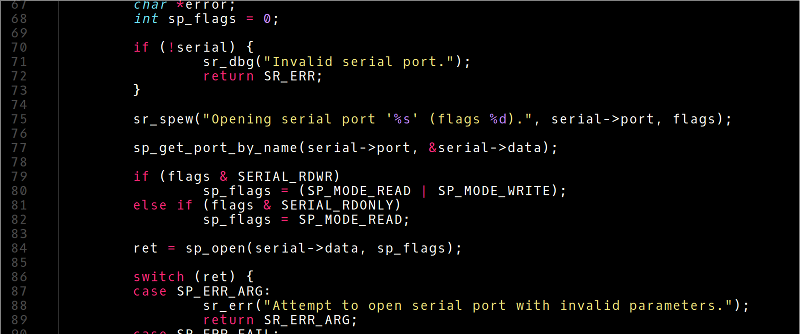
We’ll be honest, when we first saw the post we almost skipped reading it. A lot of Linux tip posts are pretty uninteresting unless you are a total beginner. But [Remy] has a lot of really great tools and how he has them installed including bat, which is like cat but with syntax coloring (see picture above), and fzf — a command line history search on steroids. He even shows how to join fzf and bat to make a very cool file browser from the command line (see below).

Continue reading “Linux Fu: Modernize Your Command Line”

NASA Shows Off Its Big Computer In 1986

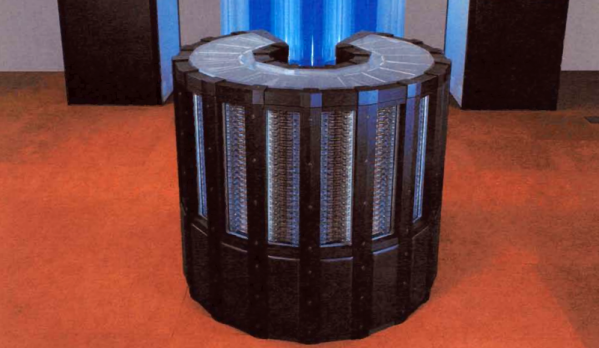
Sometimes it is hard to remember just how far computers have come in the last three or four decades. An old NASA video (see below) has been restored with better sound and video recently that shows what passed for a giant computer in 1986. The Cray 2 runs at 250 MHz and had two gigabytes of memory (256 megabytes of million 64-bit words).

Despite the breathless praise, history hasn’t been kind to the Cray 2. Based on ECL, it had 4 processors and –in theory — could reach 1,900 megaFLOPs/second (a FLOP is a floating point operation). However, practical problems made it difficult to get to that theoretical maximum.

Continue reading “NASA Shows Off Its Big Computer In 1986”

Self Folding Origami From A 3D Printer

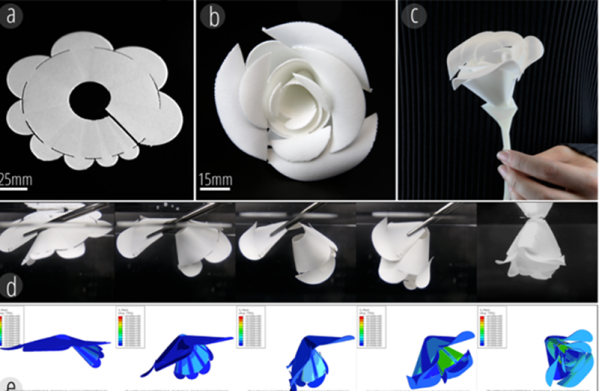
If you’ve done much 3D printing, you probably curse how plastic warps as it cools down and heats. There’s nothing more upsetting than watching a six hour print start curling off the bed and starting its inexorable march to the trash can. However, researchers at Carnegie Mellon have found a way to harness that tendency to warp with heat to make self-folding structures like those seen in the video below. There’s a paper about how it works available, too.

The Thermorph process uses commercially-available 3D printers, but requires special software. You might wonder why you would want to fold, say, a rose, when you could just print it as a fully-formed 3D model. The paper suggests that printing self-folding structures is faster and can save up to 87% on print times for the right models.

Continue reading “Self Folding Origami From A 3D Printer”