Ditch OpenSCAD For C++

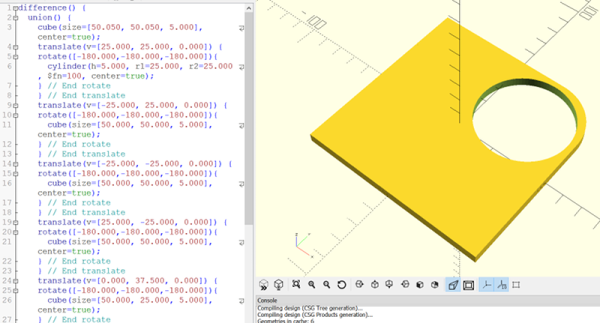
There’s an old saying that a picture is worth a thousand words. If you’ve ever tried to build furniture or a toy with one of those instructions sheets that contains nothing but pictures, you might disagree. 3D design is much the same for a lot of people. You think you want to draw things graphically, but once you start doing complex things and making changes, parametric modeling is the way to go. Some CAD tools let you do both, but many 3D printer users wind up using OpenSCAD which is fully parametric.

If you’ve used OpenSCAD you know that it is like a simple programming language, but with some significant differences from what you normally use. It is a good bet that most Hackaday readers can program in at least one language. So why learn something new? A real programming language is likely to have features you won’t find readily in OpenSCAD that, in theory, ought to help with reuse and managing complex designs.

I considered OpenJSCAD. It is more or less OpenSCAD for JavaScript. However, JavaScript is a bit of a scripting language itself. Sure, it has objects and some other features, but I’m more comfortable with C++. I thought about using the OpenCSG library that OpenSCAD uses, but that exposes a lot of detail.

Instead, I turned to a project that uses C++ code to generate OpenSCAD output, OOML (the Object Oriented Mechanics Language)). OpenSCAD does the rendering, exporting, and other functions. Unfortunately, the project seems to have stalled a few years back and the primary web-based documentation for it seems to be absent. However, it is very usable and if you know how to find it, there is plenty of documentation available.


Why not OpenSCAD?

Continue reading “Ditch OpenSCAD For C++”

Listen To The Globe

There was a time when electronic hackers (or hobbyist, enthusiasts, geeks, or whatever you want to be called) were better than average at geography. Probably because most of us listened to shortwave radio or even transmitted with ham radio gear. These days, if you try listening to shortwave, you have to be pretty patient. Unless you want to hear religious broadcasters or programming aimed at the third world, there’s not much broadcast traffic to listen to anymore

The reason, of course, is the Internet. But we’ve often thought that it isn’t quite the same. When you tuned in London on your homebrew regenerative receiver, you wanted to know where that voice was coming from, and you couldn’t help but learn more about the area and the people who live there. Tune into a BBC live stream on the Internet, and it might as well be any other stream or podcast from anywhere in the world.

The New Shortwave

Maybe we need to turn kids on to Radio Garden. Superficially, it isn’t a big deal. Another catalog of streaming radio stations. You can find plenty of those around. But Radio Garden has an amazing interface (and a few other unique features). That interface is a globe. You can see dots everywhere there’s a broadcast station and with a click, you are listening to that station. The static and tuning noises are a nice touch.

Continue reading “Listen To The Globe”

Retrocomputing For $4 With A Z80

Sure, you’d like to get in on all the retrocomputing action you read about on Hackaday. But that takes a lot of money to buy vintage hardware, right? Sure, you can build your own, but who has time for a big major project? [Just4Fun] has a Hackaday.io project that disproves those two myths and gives you no more excuses. His retrocomputer? A 4MHz Z80 that can run BASIC with 64K of RAM, all built on a breadboard with 4 ICs. The cost? About $4.

Of course, that’s with some power shopping on eBay and assuming you have the usual stuff like breadboards, wire, small components, and a power supply. While it will gall the anti-Arduino crowd, [Just4Fun] uses an Arduino (well, an ATmega32A with the Arduino bootloader) to stand in for a host of Z80 peripheral devices. You can see a video of the device below, and there are more on the Hackaday.io project page.

Continue reading “Retrocomputing For $4 With A Z80”

Rebonding An IC To Save Tatakae! Big Fighter

Preserving old arcade games is a niche pastime that can involve some pretty serious hacking skills. If the story here were just that someone pulled the chip from a game, took it apart, and figured out the ROM contents, that’d be pretty good. But the real story is way stranger than that.

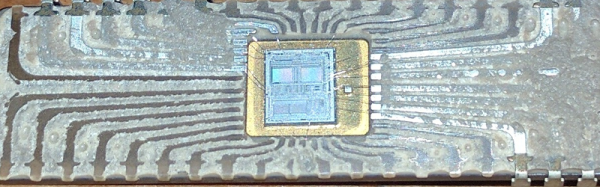
Apparently, a bunch of devices were sent to a lab to be reverse engineered and were somehow lost. Nearly ten years later, the devices reappeared, and another group has taken the initiative to recover their contents. The chip in question was part of a 1989 arcade game called Tatakae! Big Fighter, and it had been hacked. Literally hacked. Like with an ax or something worse.

You can read the story of how the contents were recovered. You shouldn’t try this at home without a vent hood and other safety gear. However, they did rebond wires to the device using a clever trick and no exotic equipment (assuming you have some fairly good optical microscopes and a microprobe on a lens positioner).

Continue reading “Rebonding An IC To Save Tatakae! Big Fighter”

8008 Exposed

[Ken Shirriff] is no stranger to Hackaday. His latest blog post is just the kind of thing we expect from him: a tear down of the venerable 8008 CPU. We suspect [Ken’s] earlier post on early CPUs pointed out the lack of a good 8008 die photo. Of course, he wasn’t satisfied to just snap the picture. He also does an analysis of the different constructs on the die.

Ever wonder why the 8008 ALU is laid out in a triangle shape? In all fairness, you probably haven’t, but you might after you look at the photomicrograph of the die. [Ken] explains why.

Continue reading “8008 Exposed”

Cheap Cat Feeder Enhances Sleep

We’ll admit it: we sometimes overcomplicate things. Look at [Peter Weissbrod’s] automated cat feeder, for example. It isn’t anything more than a bottle, a servo, some odds and ends, and an Arduino. However, it lets him sleep in without his cat waking him for service.

We looked at the code and thought, “This thing will just dispense food all the time! That’s not what you want!” Then we looked closer. [Peter] uses a common household timer to just turn the device on in the morning, let it run for a bit, and then turns it off. You can see a video of the mechanism, below.

Continue reading “Cheap Cat Feeder Enhances Sleep”

Sorting Resistors With 3D Printing And A PIC

If you aren’t old enough to remember programming FORTRAN on punched cards, you might be surprised that while a standard card had 80 characters, FORTRAN programs only used 72 characters per card. The reason for this was simple: keypunches could automatically put a sequence number in the last 8 characters. Why do you care? If you drop your box of cards walking across the quad, you can use a machine to sort on those last 8 characters and put the deck back in the right order.

These days, that’s not a real problem. However, we have spilled one of those little parts boxes — you know the ones with the little trays. We aren’t likely to separate out the resistors again. Instead, we’ll just treasure hunt for the value we want when we need one.

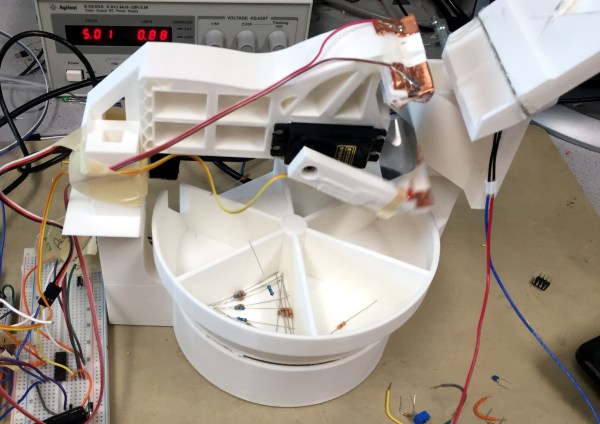
[Brian Gross], [Nathan Lambert], and [Alex Parkhurst] are a bit more industrious. For their final project in [Bruce Land’s] class at Cornell, they built a 3D-printed resistor sorting machine. A PIC processor feeds a resistor from a hopper, measures it, and places it in the correct bin, based on its value. Who doesn’t want that? You can see a video demonstration, below.

Continue reading “Sorting Resistors With 3D Printing And A PIC”